Author: suraj

  • PVC Pipe Installation Tips for a Leak-Free System

    PVC Pipe Installation Tips for a Leak-Free System

    Greetings from Headsup B2B! Find the best PVC pipes and fittings hassle-free. Whether you’re a contractor or homeowner, ensuring PVC pipes are installed properly is essential for leak-free plumbing. Check out our blog for straightforward tips on ensuring your PVC pipes stay leak-free. Apply these guidelines to execute your next project with confidence and precision.

    Understanding PVC Pipe and Fittings

    When working on a plumbing or irrigation project, understanding the different types of PVC pipes and fittings is essential. This knowledge helps ensure you choose the right materials for a durable, leak-free system.

    Types of PVC Pipes

    Schedule 40

    Schedule 40 PVC pipes are the most common type used in many applications. This type of PVC pipe is versatile, so it is suitable for both residential and commercial plumbing. These pipes are lightweight and easier to handle, making them a popular choice for DIY projects. Despite their lighter weight, Schedule 40 pipes are sturdy enough to handle typical water pressures in household plumbing systems. They are also widely used in irrigation, as they are cost-effective and easy to work with.

    Schedule 80

    Schedule 80 PVC pipes are thicker and stronger than Schedule 40 pipes. They are designed to withstand higher pressure and more demanding conditions. Because of their extra thickness, Schedule 80 pipes are often used in industrial applications where the plumbing system must endure greater stress. Although more expensive and heavier, these pipes provide better durability and reliability, making them ideal for critical systems.

    Choose between Schedule 40 and Schedule 80 PVC pipes for your project, considering your needs. Schedule 40 is suitable for household plumbing or irrigation, while Schedule 80 offers strength and durability. Consult a professional like Headsup B2B.

    Common PVC Pipe Fittings

    PVC elbows

    PVC elbows are required to bend your pipeline to get it around obstacles or to make a turn in your piping system. The two most frequent elbow angles that are offered are 90 degrees and 45 degrees, so you may route your pipeline however you like. A significantly distinct element, side elbows are frequently used as corners in projects like boxes, canopies, tents, and displays. Instead of having two ends, they have three. Although there are variants with threads, slip socket ends are found on most elbows.

    PVC tees

    PVC tees are versatile fittings with three ends, allowing lines to be split into two separate lines or connected into one main line. They are widely used in plumbing and are commonly used for PVC structures. They come in slip-socket ends or threaded versions.

    Couplings

    One of the simplest (and least expensive) kinds of PVC fittings is couplings. They are a tiny component that, often permanently, “couples” one element to another. They can join fittings and pipes together. To connect a small pipe to a large pipe or vice versa, some of them even diminish. Depending on the application, couplings with slip or female-threaded ends are offered.

    Caps and Plugs

    The very basic function of caps is to halt the flow. Pipes that don’t need to be connected to other pipes are fitted with them at the end. They can provide you with simple access to a system when needed, or they can block a pipeline that you want to develop later. They may also give PVC building projects’ pipes a polished appearance. Caps might have a socket end or a female-threaded end because they go around or outside the pipe.

    Applications of PVC Pipes fittings

    Plumbing Sector

    In plumbing applications, PVC pipes are often used to move waste, water, and other fluids in residential, commercial, and industrial structures. PVC pipes are produced and offered in a range of diameters, lengths, and dimensions. By volume and weight mass, the plumbing business is the largest in PVC applications.

    Irrigation systems

    In agriculture and gardening, irrigation systems employ PVC pipes to move water from the source to the crops. One of the key industries is agriculture, which would not exist without

    PVC pipes are widely used for all major agricultural tasks, such as water irrigation, pesticide and fertiliser spraying, sprinkler systems, and bore-well construction.

    PVC Pipes for Rainwater Management

    They are crucial for rainwater harvesting systems, ensuring efficient maintenance and distribution. They carry rainwater from rooftops to storage or harvesting systems, with special sockets for easy connection and leak prevention. PVC pipes offer superior resistance to rust compared to iron pipes and come in various sizes for easy installation. High-quality PVC pipes prevent cracks and bends and have a UV stabiliser.

    Water Supply Systems

    To deliver potable water from the source to customers in residential, commercial, and industrial facilities, PVC pipes are also used in water delivery systems.

    Essential Tools and Materials

    Tools You’ll Need

    Pipe Cutter or Saw

    To get the right length of PVC pipes, you’ll need a pipe cutter or a saw. A pipe cutter is precise and easy to use, making clean cuts every time. If you don’t have a pipe cutter, a fine-toothed saw can also do the job well. Just be sure to cut straight to avoid any fitting issues later.

    Deburring Tool

    After cutting your PVC pipe, there will be rough edges that need to be smoothed out. This is where a deburring tool comes in handy. It quickly removes any burrs and sharp edges, ensuring a smooth finish. This step is important for preventing leaks and ensuring a snug fit with the PVC pipe fittings.

    Tape Measure

    Accuracy is key in any plumbing project. A tape measure helps you get precise measurements of your PVC pipes before cutting. This ensures that your pipes and fittings align perfectly, avoiding any miscalculations that could lead to leaks.

    Necessary Materials

    PVC Pipes and Fittings

    The core components of your project are, of course, the PVC pipes and fittings. Choose the right type and size of pipes for your specific needs, whether it’s for plumbing, irrigation, or another application. Ensure you have the necessary fittings like elbows, tees, and couplings, to connect your pipes effectively.

    Primer and Cement

    To securely join PVC pipes and fittings, you’ll need primer and cement. Primer cleans and softens the pipe’s surface, ensuring a strong bond with the cement. The cement then fuses the pipe and fittings, creating a watertight seal. Always follow the instructions on the primer and cement for the best results.

    Sandpaper

    Sandpaper is also useful for prepping the pipe ends before applying primer and cement. Lightly sanding the ends of the pipes removes any dirt and smooths out the surface, helping the primer and cement adhere better. This small step can make a big difference in preventing leaks.

    Preparing for Installation

    Measuring and Cutting PVC Pipes

    Getting your measurements right is key to a leak-free PVC pipe system. Here are some tips to ensure accuracy:

    Accurate Measurement Techniques

    Before you cut, measure the length of the PVC pipe you need at least twice to avoid mistakes. Use a tape measure for precision. Mark the spot where you’ll cut with a pencil or marker. This helps in making sure your cuts are straight and exactly where you want them.

    Safe Cutting Methods

    When it’s time to cut, use a pipe cutter for a clean, even cut. If you don’t have a pipe cutter, a hacksaw will work too, but be sure to cut straight. After cutting, inspect the edges to make sure there are no rough spots or uneven areas.

    Deburring and Cleaning

    Importance of Deburring

    Deburring is the process of smoothing the rough edges left after cutting the PVC pipe. This step is crucial because rough edges can cause leaks or weak joints. Use a deburring tool or a piece of sandpaper to gently smooth the edges of the cut pipe.

    Cleaning with a Damp Cloth

    Once the edges are smooth, clean the pipe and the PVC pipe fittings with a damp cloth. This removes dust and debris that can prevent a good seal when you join the pipes and fittings. Clean surfaces help the primer and cement adhere better, creating a stronger, leak-free bond.

    By taking the time to measure accurately, cut safely, and clean thoroughly, you set a solid foundation for a successful PVC pipe installation. These steps ensure that your PVC pipe fittings and connections are secure and leak-free.

    Assembling the Pipes and Fittings

    When assembling your PVC pipe fittings, attention to detail can prevent future leaks and ensure a smooth installation process. Here’s a step-by-step guide to help you with dry fitting and applying primer and cement.

    Dry-fitting the Pieces

    Before you start gluing, it’s crucial to dry-fit the pieces. This means assembling the pipes and fittings without any adhesive to ensure everything fits properly.

    Ensuring a Proper Fit Before Glueing:

    Begin by inserting each pipe into its respective fitting. Make sure each connection is snug and the pipes slide easily into the fittings. If something feels too tight or too loose, you might need to adjust or replace the piece to avoid future leaks.

    Marking Alignment Points:

    Once you’re sure the pieces fit well, mark the alignment points with a pencil or marker. This will help you quickly and accurately reassemble the pieces after applying the primer and cement. Draw a line across the pipe and fittings so that when you reconnect them, they match up perfectly.

    Applying Primer and Cement

    With the dry fit complete and alignment points marked, it’s time to move on to applying the primer and cement. These substances are essential for creating a strong, leak-proof bond between the pipes and fittings.

    Correct Application Methods:

    Start by applying the primer to the outside of the pipe and the inside of the PVC pipe fittings. The primer cleans and softens the PVC, preparing it for the cement. Use a generous amount, but avoid over-applying to the point where it drips.

    Ensuring full coverage:

    After the primer, immediately apply the cement. Ensure that you cover the same areas that you primed. Work quickly, as the cement begins to set rapidly. Apply a thin, even layer of cement on both the pipe and the fitting.

    Once the cement is applied, join the pipe and fittings together, using your alignment marks as a guide. Insert the pipe into the fitting and give it a quarter turn to evenly distribute the cement and create a strong bond. Hold the pieces together for about 30 seconds to allow the cement to set.

    By carefully dry-fitting your pieces and properly applying primer and cement, you ensure that your PVC pipe fittings are securely assembled. This attention to detail helps prevent leaks and creates a durable, long-lasting plumbing system.

    Why Choose Headsup B2B for Sourcing PVC Pipe Fittings?

    To know more about the process in detail and for the best quality PVC pipe fittings, visit Headsup B2B. We are the most trustworthy and advanced online platform for PVC pipe fittings and other products. Our team of professionals not only helps customers find the best options at competitive prices but also helps them with the selection process. So, visit Headsup B2B and enjoy services like quality products at low cost, fast and secured delivery at your destination, and the right guidance from the experts.

  • Tool Time: Maintenance Tips to Extend the Life of Your Equipment

    Tool Time: Maintenance Tips to Extend the Life of Your Equipment

    Welcome to the blog “Tool Time: Maintenance Tips to Extend the Life of Your Equipment,” a comprehensive guide dedicated to helping you get the most out of your equipment. At Headsup B2B, we understand that your tool accessories and machines are critical to your operations, and keeping them in top shape can save you time and money while ensuring safety and efficiency on the job. Whether you’re experienced or just starting your journey in the industry, our practical tips and expert advice will help you maintain your equipment for optimal performance and longevity.

    Introduction:

    Being a business owner it’s important to understands that regular maintenance is essential to extending the life of heavy machinery and equipment, but it can be expensive if neglected.

    Machine wear and tear from daily use need periodic maintenance and downtime. Nonetheless, there are methods to reduce these expenses and prolong the lifespan of your heavy gear. Here in this blog professionals of Headsup B2B will discuss about the importance of tool maintenance and we’ll share some tips for your tool maintenance. It will help you prolong the lifespan of your equipment and machines.

    So, let’s begin!

    Daily Maintenance Practices of your tool accessories

    Maintaining your tool accessories daily can keep it running smoothly and also extends its lifespan. Here are four essential daily maintenance practices you should incorporate into your routine:

    Visual Inspections:

    Start each day with a thorough visual inspection of your equipment. Always keep an eye on any obvious signs of damage or wear, such as cracks, leaks, or loose parts. Pay special attention to tyres, belts, and hoses. Early detection of these issues will help you prevent bigger problems down the line and also keep your machinery safe to use.

    Cleaning Procedures

    Keeping your equipment clean is crucial. Dirt and debris builds up so quickly and it significantly affects the performance and causes wear and tear. Use a brush or compressed air to remove dust and grime from critical areas, and wash off mud and other residues. Regular cleaning not only improves efficiency but also makes it easier to spot potential issues during inspections.

    Lubrication Basics

    Proper lubrication reduces friction and wear on moving parts. Check your equipment’s manual for the recommended lubrication points and also ensure these areas are well-oiled. Over-lubrication can be just as harmful as under-lubrication, so use the right amount and type of lubricant for each component.

    Checking Fluid Levels

    Ensure all fluid levels, including oil, coolant, and hydraulic fluids, are within the recommended ranges. A decrease in fluid levels can cause overheating, poor performance, and serious damage. Top up fluids as needed, and also look out for any leaks that could indicate a problem.

    So, by using these simple everyday maintenance tips, you can make sure that your equipment runs efficiently, safely, and reliably.

    Weekly and Monthly Checks

    Keeping your construction equipment in top shape requires regular weekly and monthly maintenance checks. These checks help prevent breakdowns and ensure everything runs smoothly on the job. Here’s a quick guide to some of the most important tasks you should include in your routine.

    1. Inspecting Belts and Hoses

      • Look for Wear and Tear: Check belts and hoses for cracks, fraying, and other signs of damage.

      • Ensure Proper Tension: Make sure belts are tight enough but not overly stretched.

      • Check Connections: Ensure all hoses are securely attached and free from leaks.

      • Clean Surfaces: Wipe down belts and hoses to remove dust and debris.

    2. Monitoring Tire and Track Conditions

      • Check for Damage: Look for cuts, punctures, or excessive wear on tires and tracks.

      • Maintain Proper Pressure: Ensure tires are inflated to the manufacturer’s recommended levels.

      • Inspect Tread Depth: Measure tread depth to ensure it’s within safe limits.

      • Track Tension and Alignment: For tracked equipment, check that tracks are properly aligned and tensioned.

    3. Battery Maintenance

      • Check Connections: Inspect battery terminals for corrosion and ensure connections are tight.

      • Test Voltage: Use a multimeter to check battery voltage and charge level.

      • Clean Terminals: If corrosion is present, clean terminals with a mixture of baking soda and water.

      • Check Fluid Levels: For batteries that require it, check electrolyte levels and top off with distilled water if needed.

    4. Testing Brakes and Controls

      • Brake Functionality: Test brakes for responsiveness and check for unusual noises or resistance.

      • Inspect Brake Pads: Look for wear on brake pads and replace them if they’re too thin.

      • Hydraulic Controls: Check that all hydraulic controls are smooth and responsive.

      • Safety Systems: Ensure all safety interlocks and emergency stop mechanisms are functioning properly.

    Regularly performing these checks can help prevent breakdowns and extend the life of your equipment. Stay vigilant and proactive to keep your tools running smoothly!

    Seasonal Maintenance Tips

    Preparing for Extreme Weather (Winter/Summer)

    • Winter Preparation:

      • Inspect Heaters: Ensure the heating systems are functioning properly to prevent engine damage.

      • Antifreeze Levels: Check and top off antifreeze to protect against freezing temperatures.

      • Battery Care: Test the battery and clean the terminals to prevent cold weather starting issues.

      • Tire and Track Inspection: Examine for wear and replace if necessary to ensure good traction on icy surfaces.

      • Windshield and Lights: Ensure windshield wipers are in good condition and lights are working for visibility in winter conditions.

    • Summer Preparation:

      • Cooling Systems: Inspect and clean radiators and check coolant levels to prevent overheating.

      • Tire Pressure: Check and adjust tire pressure to account for temperature changes.

      • Air Conditioning: Test the air conditioning system and recharge if needed to keep operators comfortable.

      • Hydraulic Systems: Check hydraulic fluid levels and hoses for leaks due to heat expansion.

      • Shade and Covers: Use protective covers or shades to shield equipment from direct sunlight when not in use.

    Seasonal Storage Practices

    • Clean Thoroughly: Clean equipment to remove dirt, mud, and debris to prevent rust and corrosion during storage.

    • Lubrication: Apply a fresh coat of lubricant to all moving parts to prevent seizing and rust.

    • Fuel Systems: Add a fuel stabiliser to the tank to prevent the fuel from degrading and causing starting issues later.

    • Battery Maintenance: Disconnect or remove batteries and store them in a cool, dry place. Consider using a trickle charger to maintain charge.

    • Dry Storage: Store equipment in a dry, sheltered location to protect against weather elements. Use tarps or covers if indoor storage isn’t available.

    Seasonal Fluid Changes and Adjustments

    Winter Fluid Changes:

    • Oil Change: Use winter-grade oil to ensure proper lubrication in cold temperatures.

    • Hydraulic Fluid: Switch to low-temperature hydraulic fluid to maintain performance in cold weather.

    • Coolant Check: Ensure the coolant mix is suitable for freezing conditions.

    Summer Fluid Changes:

    • Engine Oil: Use summer-grade oil to withstand higher temperatures and reduce wear.

    • Hydraulic Fluid: Check and use high-temperature hydraulic fluid to avoid overheating.

    • Coolant Level: Verify coolant is sufficient and the mix is appropriate for summer conditions.

    Implementing these seasonal maintenance tips will help protect your equipment against the challenges posed by extreme weather, ensure smooth operations, and extend the life of your machinery. Regular attention to these details keeps your equipment ready to perform, no matter the season.

    Specialised Equipment Maintenance

    1. Excavators

      • Daily Inspection: Check hydraulic fluid levels, inspect tracks for wear and tear, and ensure attachments are securely fastened.

      • Lubrication: Regularly grease all pivot points to avoid unnecessary friction.

      • Clean Filters: Keep air, fuel, and hydraulic filters clean to maintain optimal performance.

      • Accessories: Use quality buckets, grapples, and hammers to prevent premature wear.

    2. Loaders

      • Tyre Pressure: Monitor and maintain the correct tyre pressure to ensure stability and avoid uneven wear.

      • Bucket Maintenance: Inspect the bucket for cracks or dents and ensure teeth are sharp and intact.

      • Fluid Levels: Regularly check engine oil, coolant, and hydraulic fluids.

      • Accessories: Attachments like forks, augers, and brooms should be maintained and stored properly.

    3. Concrete Mixers

      • Clean Drum: Wash the drum thoroughly after each use to prevent concrete buildup.

      • Inspect Chutes: Ensure chutes are clean and free of debris to avoid clogging.

      • Check Bearings: Regularly inspect and lubricate bearings to prevent seizurese.

      • Accessories: Use appropriate cleaning tools and lubricants designed for concrete equipment.

    4. Cranes

      • Cable Inspection: Frequently check cables for fraying or damage and replace if necessary.

      • Hydraulic Systems: Monitor hydraulic fluid levels and look for leaks in hoses and seals.

      • Boom and Jib Maintenance: Inspect the boom and jib for structural integrity and rust.

      • Accessories: Ensure hooks, shackles, and other lifting accessories are in good condition and properly rated for the load.

    5. Tips for Handling Specific Types of Equipment

      • Regular Training: Ensure operators are trained on the specific equipment they handle.

      • Proper Storage: Store equipment in a clean, dry place to prevent rust and deterioration.

      • Scheduled Maintenance: Adhere to manufacturer-recommended maintenance schedules.

      • Quality Parts and Accessories: Invest in high-quality parts and accessories to extend the life of your equipment and ensure safety.

    By following these specialised maintenance tips, you’ll keep your excavators, loaders, concrete mixers, and cranes running smoothly and efficiently. Remember, well-maintained equipment not only performs better but also lasts longer, saving you time and money in the long run.

    Documentation and Record Keeping of Your Tool Acessories:

    Keeping Maintenance Logs

    • Why It’s Important: Maintenance logs help track the history of your equipment, making it easier to identify recurring issues and also plan for future repairs.

    • How to Do It:

      • Record each maintenance activity: date, type of service, parts replaced, and any observations.

      • Use simple forms or templates to ensure consistency.

      • Keep logs accessible for all team members.

    Scheduling Regular Maintenance

    • Benefits: Regular maintenance prevents unexpected breakdowns, extends the life of your equipment, and also ensures safety.

    • Steps to Implement:

      • Create a maintenance calendar outlining daily, weekly, monthly, and seasonal tasks.

      • Assign responsibilities to team members to ensure accountability.

      • Also set reminders for upcoming maintenance tasks to stay on schedule.

    Using Software Tools for Maintenance Tracking

    • Advantages: Software tools streamline the maintenance process, improve accuracy, and also provides valuable insights into equipment performance.

    • How to Choose and Use:

      • Look for user-friendly software that suits your business size and needs.

      • Features to consider: maintenance scheduling, automated reminders, maintenance logs, and reporting tools.

      • Train your team on how to use the software effectively.

      • Regularly update the software with new entries to keep data current and accurate.

    How Headsup B2B Helps You with Maintaining Your Tool Accessories and Sourcing All Kinds of Equipment

    • Wide Range of Products

      • Extensive catalogue of tool accessories and equipment

      • From small hand tools to heavy machinery

    • Quality Assurance

      • Trusted brands and reliable products

      • Guaranteed durability and performance

    • Expert Advice

      • Tips and guidelines for maintaining tool accessories

      • Personalised recommendations based on your needs

    • Maintenance Services

      • Professional maintenance and repair services

      • Access to skilled technicians for complex issues

    • Easy Sourcing

      • User-friendly platform for quick and easy sourcing

      • Detailed product descriptions and reviews

    • Competitive Pricing

      • Affordable options for all budgets

      • Special discounts and offers for bulk purchases

    • Fast Delivery

      • Efficient logistics for timely delivery

      • Track orders in real-time

    • Customer Support

      • Dedicated support team for any queries

      • Assistance with product selection and troubleshooting

    • Educational Resources

      • Guides and tutorials on tool accessory maintenance

      • Webinars and workshops for skill enhancement

    • Community Engagement

      • Connect with other professionals in the industry

      • Share experiences and get advice through our platform

    Hence, By choosing Headsup B2B, you ensure your tool accessories are well-maintained and sourced from the best suppliers. We also keep your operations running smoothly and efficiently.

  • Wires and Cables in Industrial Settings: A Guide to Durability and Performance

    Wires and Cables in Industrial Settings: A Guide to Durability and Performance

    Welcome to Headsup B2B, your dependable source for top-notch wires and cables. The right wire and cable is vital in industrial environments for optimal performance and safety.

    However, with so many options, selecting the best can be challenging. By providing straightforward and helpful insights, “Wires and Cables in Industrial Settings: A Guide to Durability and Performance” aims to make your decision-making easier. This guide is perfect for engineers, purchasing managers, and business owners in the industrial sector.

    Introduction

    The wire and cable are nowadays the most important and basic material for households and industries. Wire and cable are necessary to sustain efficient data transport, power distribution, and communication in this complex world of connections. But not every cable is created equal. Beyond their external look, industrial and commodity cables differ greatly from one another.

    We’ll delve deeper into the realm of cables in this post to understand the key differences between these two groupings and why they are significant.

    What are Cables?

    An electrical cord is similar to a power cable. It consists of one or more electrical wires secured together by a covering for protection. This assembly is used to transfer electrical power between locations. Power lines can be found above, below, or in the open for permanent wiring within structures.

    Components of Wire and Cable

    Essential components make up wires and cables, ensuring they function effectively. These primary parts are conductors, insulation, shielding, and jacketing.

    Conductors

    The essential element in charge of transporting electrical current is the conductor. Conductors typically consist of copper or aluminum, though they can vary in diameter and materials to meet different voltage requirements.

    Insulation

    An insulating material envelops the conductor so as to safeguard the cable from outside influence and energy dissipation. Some of the used insulations are rubber, XLPE and PVC.

    Shielding

    To reduce electromagnetic interference and maintain the integrity of electric signals, engineers use metallic shields made from copper or aluminum.

    Jacketing

    The outermost layer, called the jacket, provides extra protection against various influences, chemicals, and ultraviolet radiation. Common types of jacketing include PVC, PE or LSZH material.

    Different Types of Wire and Cable

    Power cables are available in a variety of kinds, each intended to satisfy certain voltage and application needs. It is essential to comprehend the differences between these kinds in order to choose the appropriate cable for a certain application.

    Low Power Cables

    Low-voltage cables are essential for everyday electrical needs, powering household appliances, lighting systems, and small electronics. With a voltage range of up to 1 kV, they are versatile and easy to install, making them suitable for indoor and outdoor applications. Conductors made of copper or aluminium and insulation materials like PVC or rubber ensure reliability and efficiency in power distribution.

    Medium Voltage Cables

    Medium voltage cables range from 1KV-69KV and are important in industrial and distribution systems to supply power to operating equipment. These cables carry electric power over medium distances and are used in local electricity distribution systems. It’s important to note that manufacturers use copper or aluminum conductors and cross-linked polyethylene insulation, ensuring the cables are highly durable and reliable in performance.

    High Voltage Cables

    HV cables particularly the 66 kV cables are used for power transmission and they serve different purposes. These cables are meant to operate at much higher voltage ranges falling in between the medium voltage cables and extra-high voltage cables. They are particularly relevant in industrial and distribution loops, for which a large amount of power transmission is needed. Increased awareness of high voltage cable functions, such as 66 kV cables, makes one aware of advancement in power cables.

    Submarine Cables

    Submarine power cables play as critical in electrical interconnection over water channels to power islands and offshore initiatives. They are equipped with waterproofing features so as to withstand the threats posed by marine life and the sea bed terrain. They are essential power supply systems for the continuity of energy projects in ‘harsh’ conditions, supporting renewable energy efforts and facilitating connection of islands to the grid, thus being indispensable for offshore energy operations.

    Features of Wire and Cables

    Easy to Use

    Power cables are renowned for having an intuitive design that makes them simple to install and operate. They are available for usage in a variety of applications for people, businesses, and homes thanks to their standardised connections and simple design. Power cables are often used in exposed setups, underground installations, overhead configurations, and permanent building wiring because they are easy to handle.

    Voltage Rating

    The highest voltage that a cable can withstand without breaking is indicated by its voltage rating. Selecting a cable with the right voltage rating is essential for both effectiveness and safety.

    Material for Insulation

    The choice of the insulants impacts the cables’ stability with regard to temperature changes, mechanical pressures, as well as other environmental factors. Ideally, varying applications could probably require varying materials of insulation.

    Environmental Aspects to Take into Account

    When used in hazardous or outdoor settings, power cables need to be built to resist things like dampness, UV rays, and extremely high or low temperatures.

    Capacity for Carrying Current

    In electrical current transmission, current-carrying capacity is one of the parameters that determines the efficiency of a cable in transmitting electricity. Its implementation is invaluable in preventing overheating and system issues.

    How to Identify Quality Wire and Cable

    To ensure that the electrical system is both effective and safe, it is important that only high quality power cables be chosen. Here are some important things to think about:

    Material for Conductors

    Check if the cable is made with strong and quality conductors including copper or aluminum that facilitates power delivery.

    Quality of Insulation

    Check the insulating material. Quality cables are made from enhanced materials such as XLPE or PVC, which offers protection against environment fluctuations and electrical loss.

    Material of Jacket

    The outer jacket needs to be sturdy and impervious to sunlight, chemicals, and physical harm. High-quality cables frequently have PVC, PE, or LSZH jackets.

    Accreditations

    Seek accreditations from reputable standards organisations. Adherence to industry norms guarantees that the cable satisfies safety and functionality specifications.

    Rating for Voltage

    Choose cables which have the corresponding voltage ratings for the use intended for them. Optimum cables are designed to carry specified loads without getting overheated or having a compromised performance standard.

    Capacity for Carrying Current

    Take into account the cable’s capability to transport current. High-quality cables are made to withstand specified loads without overheating or deteriorating in performance.

    Manufacturer Standing

    Select cables made by reliable producers. It is more probable for well-known businesses to follow quality guidelines throughout production.

    Bend radius and flexibility

    High-quality cables are flexible and have an appropriate bend radius, making installation simple in a variety of situations without sacrificing functionality.

    Adaptability to Environmental Elements

    Check how resistant the cable is to other conditions such as dampness, UV radiation and high temperatures. Subsequently, cables of the highest quality are intended to withstand various situations.

    Labelling and Packaging

    Observe the labelling and packaging of the cables. A dedication to quality is demonstrated by the cable’s requirements, which are substantiated and comprehensive.

    Cable Applications

    Many applications employ different kinds of cables, each chosen for its own set of qualities and functionalities.

    Let’s examine the applications for a few typical cable types:

    Power cables

    These cables move electrical energy between locations. They are frequently used to deliver power to structures, equipment, and appliances in commercial, industrial, and domestic environments.

    Data cables

    People use communication cables to send data messages between machines. These cables find wide use in audio/video applications, computer networks, and telecommunications systems.

    Coaxial wires

    Low-loss high-frequency signal transmission is possible using coaxial cables. High-speed internet connections, CCTV installations, and TV systems frequently employ them.

    Ethernet cables

    These cables enable data transfer between devices connected to local area networks (LANs). Data centres, workplaces, and residences commonly use Ethernet cables for this purpose.

    HDMI cords

    HDMI (High-Definition Multimedia Interface) connections send high-definition video and audio information between devices. You often find these connections in entertainment devices, gaming consoles, and home theatre systems.

    USB cords

    Printers, cameras, tablets, smartphones, and power supplies connect to computers or power sources using USB (Universal Serial Bus) connections. They make it easier to transfer data and charge devices.

    Read More :- 10 Tips for Choosing the Right Wire and Cable

    Headsup B2B: Your Go-To Source for the Best Wires and Cables

    we understand how crucial quality wires and cables are for industrial operations. We aim to provide our customers with the best products that guarantee quality, safety, reliability, and top performance. We offer a wide range of wires and cables tailored to meet various industrial needs, from power and control to data transmission.

  • How to Assess the Best TMT Bar in India for Your Project

    How to Assess the Best TMT Bar in India for Your Project

    Construction materials, especially Best TMT bars, are critical to the strength and durability of a building. With a wide range of options available, selecting the right TMT bar can be overwhelming.

    Headsup B2B pride ourselves on providing the finest materials and best TMT bars to guarantee the success and longevity of your construction projects. Keep reading to find out how to select the right TMT bars for your needs.

    Introduction

    TMT bars are vital for construction projects. Choosing a reputable TMT bar manufacturer in India is essential for achieving sturdy and durable buildings. Known for their strength and longevity, TMT bars are extensively used in construction. However, the abundance of manufacturers means that finding the best one demands effort and time.

    Therefore, to assist you and make sure your construction project is constructed on a firm foundation, this article provides instructions and advice for choosing the finest TMT bars manufacturer in India.

    What are TMT Bars?

    Thermo Mechanical Treatment, or TMT for short, is a thermomechanical technique. TMT steel bars are typically used in construction as a material to increase resistance to earthquakes and other natural calamities. TMT steel bars should be corrosion-resistant to guarantee the safety of your project and to extend its lifespan.

    Types of TMT bars and their uses

    TMT bars are primarily classified into four categories: Fe 415, Fe 500, Fe 550, and Fe 600.

    We go into great depth on the applications for these specific bars below.

    Grade Fe 415

    Because of its ductility and cost-effectiveness, Fe 415 TMT is utilised in small-scale building projects. Because it is easily bent into even the most intricate shapes, it is ideal for minor load buildings.

    Applications: – Fe415 is used to reinforce houses, apartments, and other small-scale constructions. These kinds of bars can be utilised in seismically active areas due to their consistent elongation feature.

    Fe 500 classification

    Fe500 grade is widely known as the industry standard for a variety of building projects. Fe 500D and Fe 500S variations, which provide more seismic stability and ductility, are other well-liked options.

    Use: Fe 500 bars offer higher tensile strength and more ductility than Fe 415, which is specifically made to give stability to high-rise buildings while resisting load better. They may be utilised in a variety of residential, commercial, and multi-story constructions.

    These bars are main component in construction in regions with frequent earthquakes and strong loads.

    Fe 550 classification

    Fe 550-grade bars have a higher tensile strength, which makes them suitable for use in a variety of big projects.

    Applications: The F550 has an important role in the development of large-format infrastructure projects, such as brides, industrial projects, and buildings with substantial load-bearing capacity.

    These bars have a particularly strong effect in subterranean, marine, and coastal settings.

    Fe 600 classification

    One of the strongest TMT grades utilised in the construction of marine facilities, bridges, and other heavy-duty infrastructure projects is Fe 600. They ensure reduced steel congestion inside the reinforcement, lower overall consumption, and give higher tensile strength.

    Uses: Fe 600 is employed in the building of skyscrapers, plants, highways, metro projects, commercial buildings and industrial zones. often employed in large-scale projects where load carrying, durability, and corrosion resistance are given priority.

    Advantages of the TMT bars

    Increased strength

    The bars are the perfect material to use in conjunction with concrete to strengthen constructions. By strengthening their connection with concrete, the TMT bars’ distinctive ribbed design adds even more strength. The TMT bars’ ductility makes them simpler to work with, and the ability to create pre-welded meshes off-site shortens the time needed for construction as a whole.

    Corrosion-resistant

    The TMT production process gives the bars anti-rust qualities. During the water-cooling phase, the prevention of the accumulation of coarse carbides occurs, which are the primary cause of corrosion in steel. Consequently, TMT steel constructions are stronger.

    Fire-resistant

    The best TMT bars can tolerate temperatures between 400 and 600 degrees Celsius because of their great thermal stability. This safeguards the structure of the building in the event of a fire.

    Earthquake-proof

    The high degree of elasticity imparted by the soft core of TMT bars gives the structures constructed with TMT greater flexibility to withstand seismic and dynamic loads.

    Cost-effective

    The best TMT bars use less steel to produce a certain quantity of structure since they have higher tensile strength and superior elongation values. This lowers the cost of raw materials in addition to saving money on storage and shipping. Additionally, because TMT steel bars require less time to manage on-site, there are further cost savings.

    Key factors to consider before selecting Steel TMT Bars

    Certifications and standards

    Check for TMT bars certified by both ISO and Bureau of Indian Standards (BIS) to ensure they meet the necessary quality and safety standards.

    Grade of the TMT bars

    The TMT grade dictates their strength and flexibility. For projects that require enhanced durability, such as high-rise buildings, bridges, and infrastructure, higher-grade TMT bars are the preferred option. Select the grade that best addresses your project’s unique requirements.

    Quality testing

    Not all TMT bar manufacturers offer the same quality. Opt for a manufacturer renowned for producing TMT bars with consistent mechanical properties and precise chemical control. Comprehensive quality testing is necessary to verify the strength and longevity of TMT bars, following BIS guidelines.

    Manufacturing process

    Knowing the ins and outs of the production process aids in gauging the performance and quality of TMT bars. Seek out brands that prioritise regulated production processes and leverage state-of-the-art technologies. This ensures the TMT bars are defect-free and meet the necessary standards.

    Corrosion resistance

    Corrosion is a process that poses a lot of risks to the durability of a building, and, more so its structural integrity. Choose TMT bars with high degrees of corrosion resistance in terms of chemical properties such as the presence of protective oxide films on the bar surface. It will also ensure that the structure remains strong to support the building’s users for a long time and prevent formation of rust.

    Strength and ductility

    The ductility and strength of TMT are important considerations in your selecting method. It is important to strike a balance between these two qualities since never compromise on ductility to achieve high strength. TMT steel bar with a high yield strength is appropriate for heavy-duty applications. However, medium-strength TMT with outstanding ductility could be a wiser option for some applications, such as bridges and areas that are prone to earthquakes.

    Brand reputation and support

    Consider what consumers give importance to, which includes the TMT brand image and help with things after the purchase. A reliable brand will provide documents, consultation and assistance in terms of technicalities in constructing the house. This may go quite a long way in making sure that the right TMT rebar is being used.

    Why TMT Steel bars over other steel bars?

    To make sure every material is of the highest calibre, it is your responsibility as a buyer to choose the top producers of TMT bars.

    Take a look at the points below to see why TMT bars are a superior choice for building than other types of traditional steel bars:

    Flexibility

    TMT steel bars offer superior flexibility and bendability compared to conventional steel bars due to their pearlite and ferrite combo, making them highly weldable without reducing strength. They are ideal for major constructions and maintain structural integrity, making them preferred for intricate designs.

    Corrosion-resistance

    TMT steel bars, produced through a unique quenching, self-tempering, and atmospheric cooling process, are highly corrosion-resistant. This is due to their protective layer during quenching, which prevents corrosive substances from reaching the surface, resulting in longer lifespans and lower maintenance costs.

    Ductility and strength

    TMT steel bars, known for their unique combination of ductility and strength, offer enhanced stress resilience and flexibility without compromising their flexibility. Builders and engineers increasingly choose TMT bars for their strength and adaptability, with Adukia Industries providing high-quality products at competitive rates.

    Cost efficiency

    TMT bars, despite their initial cost, offer long-term benefits due to their longevity and low maintenance requirements, making them a cost-effective alternative for structures.

    Environmental impact and sustainability

    TMT bars are eco-friendly, using less energy and reducing carbon footprint compared to conventional steel bars. Their durability eliminates frequent repairs, further reducing environmental impact.

    How Headsup B2B Provides the Best TMT Bars for Construction

    Headsup B2B understand that using the best TMT bars is crucial for the strength and safety of any construction project. That’s why we are dedicated to providing only the highest quality TMT bars to our customers.

    Stringent Quality Checks

    We ensure that every TMT bar meets the strictest industry standards. Our bars undergo rigorous testing for strength, flexibility, and corrosion resistance, ensuring they are suitable for various construction needs, including earthquake-prone areas.

    Trusted Brands

    We source our TMT bars from the most reputable manufacturers known for their commitment to quality. By partnering with these top brands, we guarantee that our customers receive only the best TMT bars available in the market.

    Expert Assistance

    Our team of experts is always ready to help you choose the right TMT bars for your specific project. Whether you need advice on the best grade or want to understand more about the properties of TMT bars, we are here to provide all the information you need.

    Seamless Purchasing Experience

    With our easy-to-navigate online platform, finding and purchasing the best TMT bars is simple and hassle-free. Browse our extensive range of products, compare options, and make informed decisions with just a few clicks.

    Choose Headsup B2B for your construction needs and ensure quality and reliability in all construction processes.

  • Cost-Benefit Analysis: When to Rent vs. Buy Material Handling Equipment

    Cost-Benefit Analysis: When to Rent vs. Buy Material Handling Equipment

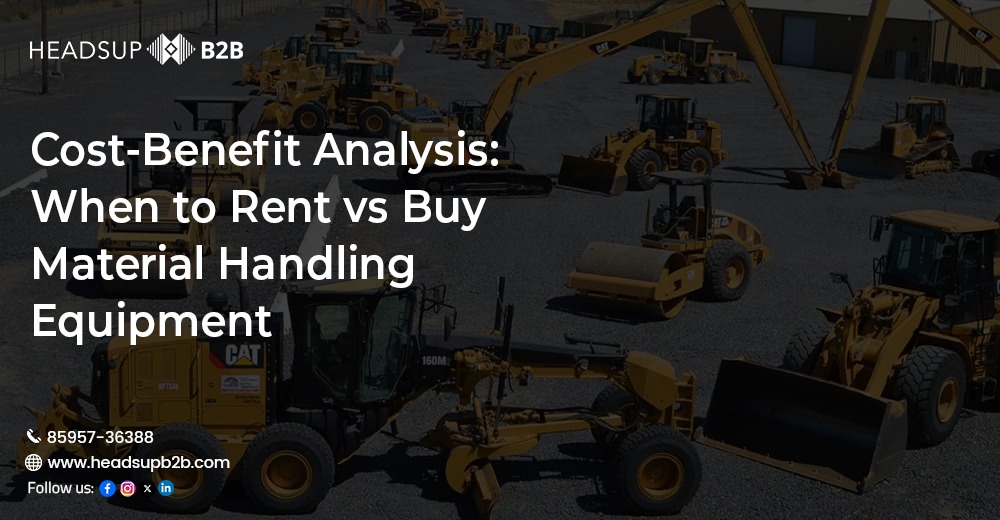
    Welcome to Headsup B2B, your go-to platform for all things related to construction equipment. Whether you’re running a small construction business or managing large-scale projects, one key decision you often face is whether to rent or buy material handling equipment. .. The budget, project efficiency, and general operations can all be significantly impacted by this choice. We will discuss renting vs purchasing industrial material handling equipment in this article, giving you useful information to help you make an informed choice.

    Introduction

    One of the most important and costly decisions that any contractor or construction firm must make is whether to purchase or rent industrial material handling equipment. Each strategy has advantages and disadvantages, so purchasers must weigh the pros and drawbacks of each option individually. Choosing wisely between renting and purchasing industrial material handling equipment might save you a significant amount of money over time, but making a poor choice can be quite expensive.

    Understanding Costs of Industrial Material Handling Equipment

    When deciding between renting or buying industrial material handling equipment, it’s crucial to understand the different costs involved.

    Initial Costs

    Purchase Price vs. Rental Fees: Buying equipment requires a significant upfront investment, often involving a hefty purchase price. In contrast, renting typically involves smaller, manageable fees, spread out over time.

    Financing Options and Down Payments: For those who opt to buy, financing options like loans can help manage the purchase. However, this usually requires a down payment, adding to the initial outlay.

    Operational Costs

    Maintenance and Repair: Ownership means you’re responsible for all maintenance and repairs. This can be costly, especially as the equipment ages. Renters, on the other hand, usually benefit from included maintenance services.

    Insurance: Owning equipment means you’ll need insurance to cover potential damages or loss. Renting often includes basic insurance, reducing your responsibilities.

    Storage and Transportation: Once you own the equipment, you’ll need space to store it and means to transport it between sites. These logistics can add significant costs.

    Hidden Costs

    Depreciation: Owned equipment loses value over time due to depreciation. This is a hidden cost that can impact your financial planning and resale value.

    Opportunity Cost of Capital: Investing a large sum in equipment means those funds aren’t available for other business opportunities. This opportunity cost is often overlooked but can be substantial.

    Understanding these costs helps make an informed decision about whether to rent or buy industrial material handling equipment. Each option has its financial implications, and it’s vital to consider all aspects to choose what’s best for your business.

    Types of Industrial Material Handling Equipment

    When to buy Industrial Material Handling Equipment?

    Purchasing large machines and equipment is undoubtedly a significant financial commitment; yet, if you have carefully considered your options and have a well-thought-out plan of action in place, you may be able to save money over time. Purchasing Equipment may be wise when…

    The equipment would be often utilised: Investing in heavy equipment such as backhoe loaders and excavators makes sense if you have a lot of projects planned for the next several months or years.

    You can afford to store and keep up the new equipment with ease: Keeping heavy construction equipment stored while not in use is one of the biggest problems. However, purchasing equipment can make more sense and be more economical if you have an industrial garage and insurance coverage. Additionally, purchasing equipment may make more sense if you have the funds to cover maintenance expenses.

    You’re going to expand: If your firm is booming, you have a tonne of projects in the works, and you’re even prepared to go to the next level, then purchasing industrial material handling equipment also makes a lot more sense because it will provide a solid return on investment down the road.

    There isn’t a firm that rents out equipment nearby, or even in your city: Getting the heavy equipment to the project site is one of the main problems. Therefore, you would have to waste money and time in the process of getting the equipment if it is a significant bother to obtain it at the job site. Purchasing equipment is the preferable option in this situation.

    When to rent IIndustrial Material Handling Equipment?

    Not everyone is wealthy enough to purchase the equipment. In certain situations, renting CE could make more sense. When…

    • Before purchasing a new equipment, it’s advisable to test it in real-world work settings by renting it and using it, even if you have the necessary investment capacity to purchase the equipment, to understand its practicality on the job site.

    • To boost the existing fleet during the busy season, consider renting the equipment to supplement the existing fleet and avoid the need to store and maintain it during the slow season, as summer work doubles.

    • You wish to minimise the expense of repairs and upkeep: Renting equipment ensures that you are not responsible for unforeseen maintenance costs on your equipment and makes it much easier to precisely incorporate the cost of the equipment into the project estimate.

    • You need specific tools for a temporary project: Specialised tools could be required for some one-time tasks. In this case, renting equipment can be a wise choice. Additionally, renting equipment is preferable than purchasing a new one, particularly for projects that last less than three years.

    Benefits of Renting Industrial Material Handling Equipment

    • Flexibility

      • Short-term vs. long-term project needs: Renting allows you to match equipment to the specific duration of your projects.

      • Ability to upgrade or change equipment as needed: Easily switch to newer models or different types of equipment as your project requirements change.

    • Lower Upfront Investment

      • Preserving capital for other business needs: Renting requires less initial cash outlay, freeing up funds for other important business activities.

      • Predictable monthly expenses: Rental fees are consistent and predictable, making budgeting easier.

    • Maintenance and Repairs

      • Reduced responsibility for upkeep: Rental agreements often include maintenance, so you don’t have to worry about repair costs.

      • Access to well-maintained, up-to-date equipment: Rental companies typically provide modern, well-maintained equipment, ensuring optimal performance and reliability.

    Read More:- 10 Essential Material Handling Equipment for Your Business

    Benefits of Buying Industrial Material Handling Equipment

    Long-Term Cost Efficiency

    • Cost Savings Over Time: Ownership can lead to lower costs in the long run compared to continuous rental fees.

    • Tax Benefits: You can take advantage of tax deductions for depreciation and interest, reducing your overall taxable income.

    Asset Ownership

    • Building Equity: Owning equipment adds value to your business, as the equipment becomes a tangible asset.

    • Resale Value: You can recoup some costs by selling the equipment when it’s no longer needed or when upgrading.

    Operational Control

    • Full Control Over Use: Owning equipment allows you to use it whenever and however you need without relying on rental agreements.

    • Customization Options: You can modify and customise the equipment to better suit your specific project needs.

    Choosse Headsup B2B

    Explore our platform for rental and purchase options of industrial material handling equipment. Whether you need to buy for long-term usage or rent for a brief project, we have a variety of options to meet your needs.

    Contact us for personalised assistance. Our professionals to help you find the best solution for your business, and make sure that you get the most value from your equipment investments.

    Follow us on social media for more tips and updates. Stay connected with Headsup B2B for the latest trends, advice, and news in the world of industrial material handling equipment.

  • Cone Zone: The Role of Traffic Cones in Road Safety Management

    Cone Zone: The Role of Traffic Cones in Road Safety Management

    Preface

    Maintaining traffic safety requires the use of traffic cones. These vivid orange cones are commonly seen on roadways, bridges, and construction sites. Because of their striking colours and unique design, they are very recognisable and helpful for directing and diverting traffic.

    Headsup B2B is a prominent sourcing platform for traffic safety cones and other road safety equipment. Our professionals understand the importance of road safety, and hence we help our customers get the best products from trustworthy manufacturers and suppliers.

    Here in this blog, we will cover all the information you want regarding traffic cones, from their basic characteristics to their wide range of uses.

    What are Traffic Safety Cones?

    The orange and white (or yellow and white) cone-shaped items you see on roadways are called traffic safety cones, often referred to as pylons, road cones, or safety cones. These are transient signs used to safely guide traffic.

    Road safety cones are easily recognisable since they are usually constructed of bright plastic and frequently have reflective stripes to increase their visibility at night. Additionally, they are lightweight and portable, allowing for fast deployment and adjustment.

    Types of Traffic Safety Cones

    There are many different kinds and sizes of traffic cones, and each one has a specific use in traffic control and road safety. For indoor events or minor road repairs, mini-traffic and tiny traffic cones—typically measuring 460mm and 500mm—are frequently utilised. Conversely, larger cones—750mm and 1m cones, for example—are more robust and conspicuous, which makes them perfect for highways and busy locations.

    There are more colours available for these traffic safety cones than the conventional orange. Cones with colour come in red, green, blue, and yellow, offering choices for a variety of applications and visibility needs. A traffic cone’s various sizes and colours have distinct functions that guarantee safety in a range of circumstances.

    Maintenance and Storage

    For traffic cones to last a long time and be effective, maintenance is necessary.

    • Frequent washing with a light soap and water can help keep their colour and reflecting qualities intact.

    • To maintain visibility and safety, any damage, such as cracks or fading, must be looked for and repaired.

    • Stoeing cones is more effective by stacking them tightly to prevent distortion and to conserve space. Their utility is further improves by proper storage, which reduces needless wear and strain.

    • Traffic cones are far more durable and functional by adhering to these easy care and storage guidelines.

    When and where are traffic safety cones useful?

    Road Construction and Maintenance

    During road construction or maintenance traffic safety cones describes the work zones. They alert vehicles to lane closures and steer them clear of danger. This safeguards employees and helps to avoid mishaps.

    Traffic Management

    Use of cones by law enforcement and traffic management staff to guide traffic during collisions, road closures, and major events. To maintain safe and orderly traffic, they erect barriers, diversions, and temporary lanes.

    Sports and Recreational Activities

    Orange traffic cones are used in sports to designate training grounds and establish boundaries. They are frequently used to give participants clear visual clues in soccer exercises, obstacle courses, and racetracks.

    Construction Sites

    To mark off work zones, offer people and equipment visibility, and guarantee the safety of both employees and bystanders, safety cones are crucial at construction sites.

    Parking Control

    Collapsible traffic cones plays crucial role in parking lots to mark off parking places, limited areas, and no-parking zones. They lessen traffic congestion and aid in vehicle organisation.

    Event Management

    PVC traffic cones are used by event planners to control crowds and guide foot traffic. To maintain safety and order at sizable events, they identify entrances, exits, and limited zones.

    Features of Traffic Safety Cones

    Vibrant Colours

    Rubber traffic cones are available in vivid hues such as lime green, red, and orange. The cones are clearly visible even from a distance because of their striking colours.

    Reflective Strips

    Traffic cones with reflective stripes are common. These improve low-light visibility and guarantee safety at night or in inclement weather.

    Sturdy Materials

    Materials used to make road traffic cones include polypropylene, rubber, and PVC. These materials tolerate severe weather and heavy use because they are resilient and weather-resistant.

    Multiple-Height Choices

    Cones are available in a range of heights to meet diverse purposes. Shorter cones work well in parking lots and pedestrian areas, whereas taller cones are appropriate for usage on roads.

    Foldable Patterns

    Traffic cones that collapse are lightweight and simple to store. For emergency circumstances and temporary traffic control, they are perfect.

    Weighted Bases

    The bases of certain traffic cones are weighted. These offer stability, keeping the cones from toppling over in blustery weather or when struck by moving cars.

    Role of Traffic Safety Cones

    Identifying the construction zones

    Traffic cones has frequent use in indicating locations undergoing maintenance or construction, assisting in warning vehicles of the presence of personnel and machinery.

    Making deviations

    In order to help cars safely navigate around an accident, road closure, or other occurrence, traffic cones play important role in temporarily divert around the location.

    Designating closed lanes

    Traffic cones play crucial role in marking off close lanes because of construction or other causes to help direct traffic into the remaining free lanes.

    Assigning directions to traffic

    To help maintain smooth traffic flow, road staff uses traffic cones to temporarily construct lanes or direct traffic around an accident or other issue.

    Pedestrian Safety

    When sidewalks needs repair or streets need to be closed, safety cones work as temporary paths for pedestrians.

    Advantages of Traffic Cones

    Portability

    Traffic cones are portable and lightweight. Emergency responders and event planners will find collapsible cones helpful since they can be kept in tiny locations.

    Cost-Effectiveness

    Cones for traffic control are less expensive than other devices. Long-term usage is ensured by their durability, offering exceptional value for the money.

    Flexibility

    Cones for traffic roads are adaptable instruments with several uses. Sports, event planning, traffic control, and other applications are all possible with them. They are useful in a variety of circumstances due to their versatility.

    Usability

    The simplicity of traffic cones is one of its main benefits. They don’t require any specialised training and are simple to deploy. They are easily arranged by anyone to control traffic or delineate regions.

    Visibility

    Traffic cones are quite noticeable because to their vivid colours and shiny strips. This lowers the possibility of collisions and raises pedestrian and motorist safety.

    Durability

    Traffic cones are resistant to a wide range of weather conditions since they are made of durable materials. They are resistant to collision, rain, and UV ray damage, so they endure longer and function dependably.

    Improvement of Safety

    Safety cones improve safety by designating obstacles, diversions, and prohibited areas clearly. They direct traffic, guard construction site workers, and avert mishaps.

    All things considered, traffic cones are a crucial safety device that keeps pedestrians, cars, and other road users safe by clearly marking where they should and shouldn’t go.

    The cutting-edge road safety equipment from Headsup B2B will improve traffic safety. Visit our platform and see our wide selection right now to preserve lives and guarantee efficient traffic flow. Put money into safety to ensure a better, accident-free future!

  • Cement Brand Comparison: Which Offers the Best Value for Money?

    Cement Brand Comparison: Which Offers the Best Value for Money?

    Preface

    An overview of why choosing the best cement brands matters for construction projects and how Headsup B2B aids businesses in making smart decisions.

    Introduction

    Cement is a cornerstone of infrastructure construction. It is essential for building homes, schools, bridges, and skyscrapers. The strength and durability of these structures are contingent on the quality of the cement.

    At Headsup B2B, we understand that choosing the right cement brand can be challenging. Our goal is to help businesses find the best cement for their needs. We focus on providing value for money, ensuring the best quality without overspending. This comparison will guide you in making an informed decision, so you can select a cement brand that meets your requirements and budget.

    Many questions about the building materials—particularly cement—come to mind when we plan to construct our homes. Since cement is one of the key components that ensure the lifespan of the structure, any improper advice or influence can be extremely costly or hurt the overall quality of the construction.

    What Type of Cement to Opt for?

    Cement is classified into several types and used for different reasons in construction projects. Therefore, it’s critical to comprehend the characteristics and applications of each form of cement. Three types of cement are typically used in ordinary construction: Portland Slag Cement, Portland Pozzolana Cement, and Ordinary Portland Cement (43 Grade & 53 Grade).

    Uses and Applications

    • In all RCC constructions, such as footings, columns, beams, and slabs, where initial and ultimate strength are the primary structural requirements, OPC 53 Grade cement is advised.

    • PPC and PSC cement are helpful for general construction projects and highly advised for masonry, plastering, and tiling projects, as starting strength is not a critical performance criterion in these cases.

    Can the same type of cement be used for all Applications

    Various varieties of cement possess unique qualities that may be optimally utilised to save costs and enhance the calibre of the building.

    As was previously mentioned, OPC 53 Grade cement is advised for all RCC projects due to its high initial and ultimate strength, which is a crucial need for structural integrity (i.e., in RCC members).

    Use PPC or PSC for non-structural/masonry applications, such as plastering, tiling, and masonry, depending on which is most cost-effective. These cements have a more effective finishing, have a slower rate of heat hydration (which makes them less prone to shrinkage and cracks), and have higher workability (since PPC and PSC include fly ash and GGBFS, respectively).

    The Best Cement Brands One Should Go For:

    When choosing a brand, cost is the most crucial factor to consider. Select a cement brand that provides the necessary grade (such as PPC, OPC 53, etc.) at the most affordable cost in your area.

    Customers frequently become confused about which brand to choose due to the abundance of excellent brands on the market. Certain brands, such as Ultratech, ACC, Ambuja, and Jaypee Associates, have several manufacturing facilities and are well-known throughout numerous states.

    Choosing the right cement brand can significantly impact the quality and durability of your construction projects. At Headsup B2B, we’ve analysed several top cement brands to help you find the best value for your money. Below, we provide an overview of the key features and market positions of four leading cement brands:

    Ultratech Cement

    UltraTech Cement Limited is India’s largest cement company and a prestigious global producer. It produces grey, white, and ready-mix concrete, with a capacity of 117.95 million metric tonnes per year. The company operates 22 manufacturing units, 27 grinding units, one clinkerization unit, and seven bulk packaging terminals. UltraTech Building Solutions (UBS) offers one-stop shopping for housebuilders, with over 2500 outlets across India.

    Shree Cement

    Shree Cement Limited is a top 5 cement company in India, distributing manufacturing operations across six states with a 44.4 million metric tonnes per annum cement manufacturing capability. The company also manufactures synthetic gypsum to replace natural gypsum in cement production. By FY26, the company expects to increase its capacity by 12% CAGR to 80 million tonnes. Brands include Shree JungRodhak, Bangur, and Rockstrong.

    Ambuja Cement

    Ambuja Cements Ltd., India’s largest cement manufacturer, operates five integrated plants and eight grinding units across the country. The company is known for its efficiency, environmental protection efforts, and innovative practices. It is the first Indian cement company to construct a captive port and has pioneered the development of multiple biomass and co-fired technologies for greener power generation.

    ACC Cement

    ACC, founded in 1936, is India’s top cement and concrete maker, with 14 modern factories, 30 ready-mix facilities, and 20 sales offices. With over 10,000 employees and 9,000 dealers, ACC is a trailblazer in manufacturing, marketing, and human management. It is known for its commitment to environmental friendliness, ethical standards, and community welfare programmes. Mid-range pricing offers a good balance between cost and quality.

    Dalmia Bharat

    The Dalmia Bharat Group, a profitable and rapidly developing one of the best cement brands in India, has experienced exponential growth in the last five years. The company is committed to responsible growth and has received numerous awards for its efforts in energy conservation, energy efficiency, safety, health, and environmental concerns, including from the Government of India. Available in most major markets, though slightly less widespread than Ultrateh, ACC, etc. Dalmia Bharat has built a strong reputation for premium quality and is trusted by many top contractors.

    JK Cement

    JK Cement Ltd. is a leading Indian grey cement producer and the world’s third-largest white cement manufacturer. Established in 1975, the company has a Grey Cement capacity of 15 MnTPA and a total white cement capacity of 1.20 MnTPA. JK Cement is also the world’s leading wall putty manufacturer and third-largest white cement manufacturer. With a strong international presence, JK Cement has a reputation in 43 countries and has two subsidiaries: JK Cement Works Fujairah FZC and JK White Cement (Africa) Ltd. Slightly higher in price, JK Cement justifies the cost with superior quality. It offers exceptional quality with a focus on achieving the highest standards in construction.

    Ramco Cement

    Ramco Cements Ltd., formerly Madras Cements, is India’s fifth-largest cement producer, producing Portland cement in eight state-of-the-art facilities. With a production capacity of 16.5 million MTPA and 10 manufacturing facilities across India, the company has been a leader in promoting mixed cement since 1997. It is widely available across various regions, making it easy to procure. Ramco Cement is one of the best cement brands in the industry, known for its reliability and consistent performance.

    Birla Corp

    Birla Corporation, founded in 1919, is India’s leading and among the best cement brands. With four divisions: cement, jute, vinoleum, and car trim, it grew into a multi-product conglomerate with a turnover of ₹1300 crore in 1998. The group owns 500 enterprises across various industries, including textiles, manmade fibres, cables, woollens, vehicles, sugar, paper, shipping, cement, and more. Birla Corp, offers competitive pricing, making it a budget-friendly option for many businesses. Known for its high strength and durability, cement ensures long-lasting construction.

    So, these are some of the best cement brands in India, and there are many more. One can choose from these brands according to their needs and budget. Always prioritise your budget before making any decision. Headsup B2B is one of the most prominent online platforms for cement and other building materials. We connect trustworthy suppliers of the best cement brands with potential buyers and make sourcing easy and smooth.

    Key Factors in Choosing a Cement Brand

    Price

    When selecting a cement brand, price is often the first factor to consider. Cement prices can vary widely based on brand and quality. Typically, prices range from to per bag, depending on the type and quality. For large-scale projects, buying in bulk can significantly reduce costs. It’s crucial to compare prices and consider bulk discounts to get the best value for your investment.

    Availability

    Availability can influence your choice significantly. Some brands might be available only in certain regions. Ensure that the brand you choose is readily available in your area to avoid delays in your project. Additionally, consider the ease of procurement. Brands with a wide distribution capacity and a strong supply chain network can offer more reliability in terms of timely delivery.

    Quality

    Quality is another important factor. The cement’s strength and durability can greatly impact your structure’s longevity. High-quality cement will guarantee that your structures are strong and long-lasting. Consistency is also key; you want a brand that delivers the same high performance every time. Look for certifications and quality marks that guarantee the product meets industry standards.

    Brand Reputation

    The reputation of a brand can provide insight into its reliability and quality. Established and best cement brands with a long history in the market tend to be more trustworthy. Customer reviews and testimonials can offer valuable information about the brand’s performance and service. Positive feedback from other businesses and contractors can help you make a more accurate decision.

    At Headsup B2B, we aim to help you navigate these factors to find the best cement brands for your needs.

    In summary, each of these brands offers unique advantages depending on your specific needs and budget. So, explore more about these brands and make informed decisions with Headsup B2B.

  • Top Building Construction Materials for Durability and Eco-Friendliness in 2024

    Top Building Construction Materials for Durability and Eco-Friendliness in 2024

    Best Eco-Friendly Building Materials for Homes | Strength Meets Sustainability

    Ee explore the Best Eco-Friendly Building Materials for 2024 that combine strength and sustainability, ensuring your projects are both durable and eco-friendly.

    Introduction

    Sustainable living is becoming more and more of a worldwide necessity in a time when environmental worries are at an all-time high. The building industry is crucial to this shift because the materials used in construction have a big influence on the state of the environment on our planet. Using eco-friendly building materials is crucial to reducing our environmental impact as we approach 2024. According to recent industry studies, there has been a notable 30% rise in the use of sustainable building practices over the last five years, indicating a strong global trend towards greener construction techniques.

    Understanding Eco-Friendly Building Materials

    What are Eco-Friendly Construction Materials?

    Green building materials are eco-friendly construction solutions derived from renewable or recyclable resources, energy-efficient techniques, or sustainable practices. They minimize environmental harm, save non-renewable resources, and promote environmental sustainability by reducing the ecological impact of construction projects.

    Importance of Eco-Friendly Building Materials

    Beyond only protecting the environment, eco-friendly building materials are crucial. They are essential to creating a sustainable future because they lessen the negative effects of construction on the environment and public health. Using such materials, even inexpensive choices, is crucial to satisfying regulatory standards, attaining energy efficiency, and improving overall quality of life in light of the growing worldwide focus on sustainability. They are essential for lowering greenhouse gas emissions, preserving water and energy, and cutting down on landfill trash.

    Advantages of Sustainable Building Materials

    Using sustainable building materials has several advantages, such as:

    Environmental Impact Reduction: Using these materials greatly reduces the carbon impact of building a home. Pollution, habitat damage, and deforestation are decreased when resources are obtained responsibly, recycled, or quickly regenerated.

    Energy Efficiency: Because environmentally friendly materials frequently have better insulating qualities, using less energy for heating and cooling is possible. This lowers utility expenditures in addition to conserving energy.

    Healthier Living Environments: Green construction materials typically contain non-toxic, less volatile elements that improve indoor air quality and reduce the risk of health problems caused by dangerous chemicals off-gassing.

    Enhanced Property Value: Tenants and buyers that place a high value on sustainability are frequently drawn to buildings built using sustainable materials. Higher property values and a better return on investment may result from this.

    Durability and Longevity: A lot of ecologically friendly, long-lasting building materials are also quite durable. As a result, during the course of the building’s lifetime, regular replacements and repairs will have less impact on the environment.

    A 2024 poll revealed that over 50% of global builders now favor eco-friendly materials, indicating their increasing acceptance and integration into standard building procedures, contributing significantly to the industry’s shift towards sustainable practices.

    Types of Sustainable Building Materials for Home

    The need for more environmentally friendly housing has sped up the creation and use of sustainable construction materials. These materials reduce the negative effects of development on the environment while simultaneously having positive long-term effects on health and the economy. The key categories of sustainable construction materials that will revolutionise houses in 2024 are given here with emphasis on their special qualities, and benefits.

    Recycled Steel

    Recycled steel is a popular green building material due to its strength and longevity. Salvaged steel from automobiles, buildings, and other structures, melted down, and reformed into new steel goods. This reduces the carbon footprint of acquiring and processing raw materials and lowers the total energy consumption of the steel industry.

    Benefits

    • Cuts down on trash and landfill usage: Reusing scrap steel reduces the amount of waste that is disposed of in landfills.

    • Energy efficiency is around 75% less energy-intensive than producing new steel from fresh sources.

    • Strength and durability: Provides the same structural integrity as fresh steel, which is necessary for heavy-duty constructions and building frames.

    Bamboo

    Bamboo is well known for its outstanding environmental qualities. Bam is one of the fastest-growing plants on Earth. And it may be harvested every three to five years, unlike hardwood trees, which can take decades to reach maturity. Compared to conventional hardwoods, it is a more sustainable option because of its quick development cycle. Moreover, bamboo naturally wards off pests and diseases, reducing the need for artificial pesticides that are harmful to the environment.

    Benefits

    Renewable quickly: Bamboo grows three to five years to reach full size, much faster than hardwood trees.

    Carbon sequestration: Compared to many tree species, bamboo forests are better at absorbing carbon dioxide.

    Versatility: It may be used for many different things, such as decorative treatments and structural parts.

    Recycled Wood

    Reclaimed wood, obtained from dismantling existing buildings. It is one of the important component in new construction to reduce environmental impact and the need for new raw materials. Each piece of recycled wood has a distinct grain and patina, giving dwellings a rustic look without removing more trees. Cross-laminated timber (CLT) construction is becoming increasingly popular in sustainable architecture.

    • Waste reduction: It assists in lowering the amount of stuff that is thrown away.

    • A distinct visual appeal provides a unique appearance with a touch of history.

    • lowers the loss of forests: reduces the need for fresh wood, and safeguards the ecosystems of forests.

    Hempcrete

    The production of hempcrete occurs with hemp hurd, the woody core of the hemp plant, mixing with water and a lime-based binder. Consequently, a lightweight cementitious insulating material for walls, floors, and roofs. Hempcrete is environmentally friendly and sustainable because, throughout its curing process, it collects more CO2 than it releases. It controls moisture in the structure and acts as a great insulator, lowering the likelihood of mould growth and respiratory issues.

    Benefits

    Extremely sustainable: Hemp grows quickly without much water and doesn’t require toxic pesticides.

    Great insulation: offers exceptional acoustic and thermal qualities.

    Carbon-negative: Seeks out and retains ambient CO2 for growth and healing.

    Cork

    The cork oak tree, which regenerates its bark every nine to twelve years, is a renewable resource. Cork is main component for its insulation properties in flooring and wall coverings, and its natural resilience and compressibility make it a comfortable material. This growth is due to the increasing demand for natural cork, which can preserve wine for longer and has good storage capabilities.

    Benefits

    Sustainable harvesting cycle: Cork bark regenerates every 9 to 12 years, making it a renewable resource.

    Thermal insulation: Energy expenses are decreased by thermal insulation, which provides inherent thermal resistance.

    Acoustic properties: It is perfect for calm, quiet household conditions and helps decrease noise transmission.

    Straw Bales

    The production of bales of natural straw occurs from wheat, rice, barley, or oats are crushed, heaped, and covered with plaster. Because of this technique’s exceptional insulating qualities and sustainability, green buildings today have brought it back to life. Straw is a low-impact material and a good insulator made from agricultural waste. The plaster coating of correctly build straw bale structures , provides good fire protection as well as moisture and insect resistance.

    Benefits

    Better insulation: Straw bales may save a lot of money on heating and cooling because of their high R-values.

    Low-cost material: Straw is a cheap and easily accessible resource since it is frequently seen as agricultural waste.

    Fire resistance: Straw bale walls have the potential to be more fire resistant than many conventional building materials when properly sealed.

    Why Headsup B2B is the Best Online Platform for Sourcing Eco-Friendly Construction Material?

    Choosing the right platform for sourcing building materials can make a huge difference in the success of your projects. Here’s why Headsup B2B stands out as the best choice for builders, contractors, and developers:

    Wide Range of Building Construction Materials

    We offers a vast selection of building construction materials, from traditional options like steel and concrete to innovative and sustainable choices like bamboo and hempcrete. We can meet all demands related to your project.

    Quality Assurance

    We understand that the quality of materials is crucial for the durability and safety of your builds. That’s why we only partner with trusted suppliers who meet our high standards. You can be confident that every product you purchase is reliable and top-notch.

    Competitive Pricing

    we believe in providing value for your money. Our platform offers competitive pricing on all materials, ensuring you get the best deals without compromising on quality.

    Easy Navigation

    Our user-friendly website makes it simple to find exactly what you’re looking for. With intuitive search functions and detailed product descriptions, you can quickly locate the materials you need and make informed decisions.

    Sustainability Focus

    We are committed to promoting eco-friendly building practices. Our platform highlights sustainable materials, helping you choose options that are good for both your projects and the planet.

    Expert Support

    Need advice or have questions? Our team of experts is here to help. Whether you need assistance with product selection or have technical queries, we’re just a call or click away.

    Reliable Delivery

    We know that timely delivery is critical for keeping your projects on track. Headsup B2B ensures prompt and reliable shipping, so you get your materials when you need them.

    Secure Transactions

    Your security is our priority. Our platform uses advanced encryption and secure payment methods to protect your personal and financial information.

    With Headsup B2B, sourcing construction materials is easier, faster, and more reliable.

  • Bright Choices: The Top 3 Solar Structures for Your Home in 2024

    Bright Choices: The Top 3 Solar Structures for Your Home in 2024

    Preface

    Welcome to Headsup B2B, your go-to online platform for all things solar. Incorporating solar power into our homes has become more accessible and affordable as people become aware of sustainable living. With 2024 shaping up to be a groundbreaking year for solar technology, it’s time to explore the top solar structures that can transform your home into an eco-friendly haven. In this blog, “Bright Choices: The Top 3 Solar Structures for Your Home in 2024,” we will guide you through the best options available, helping you make informed decisions for a greener future.

    Introduction

    Homeowners now see solar panels as a desirable and reasonable investment, despite its initial perception as a technology of the far future. These sleek, energy-producing marvels are transforming the way we power our homes, providing an eco-friendly alternative to traditional energy sources. You’ve come to the correct site if you’re interested in using solar energy to lower your energy costs and also save the environment.

    With a thorough review covering everything from the fundamentals of solar panel operation to the ins and outs of installation, this guide seeks to dispel any confusion regarding solar panels and their many advantages.

    How do Solar Panels Work?

    Fundamentally, solar panels convert sunlight into electrical energy, much like nature’s own power plants. Photovoltaic cells sometimes referred to as solar cells, are a remarkable material that is the foundation of it all. This is how they function:

    Capturing Sunlight

    Think of every solar panel as a collection of microscopic cells collaborating to absorb the daily abundance of sunshine that blesses our planet. Magic occurs in these cells when sunlight, made up of tiny energy packets known as photons, strikes them.

    Often composed of silicon, photovoltaic cells are the main attraction. They have an unusual characteristic in that sunlight causes the electrons inside the cells to get excited. The production of electric current occurs when these energised electrons begin to flow. This is the secret to turning solar radiation into electrical power.

    Generating Electricity

    Direct current (DC) electricity is produced as the electrons go through the cells. On the other hand, alternating current (AC) powers the majority of our appliances and the electrical grid. An inverter within your solar system does its magic, turning DC into AC to make it compatible. This supplies energy to all the lights, appliances, and other fixtures in your house.

    Top 3 Types of Solar Structures

    Learn about the best types of solar structures and their distinct advantages to assist you in choosing a sustainable option for your house, from standard to raised and sloping roof solar structures.

    Regular solar structure

    The regular solar structure is a common method for installing solar panels on residential and commercial buildings. It involves installing panels directly onto the roof using mounting brackets and hardware. Anchor fasteners are used to anchor the structure to the slab, with holes filled with concrete bonding chemicals to prevent water seepage. This structure is cost-effective, efficient, and flexible, making it suitable for most roof types, like flat and also sloping ones. It requires minimal maintenance and can last up to 25 years. The structure is also flexible and functional, making it an ideal choice for residential and commercial buildings.

    Elevated Solar Structures

    You can solve your energy demands creatively with elevated solar structures.

    One kind of solar installation that includes putting solar panels on a structure above a building’s roof is called an elevated solar structure. It produces a shaded space below the solar panels that may be used for storage or outdoor sitting, among other things.

    The fact that an elevated solar structure adds more shaded space to a property, increasing its usable space, is one of its main benefits. This kind of solar construction is artistic as well and may enhance the appearance of your home. For business buildings or residential homes with bigger outside spaces, elevated solar systems are the norm.

    Sloping Roof Solar Structures

    Solar structures with sloping roofs optimise output. Installing solar panels on a sloping roof at an angle is known as sloping roof solar construction. The panels’ angle is changed in accordance with the roof’s angle to guarantee optimal solar exposure and optimum energy generation.

    A sloping roof solar structure’s ability to optimise energy output through position and angle is one of its primary benefits. Since it doesn’t require additional ground or roof area, this kind of solar structure is very effective in terms of space utilisation.

    Important parameters to be considered while installing solar structure

    Advantages and disadvantages of New Solar technologies

    Regular, Elevated, and Sloping Solar Structure: Which is Best?

    • There are a number of crucial factors to take into account when thinking about installing solar panels on your property. Ensuring your property is appropriate for solar installation should be your first priority.

    • It’s also critical to take various solar systems’ sizes into account. Your energy use, the size of your property, and the kind of solar structure you select will all have an impact on the size of your solar system.

    • The rivalry among bidders in the solar area is growing along with the demand for solar energy. Some businesses cut corners on the quality of the mounting structures for solar PV systems in an effort to keep prices down. And hence, an unstable or ineffective system is the end outcome.

    • Whether you go for a raised sun structure, sloping roof solar structure, or normal solar structure, each style offers special benefits to fit various property types and tastes. You may take advantage of clean, renewable energy for many years to come by carefully weighing your alternatives and collaborating with a skilled installer.

    Why Headsup B2B is the Best Online Platform for Sourcing Solar Panels?

    When it comes to sourcing solar panels, Headsup B2B stands out as the top choice. Here’s why:

    1. Wide Range of Options

    Headsup B2B offers a vast selection of solar panels from leading manufacturers. If you’re looking for high-efficiency panels, budget-friendly options, or the latest solar technology, you are at the right place.

    2. Trusted Quality

    Quality is our priority. We only partner with reputable brands known for their durability and performance. This guarantees the long life of the solar panels, providing reliable energy for your home or business.

    3. Competitive Pricing

    We understand that cost is a crucial factor. At Headsup B2B, you’ll find competitive prices on all our solar panels. Additionally, our platform also offers promotions and discounts regularly to help you save even more.

    4. Expert Support

    Not sure which solar panel is right for you? The experts at Headsup B2B are here to help. From product recommendations to installation advice, we provide our clients with the best services and guidance they need to make the right decision.

    5. Easy Navigation and Ordering

    Our user-friendly website makes it simple to browse, compare, and purchase solar panels.

    6. Fast and Reliable Delivery

    We know you want your solar panels installed as soon as possible. So, we have a dedicated team that guarantees on-time and safe delivery.

    For the best solar panels and a seamless shopping experience, choose Headsup B2B

  • Safety Measures to Follow While Handling Welding Electrodes

    Safety Measures to Follow While Handling Welding Electrodes

    Preface

    your go-to online platform for all things related to welding electrodes. Welding is important in many industries like construction, steel, machine manufacturing etc.

    However, handling the welding electrodes is quite challenging and needs proper care to ensure safety and efficiency. This blog will guide you through the safety measures. We’ll provide an insightful information and educate peoples for better handling and safety.

    Introduction

    Welding is one of the major components in construction and other industries. However, working with welding electrodes can be dangerous if not handled properly.

    Safety is the most important part of welding, protecting the worker and the workspace. In this blog, our professionals will discuss the key safety measures you should follow while handling welding electrodes.

    Personal Protective Equipment (PPE)

    Using the right Personal Protective Equipment (PPE) is vital for anyone working with welding electrodes. Here’s a look at the essential PPE items every welder should use:

    Welding Helmet

    A welding helmet protects your face and eyes from the intense light and sparks produced during welding. It also shields you from harmful UV and infrared rays, preventing eye damage and burns.

    Safety Goggles

    Safety goggles are crucial for protecting your eyes from flying debris and particles that can occur while welding. They provide an additional layer of protection under the welding helmet.

    Protective Gloves

    Welding gloves are made from fire-resistant materials and protect your hands from burns, cuts, and electric shocks. They also offer a good grip, making it easier to handle welding tools and materials safely.

    Fire-Resistant Clothing

    Fire-resistant clothing, such as a welding jacket and pants, protects your body from sparks, heat, and molten metal. These clothes are designed to resist catching fire and minimize burns.

    Steel-Toe Boots

    Steel-toe boots safeguard your feet from heavy objects that might fall during welding. They also protect against burns from hot metal and offer a firm grip on potentially slippery surfaces.

    Importance of Each PPE Item

    Each piece of PPE plays a critical role in keeping welders safe. A welding helmet and safety goggles protect your eyes and face, while gloves shield your hands. Fire-resistant clothing covers your body, and steel-toe boots keep your feet safe.

    Together, they ensure comprehensive protection, allowing you to focus on your work without risking injury. Always wear the proper PPE to stay safe and perform your best while welding.

    Work Environment Safety

    Creating a safe work environment is crucial when handling welding electrodes. Here are some key points to ensure your workspace is safe:

    1. Proper Ventilation

    Good ventilation is essential in a welding area. Welding produces fumes and gases that can be harmful if inhaled. Ensure that your workspace has enough ventilation to keep the air clean. Use exhaust fans or ventilation systems to remove toxic fumes and provide a steady supply of fresh air.

    1. Fire Safety Measures

    Welding involves high temperatures and sparks, which can easily start a fire. Always have fire safety equipment, like extinguishers and fire blankets, readily available. Keep flammable materials away from the welding area and make sure there are no loose wires or leaks that could cause a fire hazard.

    1. Adequate Lighting

    Proper lighting is important for precision and safety in welding. Make sure your workspace is well-lit to avoid mistakes and accidents. Use bright, focused lights to clearly see your work area and reduce the risk of injury.

    1. Keeping the Workspace Clean and Organized

    A clean and organized workspace can prevent accidents. Keep your tools and materials neatly arranged and avoid clutter. Regularly clean the area to remove any debris or hazardous materials that could cause slips, trips, or other accidents.

    By following these steps, you can create a safer work environment, reducing risks and improving the quality of your welding projects.

    Handling and Storage of Welding Electrodes

    Proper storage and handling of welding electrodes are crucial for safety and efficiency. Here are some key points to consider:

    1. Proper Storage Conditions (Temperature, Humidity)

      • Store welding electrodes in a dry, cool place to maintain their quality. High humidity and fluctuating temperatures can damage the electrodes, making them less effective.

      • Use sealed containers or electrode ovens to keep them dry and at a consistent temperature.

    1. Importance of Keeping Electrodes Dry

      • Moisture can cause welding defects like porosity, leading to weak welds. Always keep electrodes dry to ensure strong, reliable welds.

      • If electrodes get damp, dry them according to the manufacturer’s instructions before use.

    1. Correct Handling Techniques to Avoid Contamination

      • Handle electrodes with clean, dry hands or gloves to prevent contamination. Oil, grease, and dirt can affect the welding process.

      • Avoid touching the flux coating of the electrode as it is crucial for proper welding.

    1. Safe Disposal of Used and Damaged Electrodes

      • Dispose of used and damaged electrodes properly. They can be sharp and pose a risk if left lying around.

      • Follow local regulations for disposing of welding waste to ensure environmental safety.

    By following these storage and handling tips, you can maintain the quality of your welding electrodes and ensure a safer working environment.

    Chemical Safety

    When welding, it’s important to be aware of the fumes and gases that are produced. These can be harmful if inhaled. To protect yourself, always use the right respiratory protection, such as masks or respirators, to filter out dangerous substances.

    Ensuring proper ventilation in your workspace is crucial. This helps to keep the air clean and reduces the risk of breathing in harmful fumes. Use fans, exhaust systems, or welds in open areas to improve air circulation.

    Handling and storing chemicals safely is another key aspect of chemical safety. Keep all welding-related chemicals in labelled containers and store them in a cool, dry place. Make sure to follow the manufacturer’s instructions for both use and storage to prevent accidents.

    How Headsup B2B is a Reliable Platform for Sourcing Welding Electrodes

    When it comes to sourcing welding electrodes, reliability is key. Headsup B2B stands out as a trusted platform for all your welding needs. Here’s why:

    1. Quality Assurance: Headsup B2B partners with reputable manufacturers to ensure you get top-quality welding electrodes. Every product goes through rigorous testing to meet industry standards.

    2. Wide Selection: Whether you need electrodes for stainless steel, aluminum, or any other material, Headsup B2B offers a wide variety to choose from. This makes it easy to find exactly what you need for any project.

    3. Competitive Pricing: We understand the importance of cost-effectiveness. Headsup B2B provides competitive prices without compromising on quality, ensuring you get the best value for your money.

    4. User-Friendly Platform: Our website is designed for easy navigation, making it simple to find and order the products you need. Detailed product descriptions and customer reviews help you make informed decisions.

    5. Reliable Delivery: Timely delivery is crucial for any business. Headsup B2B ensures fast and reliable shipping, so you get your welding electrodes when you need them.

    6. Excellent Customer Support: Our dedicated customer support team is always ready to assist you with any questions or concerns. We are committed to providing a seamless shopping experience.

    By choosing Headsup B2B, you can trust that you are getting high-quality welding electrodes from a reliable and customer-focused platform.