Author: suraj

  • Why Structural Steel is the Backbone of Large-Scale Infrastructure Projects

    Why Structural Steel is the Backbone of Large-Scale Infrastructure Projects

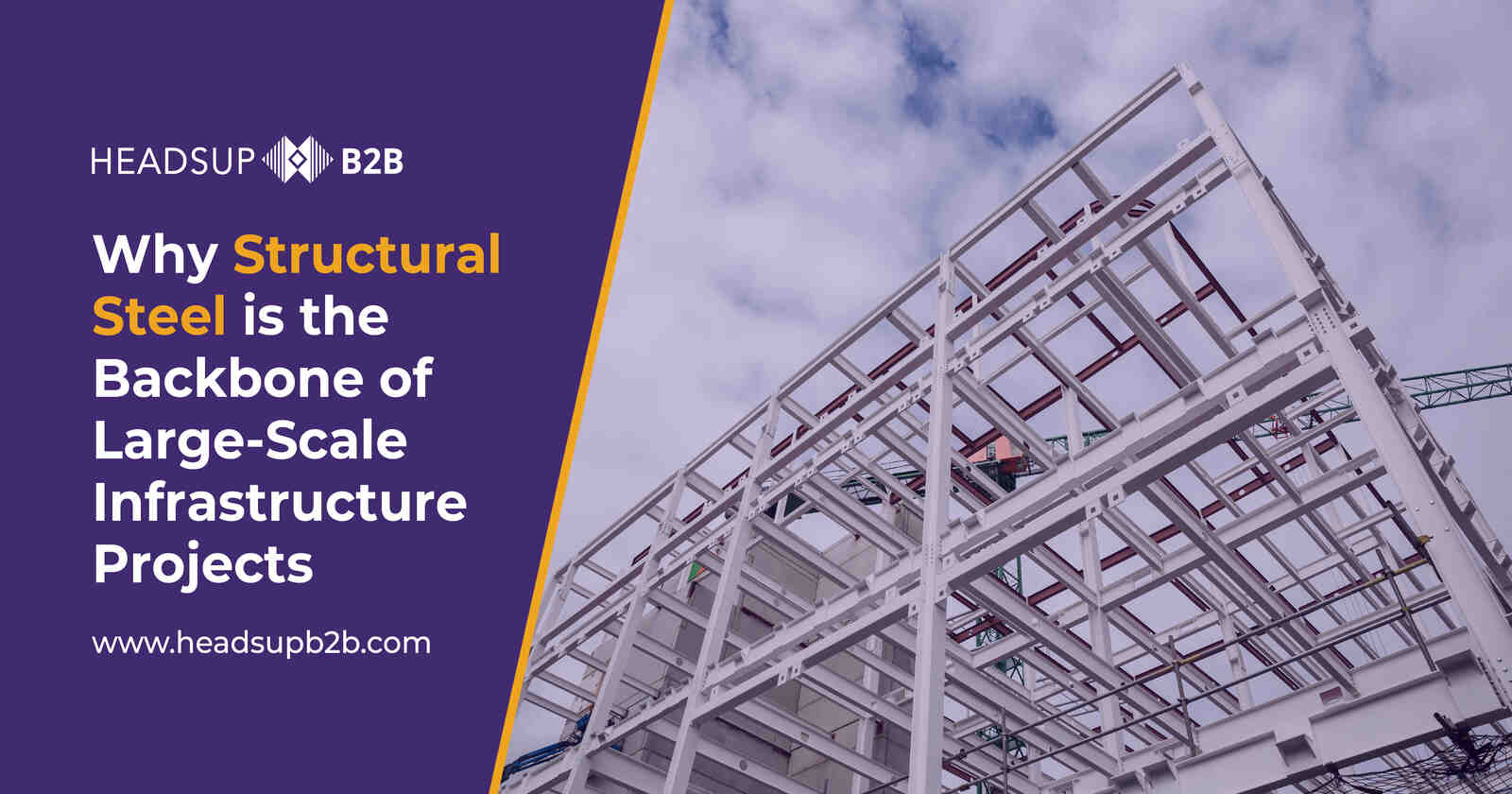
    India is expected to produce approximately 158 million tonnes of crude steel by January 2025. With the same, the country stands as the second-largest steel manufacturer globally. The growing population and evolving infrastructure needs have led to numerous government-backed initiatives.

    Several ambitious infrastructure projects such as Bharatmala and Smart City mission along with development projects have led to an increase in steel demand, making it vital to the country’s economic growth.

    Iconic structures made of structural steel

    India boasts the tallest statue in the world, built using 6500 tonnes of structural steel, the Statue stands tall at 182 meters. Be it Sardar Patel’s statue of unity or the Mumbai Trans harbour link, the high carbon content in the steel makes the construction material highly robust.

    Structural Steel as a Driver to India’s Infrastructure Revolution

    Structural steel plays an important role in fueling the infrastructure revolution in India due to the many factors supporting it, such as strength and durability ensuring the robustness of roads and elevated bridges where safety is paramount. Structural steel can be fabricated into different shapes and sizes, allowing it to be a part of complex designs – especially beneficial in limited urban space.

    Resilient Solutions for Diverse Indian Conditions

    Any infrastructure project needs to withstand the extreme weather conditions. Resilient infrastructure material is of significant importance for diverse conditions – be it monsoon-laden northeast India, the high seismic zone areas such as the Himalayas or the coastal areas along the Arabian Sea and Bay of Bengal. Structural steel’s high tensile strength helps endure the impact of natural hazards like earthquakes and cyclones. These buildings can withstand heavy rains and floods without bending and warping – owing to their flexibility and ductility.

    Structural steel plays an important role in the infrastructure of Delhi and Guwahati due to high seismic resilience.

    Design Versatility for Indian Megaprojects

    Steel’s versatility is highlighted in projects like Signature Bridge and Howrah Bridge. The signature bridge constructed in Delhi stands out due to its intricate structure that symbolizes cultural reverence in greeting hands form. Due to favourable mechanical properties, Signature Bridge has utilised structural steel grades such as S355J2 and S355N. While the bridge is resistant to seismic activities and can withstand dynamic load its innovative design enhances its aesthetic appeal.

    Largely made of structural steel, Kolkata’s Howrah bridge was completed in 1943. It connects Kolkata and Howrah over the Hooghly River and carries a daily load of 100,000 vehicles with pedestrians. The iconic structure of the bridge is a suspension that spans 705 meters without any central support.

    Blending Modern Techniques With Traditional Strength

    The high carbon content in structural steel makes it a preferred choice for construction that is strong and durable – for instance, airports and flyovers. From iconic statues to highways, bridges and ports, the adaptability and versatility of structural steel have made it crucial to the fast-track growth of the Indian infrastructure landscape. Steel’s excellent strength-to-weight ratio and ability to cater to various construction requirements. Be it residential or commercial settings, the versatile characteristics add to its high credibility and suitability for construction materials in all kinds of infrastructure projects.

    Structural steel is the backbone of any infrastructure project and its features make it a reliable choice for any construction needs –

    High Weight-to-Strength Ratio

    The excellent weight-to-strength ratio makes it lighter than other construction materials such as concrete and wood while maintaining the robustness of the building. This characteristic allows for smaller foundations and reduced load on structures.

    Durability

    Structural steel is highly durable and is resistant to corrosion and natural hazards like earthquakes, cyclones and floods. Unlike other materials, it doesn’t crack warp or shrink over time, making it reliable for long-term applications.

    Speed of Construction

    The prefabrication feature of structural steel enables for a significantly reduced construction time. The faster construction also leads to cost savings as the assembly of the modular components to build a structure is done on-site.

    Flexibility and adaptability

    Structural steel is highly flexible due to the inherent characteristic of the steel, making it highly adaptable, allowing for open floor plans with fewer columns, making it easier to adapt spaces.

    Sustainability

    Steel is 100% recyclable making it an environmentally friendly choice for infrastructure construction projects. The adaptability extends their lifespan making them fit to be repurposed rather than demolished,

    Structural steel’s unmatched strength, resilience, adaptability and versatility make it the perfect construction material. Its ability to blend with innovative construction methods like modular and pre-fab leads to unparalleled time and cost efficiency.

    Structural steel’s unmatched strength, resilience, and sustainability make it indispensable for India’s infrastructure growth. With it becoming crucial for infrastructure project accomplishments, you must receive the right support at every step. From sourcing to ensuring on-time delivery and customer support after delivery, Headsup B2B is your reliable partner for your project success.

    Partner with Headsup B2B to explore advanced structural steel solutions and ensure the success of your next project. Contact us today!
  • Renewable Energy Companies in India

    Renewable Energy Companies in India

    India’s renewable energy market has witnessed rapid growth. It is presently valued at over USD 21 Billion and growing at a CAGR of 8.77%. The country’s renewable energy capacity stands at 201.45 Gigawatts (GW) with a portfolio of 47.71 GW of Wind power, 92.12 GW of Solar power, and 56.96 GW of Hydropower. India’s ambitious target of 500 GW of renewable solutions offers substantial market opportunities in clean energy.

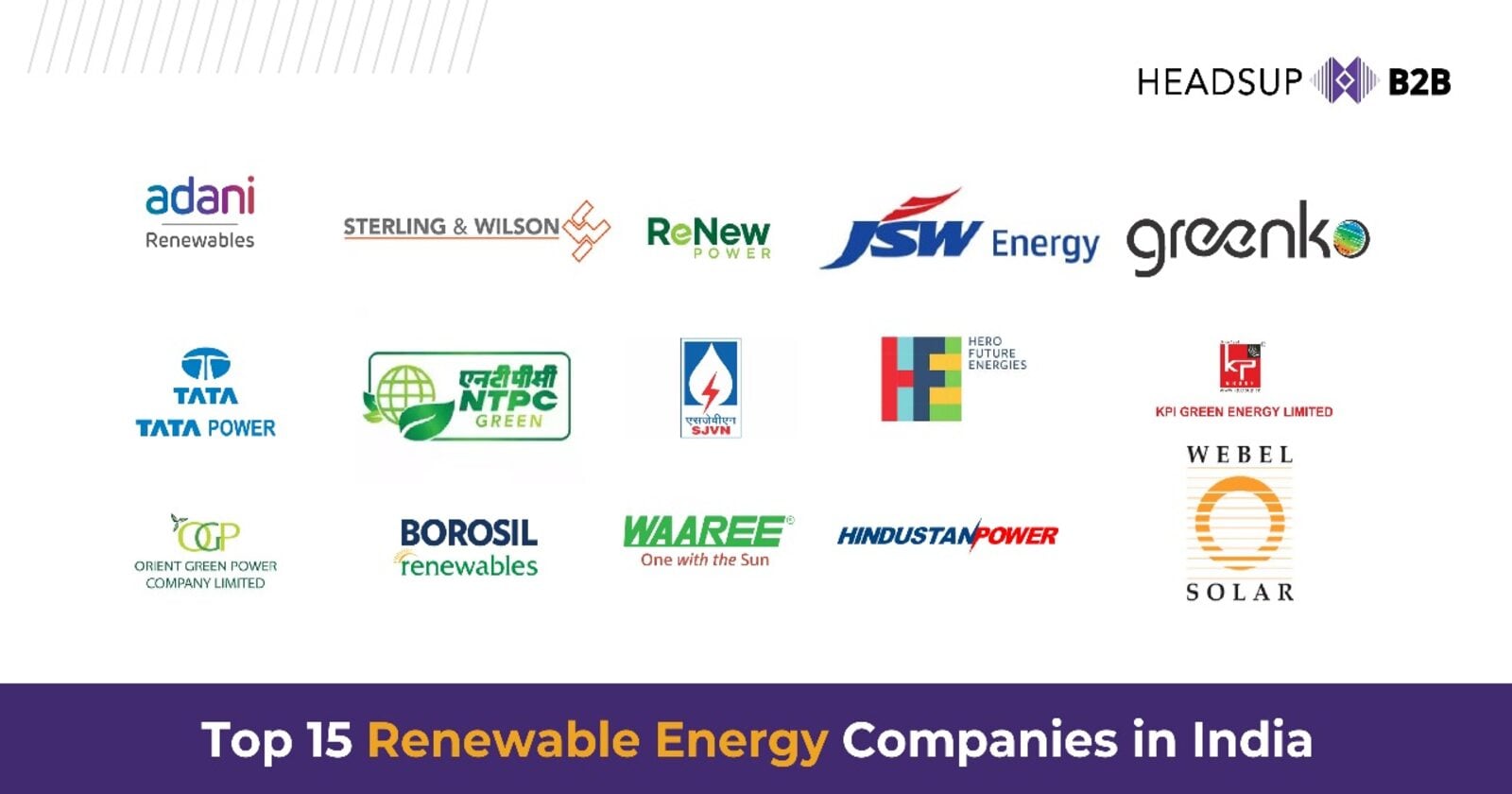
    Top 15 Renewable Energy Companies in India

    1. Adani Green Energy Limited

    Adani Green Energy Ltd (AGEL) is India’s largest renewable energy company with a portfolio of 20,434 MW. The company operates in solar power, wind power, hybrid renewable energy, and energy storage solutions, with a presence in 7 Indian states. AGEL aims to reach a 50 GW renewable energy portfolio, supported by a long-term power purchase agreement with the government for 25 years. The company is also committed to sustainable growth, with water-positive plants having a capacity of 200 MW. AGEL is credited with commissioning the world’s largest Wind Solar Hybrid Power Cluster in Jaisalmer, Rajasthan, with a capacity of 2140 MW.

    2. Sterling & Wilson

    Sterling & Wilson is a global leader in renewable energy solutions, with a presence in 28 countries, including India, the United States, Africa, and Latin America. The company has successfully executed 268 projects worldwide, ranging from 1 MWp to 1177 MWp. A notable project is the 1000 MWhH standalone BESS project in Rajasthan, which is scheduled for completion by 2025.

    3. ReNew Power

    ReNew Power is India’s leading decarbonization company with a portfolio of 15.6 GW of renewable energy, including 4.7 GW of wind energy (10% of India’s total wind capacity). The company has mitigated 16 million tons of carbon emissions in the last two years and has a presence in 9 Indian states. ReNew’s commissioned capacity stands at approximately 10.1 GW, lighting up 14 million homes and comprising 1% of India’s electricity demand. ReNew is also spearheading a Round-the-Clock (RTC) renewable energy project in Rajasthan, Karnataka, and Maharashtra.

    4. JSW Energy

    JSW Energy has a generation portfolio of 10 GW, with 61% of its capacity coming from renewable sources. The company aims to grow to 20 GW by 2030, with operations in several states, including Andhra Pradesh, Maharashtra, and Karnataka. JSW’s portfolio includes 675 MW of solar power, 675 MW of wind energy, and 1391 MW of hydropower. The company has already commissioned India’s largest standalone wind project with a capacity of 810 MW and has adopted green technologies at its Vijaynagar plant, including a reed bed-based sewage treatment system.

    5. Greenko Group

    Founded in 2006, Greenko operates with a mission to digitize, decarbonize, and decentralize India’s energy sector. With a renewable energy portfolio of 7.5 GW across solar, wind, and hydropower, Greenko is present in 15 Indian states. The company has commissioned two integrated renewable energy storage projects, including the Saundatti Integrated Renewable Energy Storage Project, a 2.66 GW project with 1.26 GW of pumped storage, 1.0 GW of solar, and 0.4 GW of wind energy.

    6 Tata Power Renewable Energy Limited

    Tata Power Renewable Energy Ltd (TPREL), a subsidiary of Tata Power, was established in 2007. The company has a portfolio of over 12.8 GW of renewable energy, including 2 GW of rooftop solar systems and more than 100,000 solar water pumps. TPREL’s wind energy portfolio stands at 1,030 MW, and it operates in several Indian states, including Maharashtra, Gujarat, and Tamil Nadu. The company’s Dholera solar facility in Gujarat is India’s largest solar tracker system, with a capacity of 300 MW, and the Kayamkulam floating solar project in Kerala is India’s largest with a capacity of 101.6 MWp.

    7. NTPC Renewable Energy Limited

    NTPC Renewable Energy Ltd (NTPCREL), established in 2020, has a portfolio of 4048 MW in solar, wind, and hybrid projects. The company aims to achieve a total installed capacity of 60 GW by 2032. NTPCREL has a presence in several states, including Rajasthan, Gujarat, Tamil Nadu, and Uttar Pradesh, and is implementing projects under the Indian government’s Ultra Mega Renewable Energy Power Park scheme.

    8. SJVN Green Energy

    SJVN Green Energy, a subsidiary of Satluj Jal Vidyut Nigam Ltd. (SJVN), has a total capacity of 2,466.50 MW, including 1,972 MW of hydropower, 97.6 MW of wind, and 156.9 MW of solar. The company’s largest project is the 90 MW Omkareshwar Floating Solar Project in Madhya Pradesh, which is North and Central India’s largest solar floating project.

    9. Hero Future Energy

    Hero Future Energies (HFE), established in 2012, has a global portfolio of 6 GW of renewable energy assets across India, the UK, Bangladesh, Ukraine, and Vietnam. The company operates in 7 Indian states, including Rajasthan, Maharashtra, and Tamil Nadu. HFE commissioned India’s first Wind Solar hybrid project (87 MW) at Manvi, Karnataka.

    10. KPI Green Energy

    KPI Green Energy, established in 2008, has a presence in Gujarat, Uttarakhand, and Maharashtra. The company offers commercial solutions as a Captive Power Producer (CPP) and Independent Power Producer (IPP) under its ‘Solarism’ brand. The company operates solar plants in Gujarat with a total capacity of 66 KV and 11 KV transmission lines.

    11. Orient Green Power

    Orient Green Power, established in 2006 and headquartered in Chennai, operates a wind power portfolio of 402.3 MW, with plans to expand to 1000 MW. The company is present in Gujarat, Tamil Nadu, Andhra Pradesh, and Karnataka.

    12. Borosil Renewables

    Borosil Renewables, established in 1962 and headquartered in Mumbai, is a global leader in solar glass manufacturing. The company’s state-of-the-art facility in Gujarat has a production capacity of 1000 tons per day, translating to 6.5 GW annually. Notable products include Selene (anti-glare solar glass) and Shakti (high-efficiency solar glass).

    13. Waaree Energies

    Founded in 1990, Waaree Energies is headquartered in Mumbai and has an installed capacity of 12 GW. The company operates at 388 locations across India, with manufacturing facilities in Gujarat, Uttar Pradesh, and Noida. It also has the country’s largest PV Module manufacturing capacity and offers a range of solar products designed for durability and performance.

    14. Hindustan Power Projects

    Founded in 2008, Hindustan Powerprojects has a portfolio of 4 GW in thermal and solar energy. The company has commissioned a 50 MW solar capacity in Punjab and a 30 MW solar farm in the state. Additionally, it operates the Anuppur Thermal Power Plant, with a total capacity of 2,520 MW.

    15. Websol Energy Systems

    Websol Energy Systems, established in 1994 and headquartered in Kolkata, specializes in manufacturing Mono PERC solar cells and modules. With an annual production capacity of 600 MW for solar cells and 550 MW for modules, Websol’s products are designed to maximize energy output and efficiency.

    Conclusion

    India’s renewable energy market is rapidly growing, with key players like Adani Green Energy, ReNew Power, and JSW Energy at the forefront.  We at Headsup B2B can help streamline your renewable solutions sourcing and procurement. Contact us today to know more.

  • On-grid vs Off-grid Solar Systems – Key Differences and Benefits

    On-grid vs Off-grid Solar Systems – Key Differences and Benefits

    As of 2024, India has reached a solar power capacity of 60 GW—a significant leap from 3 GW in 2014. This growth was fueled by the launch of the National Solar Mission in 2010, which aimed for 20 GW by 2022. It is projected that solar’s share in the electricity mix will rise from 5% in FY 2022 to 25% by FY 2032. Additionally, technological advancements have made solar energy more cost-effective and efficient.

    The goal was revised to 100 GW, owing to promising growth in the sector. For the same, various technologies including On-grid and off-grid solar systems are being used to ensure energy accessibility, efficiency, and sustainability. The choice of these systems for particular projects depends on the energy needs with distinct features, advantages, and applications suited to different energy needs.

    What is an On-Grid Solar System?

    On-grid solar systems, as the term suggests, are solar systems that are connected to the grid. They are deployed with a direct connection with the utility grid and do not require battery backup. In this type of system, the electricity is first used by the consumers, and the unused, remaining power is exported back to the grid. The excess energy is measured through net metering, where users get credit for the surplus energy supplied. The components that are used in On-grid systems have components including solar panels (photo-voltaic panels), mounting structures, metering systems to allow users to get energy credits, and power junction units. These systems are used in different settings such as urban homes, businesses, and areas with reliable grid, and infrastructure.

    What is an Off-Grid Solar System?

    Off-grid solar systems are deployed independently of the grid, providing a sustainable and reliable energy source. They can generate their energy without being dependent on the grid making them suitable for remote areas. In terms of components, they incorporate solar panels to convert solar energy into electricity, charge controllers for energy efficiency and inverters for powering devices in off-grid setups. Due to their independence, they are suited to remote locations and areas with unreliable or no grid access.

    Key Differences Between On-Grid and Off-Grid Systems

    Dependency on the Grid:

    On-Grid systems are dependent on utility grids that allow them to draw power when solar energy is insufficient whereas Off-grid systems are independent of utility grids.

    Energy Storage:

    On-grid systems do not require battery storage because they can utilize the grid as backup source. Whereas off-grid systems require continuous power supply during periods without sunlight hence they require battery storage to store energy.

    Cost:

    On-grid storage is less expensive compared to off-grid storage due to absence of costly battery storage solutions. Cost-efficiency makes On-grid more accessible to the homeowners. Due to the requirement of batteries along with additional equipment, the cost is higher in off-grid solar systems.

    Suitability:

    On-grid are suitable for urban and sub urban areas relevant to those who are aiming for cost-efficient solar systems whereas off-grid are suitable for remote areas where utility grid is not available and there is a need for reliable power back-up.

    Key Benefits of On-Grid and Off- Grid Systems

    On-Grid Solar Systems

    • On-grid solar systems have lower upfront costs.

    • They have the ability to sell surplus energy to the grid (net metering).

    • There is no battery replacement and minimal maintenance is required.

    Off-Grid Solar Systems

    • Off-grid systems are completely energy independent.

    • These solar systems have reliable power supply in remote locations.

    • They are ideal for areas with frequent power outages.

    Factors to Consider When Choosing Between the Two:

    Four factors that need to be considered considered when choosing between the two –

    • Location and grid availability.

    • Energy consumption needs.

    • Budget for installation and maintenance.

    • Long-term sustainability goals.

    Both on-grid and off-grid systems have their distinct advantages and disadvantages. The choice depends on budget, personal preferences related to energy independence, reliability and location. The revised goal of the National Solar Mission, 2022 has expanded the solar power scope paving the way for adoption of both on-grid and off-grid solar systems. Headsup B2B is here to cater to your solar power needs with tailored, efficient solutions. Contact Headsup B2B for all your solar energy solutions needs.

  • Types of Electrical Wiring for Residential Buildings

    Types of Electrical Wiring for Residential Buildings

    Electrical wiring is vital to the power distribution of any building or structure. To cater to the powering needs of a building, a wide range of wires and cables are available to connect g central power sources, lights, and other appliances used for power distribution.

    With the variety of wires and cables available for different uses, it’s essential to understand the specifications and applications of each. The growth in the number of construction and electrical projects has driven the increased demand for these specialized materials. The global wire and cable market stood at $201 billion in 2024 with a projected growth of $266.2 billion by 2029 with a CAGR of 5.8%.

    Selecting the right type of wire, suited to the needs of your residential project is essential. This blog delves deeper into the various types of wires suited to the needs of different types of residential buildings and structures.

    NM Cable (Non-Metallic Cable)

    NM cables known as Romex wires, are non-metallic wires with two or more hot conductors and one grounding insulator. The conductors are wrapped together in a plastic sheath.

    They are suitable for indoor wiring applications like switches, power outlets, and light fixtures.

    NM cables are preferred in dry locations because they are insulated with a protective plastic sheath that is not designed to withstand moisture. They are also color-coded to depict the type of wiring gauge. For instance, 14-gauge for 15-amp circuits are white, and 12-gauge for 20-amp circuits are yellow.

    These cables are popular in homes for various reasons including the versatility of use and ease of installation. The most common NM Cables used at homes include –

    • 8-gauge wire:

      • Ampacity: Suitable for 40-amp circuits.

      • Sheathing Color: Comes with black sheathing.

    • 10-gauge wire:

      • Ampacity: Rated for 30-amp circuits.

      • Sheathing Color: Comes with orange sheathing.

    • 12-gauge wire:

      • Ampacity: Designed for 20-amp circuits.

      • Sheathing Color: Comes with yellow sheathing.

    • 14-gauge wire:

      • Ampacity: Intended for 15-amp circuits.

      • Sheathing Color: Comes with white sheathing.

    Conduit Wiring ( PVC or Metal )

    Conduit wiring is a method of electrical installation of wires to enclose them within protective piping layers known as conduits. The protective pipe safeguards the wires from damage, environmental hazards, and moisture. They are used in residential settings due to their flexibility and durability. Various types of conduit wirings include surface and concealed conduit wirings. Surface conduit wirings are directly mounted to the surface of walls and ceilings, and used to power residential lighting circuits throughout homes, electrical outlets in living spaces, kitchens, and bathrooms. Concealed conduit wiring involves electrical cables within conduits hidden behind walls, ceilings, or floors. Concealing the wires helps in enhancing the aesthetics of a building.

    Casing and Capping Wiring

    Casing and capping are different types of wirings that involve encasing insulated wires within protective pipes known as conduits to safeguard from physical damage. Casing is a traditional method involving encasing insulated wires within a cap. This is suited for low-voltage applications in residential and commercial settings. These wires can further be classified in two ways –

    Press and Fit is one of the most common types of Casing and Capping, where the bottom portion is fastened to the wall first, followed by feeding the wiring and pressing the cover into place.

    Wooden Casing is traditionally made from seasoned wood, this type uses grooves to hold the wires securely. It is less commonly used today, due to advancements in materials.

    Twin and Earth Wiring

    Twin and Earth wiring (T&E wiring) is used in fixed installations and is known for its simplicity in design, installation, and maintenance. In its design, two current-carrying insulated conductors with an uninsulated conductor are attached to the ground. These conductors are generally made of copper with PVC insulation. The uninsulated, protective layer provides grounding to ensure safety. Made of PVC or thermoplastic material, the sheathing layer protects the inner conductor from unfavorable environmental conditions such as UV rays. In domestic settings, they are used in lights, switches, and power outlets for televisions, computers, and kitchen appliances. Ideal for connecting fixed devices and appliances, they are used in ovens, washing machines, and hobs.

    Armored Cable (BX)

    Armored cables are also known as BX cables, they come with a protective metal armor. It consists of flexible, galvanized steel that provides physical protection and durability for electrical installations. The armor is designed with wound steel strips for increased durability, flexibility, and strength. These cables are suited for areas requiring extra protection such as basements or garages. They are also used in heavy-duty appliances like air conditioners, washing machines, and water heaters, where enhanced safety and durability are crucial.

    Low-Voltage Wiring

    Low voltage wirings operate below 50 Volts. Apart from other uses, they are used in landscape lighting and security systems. Low-voltage wiring is also used in various modern-day home appliances including doorbells, smart TVs, and networking devices like Wifi routers, ethernets, and sensors. Lower voltage levels reduce the risk of electrical shocks and fires, making it a safer choice for residential wiring. Low-voltage wiring is cost-efficient, versatile, and environmentally friendly.

    THHN/THWN Wire

    Thermoplastic High Heat-resistant Nylon-coated and Thermoplastic Heat (THHN) and Water-resistant Nylon-coated (THWN) wires are commonly used in residential buildings, due to their durability and versatility, power distribution. They are made with thermoplastic PVC insulation and nylon coating. They are rated for a maximum of 90°C (194°F) in dry conditions and 75°C (167°F) in wet environments. In THWN Wire, they are rated for 90°C (194°F) in both dry and wet conditions. T

    They are used for power distribution in lights, switches, and outlets throughout the home and appliance wirings such as refrigerators, ovens, and air conditioners. They are suitable to use in dry and damp conditions making them versatile for different areas around the house and they have effective grounding systems to provide safety against electrical shock.

    Conclusion

    The choice of wires depends on the requirements of a particular residential or building project. Different aspects of wires and cables including conductibility, insulation, grounding, and the engineering of the wires make them suitable for appliances with varied voltage, temperature, and moisture. These factors must be considered when choosing the right wires from a range of options available. Choose the perfect wires for your project with Headsup B2B, your trusted partner in sourcing high-quality, reliable solutions—contact us today to streamline your wiring needs.

  • Exploring The Different Types of Road Safety Barriers

    Exploring The Different Types of Road Safety Barriers

    As traffic continues to grow, the demand for road safety measures has surged. In 2024, over 10,000 tenders were published for road safety barriers, including crash barriers. The market, valued at USD 10.63 billion in 2024, is projected to reach USD 15.5 billion by 2032, reflecting a compound annual growth rate (CAGR) of 4.83% between 2024 and 2032. Road safety barriers make roads safer for pedestrians, motorcyclists, vehicle passengers, and stray animals. Depending on usage, there are different types of road safety barriers.

    1. Metal Beam Crash Barrier

    Metal Beam Crash barrier is a safety feature primarily constructed from galvanized steel to provide impact resistance and durability. The main functions of crash barriers include impact absorption, vehicle redirection, and visibility improvement. There are two types of metal beam crash barriers – W-beam crash barriers and Thrie-beam crash barriers. W Beam crash barriers are shaped as the letter W, providing these barriers structural strength and flexibility. They are used on rural roads and highways to prevent vehicles from veering off. Thrie beam crash barriers feature a wave-like design, ideal for expressways because they have higher impact resistance and improved safety features such as enhanced vehicle redirection and better energy absorption, and during high-speed collisions.

    2. Wire-Rope Barriers

    Wire rope barriers’ main role is to prevent vehicles from colliding with any fixed object or terrain. These road safety barriers reduce the impact by deflecting the vehicle off a tensioned rope after it experiences a collision. The deflection leads to gradual deceleration which reduces the risk of serious injuries compared to rigid barrier materials. Wire Rope barriers have led to about an 87% decrease in crashes as per reports and are effective in both median and side applications.

    3. Concrete Barriers

    Concrete barriers help in road traffic management and are primarily used to separate traffic lanes on roads and construction sites. Several types of barriers that come under concrete barriers include J-rail barriers, jersey barriers, and concrete step barriers. The material used in making these barriers is reinforced concrete which is resistant to harsh weather conditions. When vehicles collide kinetic energy is generated so that concrete barriers can structurally dissipate to absorb the energy. Apart from preventing cross-over accidents, they are also highly durable.

    4. Water-Filled/Sand-Filled Barriers

    Water-filled and sand-filled barriers are lightweight barriers and are primarily used in traffic management. They are constructed with plastic and are filled with water or sand to provide stability. They are ideal for construction sites and events. Water-filled and sand-filled barriers are mainly used in temporary set-ups because they are lightweight. The recyclable nature of the material makes these barriers eco-friendly thanks to minimal waste generation and environmental impact. Owing to their filled weight, they are resistant to displacement, making them suitable for permanent and semi-permanent installations.

    5. Safety Cones

    Safety cones, also known as traffic cones, are used to ensure safety during the construction process, managing traffic and crowd management. In terms of characteristics, they are made up of PVC and have reflective collars for maximum visibility in conditions with low light.

    6. Flexible Barriers

    Flexible barriers are made of ropes made of polymer or wire which are held between vertical supports known as posts. This design allows them to absorb impact and energy. They are utilized in industrial settings, construction sites, and roadways. Flexible barriers are modular and this feature makes them adaptable. The modularity of the barriers caters to different site needs and layouts.

    7. A-Frame Barriers

    A-frames are portable and versatile safety barriers. These types of road safety barriers are primarily used in directing traffic, pedestrian protection, and crowd control. They consist of two triangular pieces connected by horizontal tubes and planks. Their shape provides visibility and stability, making it easy for them to be assembled and disassembled. They are generally made up of high-density plastic that can withstand harsh weather conditions. A-Frame barriers are portable and are finished in bright colors that make them visible in low light and dark environments.

    Contact Headsup B2B for Safer Roads

    Road safety barriers play an important role in ensuring road safety for all from pedestrians and motorists to animals. Each type of barrier caters to a particular need – be it absorbing impact, managing traffic flow, or re-directing traffic. Headsup B2B is your one-stop solution for all road safety requirements—contact us today to help create safer roads for everyone.

    FAQ

    1. What are road safety barriers, and why are they important?

      Road safety barriers are equipment manufactured to promote road safety. Their purpose is to make roads safer from vehicle crashes. They are designed to protect pedestrians, motorists, and animals from road crashes.

    2. What types of road safety barriers are available?

      There are a range of road safety barriers available. The choice of the barriers to be installed depends on usage including flexible, semi-rigid, rigid, portable, and temporary barriers.

    3. How do road safety barriers help prevent accidents?

      Road safety barriers help prevent accidents in different ways. They help protect from vehicle collision, impact absorption, separation from traffic, work zone safety, and enhanced visibility.

    4. Where are road safety barriers commonly used?

      Road safety barriers are commonly used for highway safety, work zones, bridge and tunnel protection, traffic management, pedestrian safety, impact absorption, and temporary applications like traffic diversion.

    5. How do you choose the right road safety barrier?

      The choice of road safety barriers is important to meet the purpose of the installation. The choice depends on different factors such as the type of road, the volume of traffic, expectations for crash severity, specific requirements for the site, and the needs of pedestrian safety.

  • Enhancing Supply Chain Fulfillment: Headsup B2B’s Role as a Reliable Fulfillment Partner

    Enhancing Supply Chain Fulfillment: Headsup B2B’s Role as a Reliable Fulfillment Partner

    Importance of Supply Chain Fulfillment in Project Success

    A streamlined supply chain is the foundation of any project and order fulfillment plays a crucial role in ensuring that success. An efficient fulfillment process will ensure successful project management and client satisfaction – from the time an order is placed to its delivery, and continuous customer care post that. And studies show that technology-driven fulfillment processes lead to 30% faster delivery time, reduced costs, and higher customer satisfaction.

    Technology’s Role in Transforming Fulfillment

    Technology integration has made supply chain fulfillment efficient and seamless, ensuring exceptional customer experience, and reducing bottlenecks and costs. By integrating operational efficiency with customer-centric outcomes, technology can plug the gaps in processes and improve project results.

    Delivery Timelines as the Key Success Indicator

    Meeting delivery timelines is a key indicator of project success in the infrastructure industry. The supply chain fulfillment process ensures reliable and timely deliveries leading to on-time, successful project execution. By ensuring necessary materials are available on time, delays are minimized upholding customer trust.

    Cost Optimization Through Technology-Driven Fulfillment

    A tech-integrated fulfillment process can utilize tools like data analytics and automation which can help optimize costs. Real-time visibility from automated order placement can reduce inventory holding costs. While reduced costs can contribute to the profitability of the company, on-time delivery, and post-delivery support will also lead to satisfied customers. Technology-driven fulfillment processes minimize wastage throughout the process leading to an almost 33% reduction in costs.

    The End-to-End Nature of Supply Chain Fulfillment

    In the infrastructure industry, supply chain fulfillment is an end-to-end process from order placement to timely delivery and support after delivery. While fulfillment is important for a great project finish, it is only one component of the complete supply chain. A project’s success depends on the management of the entire supply chain.

    Headsup B2B – Your One-Stop Procurement Partner

    HeadsUp B2B is an integrated online marketplace specializing in infrastructure-related materials. This one-stop shop enables end-to-end supply chain fulfillment, from demand aggregation, direct sourcing of high-quality materials, and real-time tracking to ensure timely delivery. A responsive and dedicated team is in place to support you throughout your procurement journey. The company leverages innovative, cutting-edge technology to ensure project success.

    How We Work at Headsup B2B

    Demand Aggregation

    Demand aggregation is the process of efficiently combining procurement needs across multiple entities or project requirements. It streamlines and ensures cost-effective sourcing. Headsup B2B analyzes and consolidates customer demands to effectively align with market requirements. Being a comprehensive online marketplace ensures all the requirements for a single project are available on the portal simultaneously.

    Sourcing is the next step after demand aggregation, where the materials are sourced as per demand. It is important to ensure that the sourcing is done through verified and reliable suppliers to procure high-quality materials. To ensure quality, Headsup B2B collaborates with manufacturers and suppliers of high credibility and reputation. Sourcing directly from manufacturers ensures reliability and cost savings. Also, a tech-integrated centralized platform reduces the need to source materials from multiple suppliers, saving time and reducing complexity.

    Real-Time Tracking

    Real-time tracking is an innovative feature that helps companies track the estimated delivery time of goods and materials. This technology-enabled feature can help you have a contingency plan in place, in case of delays.

    Headsup B2B’s real-time tracking uses real-time insights to enable scheduling the next steps of the project based on the time of delivery. It helps predict delays, minimize downtime, and plan to mitigate risks. It enables its clients to be informed and maintain complete control over deliveries.

    Delivery and Support

    On-time delivery is important for successful supply chain fulfillment which is vital for a seamless project execution. Timely delivery ensures that all the phases of the project life cycle are completed within the designated time. This prevents bottlenecks or downtime at any stage, leading to overall cost-efficiency Post-project customer support also plays a crucial role in resolving any pending issues, promoting customer satisfaction. Headsup B2B ensures the timely delivery of materials while also providing continuous, ongoing support. Our team is always available to resolve queries and ensure smooth, post-delivery processes.

    Conclusion

    From demand aggregation to material sourcing, real-time tracking, and support, Headsup B2B is your comprehensive fulfillment partner. Be it TMT bars for a large-scale commercial project or safety cones for roadworks — Headsup B2B is your trusted fulfillment partner for all your infrastructure project requirements.

    Ready to elevate your supply chain fulfillment? Contact Headsup B2B for solutions tailored to your project needs

  • Top 10 Infrastructure Projects in India in 2025

    Top 10 Infrastructure Projects in India in 2025

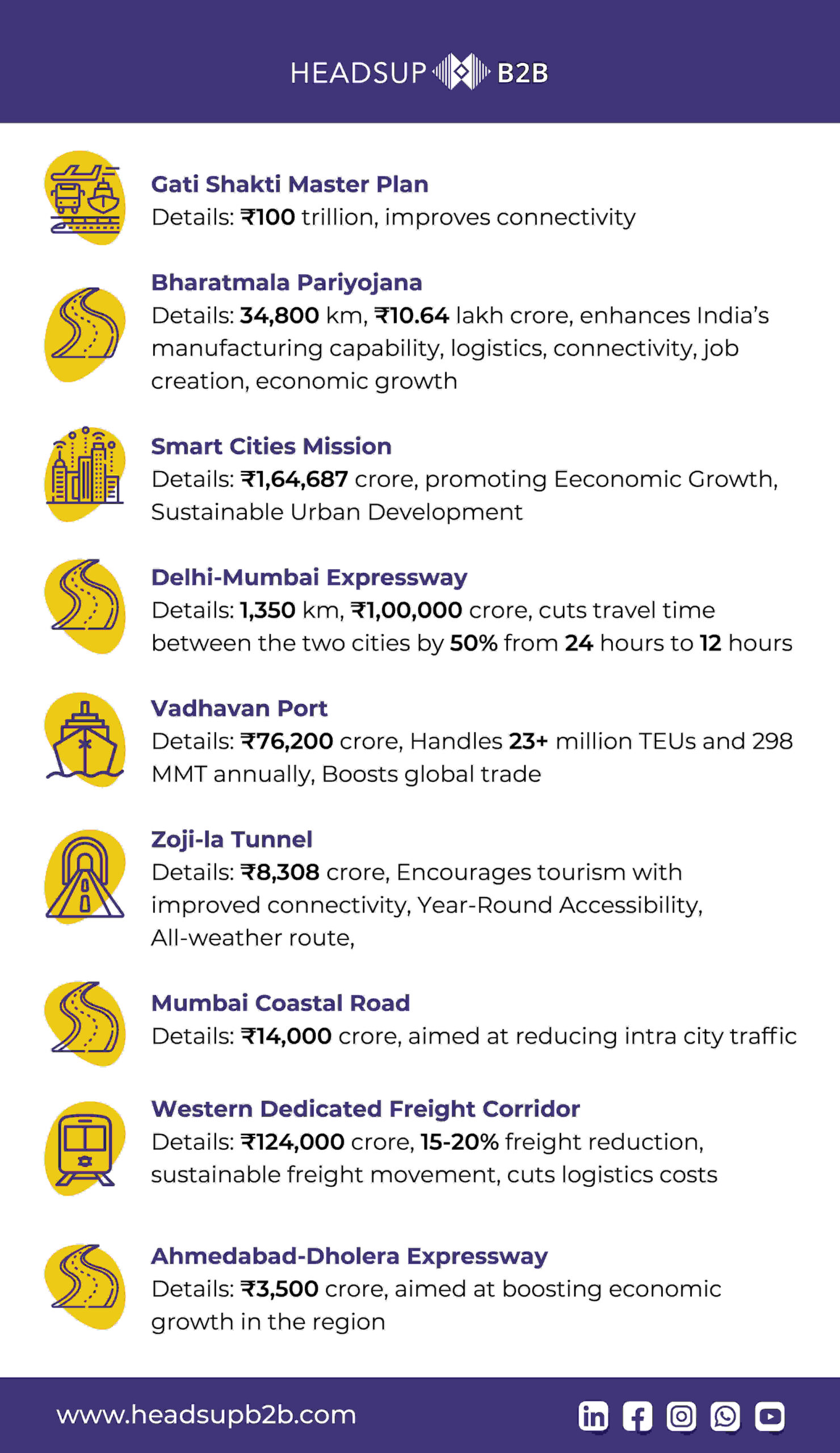
    India, the world’s fifth-largest economy, is undergoing a major infrastructure transformation. The nation is rolling out several large-scale, infrastructure projects, to improve trade and boost the economy. These initiatives aim to transform the country’s infrastructure landscape, contributing to India’s mission to become a developed country under Mission 2047. Through notable projects like Bharatmala Paryojana, Multimodal PM Gatishakti, and Vadhavan Port, India is poised to significantly strengthen its manufacturing and logistics sectors, leading to more trade and investments. These ambitious projects will also provide massive employment generation opportunities, and improve the country’s overall economic health. Let us look at the top 10 infrastructure projects in 2025, enabling the country’s growth and development at both domestic and international levels.

    1. Gati Shakti National Master Plan

    Launched in October 2021, the PM Gati Shakti National Master Plan is a transformative, multi-modal initiative by the Government of India. It aims to enhance connectivity across over 100 cities.

    The plan is being built on an investment of ₹100 trillion. The goal is to reduce the country’s logistics cost from 14-16% of the GDP to 9%. This will encourage economic growth and improve the efficiency of transportation networks in the country. Under the umbrella of Gati Shakti NMP, a range of infrastructure projects, including roads, railways, ports, airports, and mass transit systems are present.

    The program incorporates various infrastructure schemes of different ministries and state governments – like Bharatmala, Sagarmala, inland waterways, dry ports, land ports, and UDAN – a regional connectivity scheme.

    The National master plan aims to reshape India’s position globally as a manufacturing and trade hub. In order to facilitate quicker transportation of both raw materials and completed goods the Gati Shakti NMP will enhance connectivity in strategic economic zones.

    The enhanced efficiency will assist Indian producers in offering competitive prices for their products in global marketplaces. With NMP India will increase its ability to draw in foreign investment, propel industrial growth, generate millions of jobs across the country and strengthen its economy as a whole. Raw materials and completed goods will be transported more quickly thanks to the Gati Shakti NMPs improved connectivity in strategic economic zones.

    The enhanced efficiency will assist Indian producers in offering competitive prices for their products in global marketplaces. India will increase its foreign investment propel industrial growth generate millions of jobs across the country and strengthen its economy overall with NMP.

    2. Delhi-Mumbai Expressway

    Spanning 1,350 kilometers, the Delhi-Mumbai Expressway was launched in 2019 and is expected to be completed in 2025. The game-changer expressway will reduce the travel time between Delhi and Mumbai by almost 50%. It is India’s largest greenfield expressway and is aimed at improving connectivity between Delhi, Uttar Pradesh, Haryana, Rajasthan, Madhya Pradesh, Gujarat, and Maharashtra.

    The project is expected to cost ₹1,00,000 crore and will improve logistics and trade across the Delhi -Mumbai corridor by large means.

    3. Smart Cities Mission

    The Smart Cities Mission was launched by the Government of India in 2015 to develop 100 cities across 28 states. It entails 8,075 projects with an investment of ₹1,64,687 crore. Apart from ensuring sustainable development, enhancing the quality of life in these cities, building robust infrastructure, and strengthening urban development, this mission will also generate employment. A total of 10 lakh direct and 30 lakh indirect employment is expected to be created under the Smart City Mission.

    4. Bharatmala Pariyojana

    Bharatmala Pariyojana was envisioned in 2017. Of the total 34,800 km, 18,714 km will be completed in 2024. The project has attracted investments worth ₹10.64 lakh crore, will improve land connectivity across the country, and will also help with employment generation, including a projected 45 crore man-days of direct employment and 57 crore man-days of indirect jobs. The financing of the project was done through a combination of budget allocations and private investments. Bharatmala Pariyojana will also build 2000 kilometers of new border roads, increasing connectivity with neighboring countries like Bangladesh, Myanmar, Bhutan, Thailand, and Nepal. This will create mutually beneficial trade opportunities and strengthen regional cooperation. Apart from cross-border trade enhancement, connecting major economic hubs and feeder routes will also boost domestic trade.

    5. Vadhavan Port

    Vadhavan Port will redefine India’s maritime capabilities. This ambitious project aims at handling over 23 million TEU containers by 2040. The port is a joint venture between the Maharashtra Maritime Board (MMB) and the Jawaharlal Nehru Port Authority (JNPA). India’s deep draft port deficit is addressed by its 20-meter depth. It aims to reduce congestion at JNPT and play a vital role in boosting India’s trade, positioning India as a leading maritime player on global trade routes. With a projected investment of ₹ 76,200 crores, Vadhvan Port will also contribute to India’s logistics capability by boosting overall cargo handling capacity.

    6. Zoji-la Tunnel

    Zoji-la Tunnel is situated between Srinagar and Drass on the Srinagar-Leh Highway in Jammu and Kashmir. It was built with an investment of ₹8,308 crore. The 14.2 km long tunnel is estimated to be one of Asia’s longest bi-directional tunnels and will significantly reduce the travel time across Zoji-la Pass. At 11,575 feet, the project provides an all-weather route, increasing the tourism and economic activities in the region. The completion deadline of the pass has been revised from 2026 to 2030, as of January 2025, 40% of the work has been completed.

    7. Mumbai Coastal Road Project

    Launched in 2018 and phase one inaugurated in 2024, the Mumbai Coastal Road Project (MCRP) will connect Marine Drive in South Mumbai with Kandivali in the Northern part of the city. In 2024, the opening of the Marine Lines Flyover, connecting Marine Drive to the Bandra Worli Sea Link, has already improved connectivity and eased traffic congestion. With a budget of ₹14,000 crore, the entire project is expected to be completed by the mid-2025. This ambitious initiative includes an 8-lane access control expressway to decongest the city and promote sustainable development. The 29.20 km long tunnel has features like a twin tunnel under Malabar hills with scenic views along its stretches. In addition to reducing city traffic congestion, the MCRP enhances trade and commerce by lowering operational costs for businesses.

    8. Western Dedicated Freight Corridor

    The Western Dedicated Freight Corridor (WDFC) aims to connect Dadri in UP to Jawahar Lal Nehru Port (JNPT) in Navi Mumbai, Maharashtra, going through Gujarat, Rajasthan, and Haryana. It has a total investment of ₹124,000 crore. WDFC aims to increase the speed of goods movement which will significantly reduce logistics costs, through a comprehensive rail network for freight trains. It will cover 1,506 kilometers, with over 93% of the total length completed by January 2025, and the rest by the end of 2025. The completed portions of WDFC have already reduced the travel time between mines and thermal power plants from 35 hours to 20 hours. With 240 trains already operating daily in the corridor, they have reduced overall logistics costs by 13-15% to below 10% of the country’s GDP.

    9. Central Vista Redevelopment

    Central Vista Redevelopment Project aims at modernizing the administrative heart of the country, in the capital New Delhi with an investment of ₹20,000 crore. The administrative buildings under the project include the new parliament building, a common central secretariat, and various public spaces. The development along a stretch of 3.2 km is expected to improve administrative efficiency and the urban landscape. As of January 2025, approximately 85% of the construction has been completed, with the remaining 15% expected to be finalized by mid-2025.

    10. Ahmedabad-Dholera Expressway

    The Ahmedabad-Dholera Expressway connects Sardar Patel Ring Road near Sarkhej in Ahmedabad and Adhelai village in Bhavnagar, passing through the Dholera Special Investment Region (DSIR). 80% of The Ahmedabad-Dholera Expressway has already been completed and is expected to be completely operational by early 2025. The project has a budget of ₹3,500 crore and spans a distance of 109 km. It aims to improve access to the major industrial hubs, promoting economic growth and attracting investments in Gujarat.

    Conclusion

    Mission 2047 envisions making India a developed country as she turns 100. To realize the same, the country is undergoing a holistic transformation with visionary projects like the Gati Shakti National Master Plan, Delhi Mumbai Expressway, Bharatmala Pariyojana, and Smart City Mission all aimed at boosting trade, generating employment opportunities, and strengthening our economy. These significant shifts reflect India’s drive to sustainable development, innovation, and becoming a global powerhouse.

    These projects lay the foundation for a modern infrastructure supporting India in her journey towards becoming a developed economy.

    Headsup B2B is a one-stop shop for all your infrastructure needs. Contact us today at +91 93133 06060 or write to us at info@headsupb2b.com

  • How to Choose the Right Building Material Supplier for Your Projects

    How to Choose the Right Building Material Supplier for Your Projects

    The backbone of any construction project is the quality of its materials. And for the same reason, you must partner with a trustworthy building material supplier. A dependable supplier helps you complete the project within your timeline and budget while meeting the quality benchmark. At Headsup B2B, we understand the high importance of procurement in the infrastructure industry and how crucial a good supplier relationship is for the project’s success.

    Why Choosing the Right Supplier Matters?

    Building construction materials are the core of any construction project and there can be no compromise when it comes to their quality.. Supreme quality building construction materials mitigate structural failure, ensure safety and save on future repair costs. A trustworthy building material supplier ensures:

    • Consistent, High-quality: Materials that adhere to industry standards and project specifications.

    • On-Time Delivery: Avoiding project delays by delivering materials precisely when needed.

    • Cost-Effective Options: Balancing budget-friendly pricing with superior quality.

    • Custom and continued Support: Expert recommendations matching your project’s needs.

    Factors to Consider When Choosing a Supplier

    1. Material Quality and Standards Compliance

    High-quality building construction materials are critical for a project’s success. Choose the right and trusted building material supplier, who can guarantee materials that meet the highest quality standards and comply with industry standards. Request documentation or samples to verify compliance. For instance, when choosing a construction material supplier of products such as cement, go for a supplier with BIS-certified products, bulk purchase options, and comprehensive test reports. Reliable suppliers are transparent about their processes and certifications.

    2. Proven Reputation and Experience

    A building material supplier’s reputation indicates their reliability and expertise. Seek out reviews, testimonials, and case studies to understand their credibility. Long-standing suppliers are more likely to have streamlined their processes and earned the trust of their clients. The key questions you must ask should include

    • How extensive is their experience in the industry?

    • What kinds of projects have they worked on?

    • References from or a portfolio of previous projects

    3. Pricing Clarity and Fairness

    Cost plays a vital role in supplier selection and clarity in pricing is as important. Partner with suppliers that provide transparency in costing with detailed and competitive cost breakdowns, without hidden fees. Trustworthy suppliers ensure their price quotes are clear and itemized to plan effectively.

    4. Reliable Delivery Services

    The success of your project depends on meeting deadlines effectively, so timely delivery of materials is important. Evaluate the supplier’s ability to handle logistics effectively and ask about contingency plans for potential delays. Consider factors such as the supplier’s logistical strength, fleet size, storage facilities, and the distance between their operations and your project size.

    5. Commitment to Sustainability

    As green construction is at the forefront of the modern construction industry, partnering with an eco-conscious supplier with ethical sourcing policies is a smart move. The choices benefit the environment and position your company as a leader in sustainability.

    6. Reliable Customer Service & Support

    The supplier’s willingness and responsiveness to manage unforeseeable issues during your project can have a significant impact on the project’s success. Choose a supplier, after assessing their communication channels, availability, and after-sales service to ensure you have all the support needed to overcome challenges effectively and swiftly.

    5 Steps to Vet a Building Material Supplier

    1. Define Your Needs

    Identify the type and quantity of your materials, along with a timeline for supplier selection.

    2. Research Suppliers

    Utilize Headsup B2B and research industry directories to find credible supplier options.

    3. Get Proposals and Samples

    Request for proposals, certifications, and product samples to evaluate a supplier’s offerings.

    4. Assess Infrastructure Support

    Assess the supplier’s facilities, and inspect storage, inventories, and processes to verify reliability.

    5. Make it Official

    Negotiate detailed contracts and outline clear terms for quality and delivery.

    Potential Delays & Pitfalls

    • Lack of Transparency: Suppliers may be reluctant to share certifications or test reports, indicating potential issues with transparency or compliance.

    • Communication Challenges: Delayed responses or unclear answers suggest potential reliability and communication issues.

    • Negative Market Reputation: Patterns of negative market feedback about quality or delivery indicate deeper concerns about the supplier’s performance.

    • Unrealistic Pricing: Unrealistic prices and offers that seem too good to be true often come at the cost of quality and can lead to unexpected issues.

    At HeadsUp B2B, we make supplier selection seamless with

    • Access to Trusted Suppliers: A curated network of pre-vetted, dependable partners.

    • Easy Comparisons: Transparent pricing and detailed product listings at your fingertips.

    • Efficient Logistics: Robust support for on-time, hassle-free deliveries.

    • Sustainable Choices: A wide range of eco-friendly materials to align with your sustainable values.

    The Headsup Difference

    Choosing Headsup B2B takes out the guesswork of selecting the right building material and provides you with a strategic partner. At Headsup B2B, we understand the importance of quality and provide the tools and the support that is needed to succeed. Let us help you streamline your procurement process and aid in securing the best material for the success of your project. Contact us today at +91 93133 06060 or info@headsupb2b.com!

    FAQs

    1. Why is it important to choose the right building material supplier for my construction project?
    Choosing the right supplier ensures you receive high-quality materials that meet project specifications, are delivered on time, and at competitive prices. This helps avoid delays, ensures the project’s structural integrity, and reduces overall cost.

    2. What are the key factors to consider when selecting a building material supplier?
    The key factors include high-standard material quality, the supplier’s reputation, experience, comprehensive material selection, pricing transparency, reliable delivery services, commitment to sustainability, and excellent customer service.

    3. How do I verify a supplier’s credibility and quality of materials?
    Look for documentation such as certifications (e.g., BIS-certified products), test reports, samples, and case studies. A reputable supplier will be transparent about their processes and provide evidence of industry compliance and a portfolio of successful projects

    4. What role does sustainability play in choosing a building material supplier?
    Sustainability is becoming increasingly important in construction. Partnering with a supplier committed to ethical sourcing and eco-friendly materials helps reduce environmental impact and positions your organization as a leader in green construction.

    5. How does HeadsUp B2B simplify the supplier selection process?
    HeadsUp B2B offers a curated network of pre-vetted suppliers, making comparing prices and products easier. We provide access to reliable suppliers with proven track records of supplying high-quality products, support for timely deliveries, and sustainable options for your project needs.

  • Your Trusted Partner for Procurement to Fulfillment: HeadsUp B2B

    Your Trusted Partner for Procurement to Fulfillment: HeadsUp B2B

    In any industry, procurement is like a Rubik’s cube that takes time and careful management to align all the pieces. From finding trustworthy suppliers to ensuring budgets and timelines are met, the process requires precision and adaptability.

    While procurement is like a giant puzzle, with a time-consuming supplier search, paperwork, and negotiating prices, it is an important process that ensures efficiency for businesses. Streamlining the procurement process then becomes imperative for any successful business.

    Meet HeadsUp B2B: Your Streamlined Procurement Solution

    HeadsUp B2B simplifies procurement from start to finish. By offering a unified platform that covers everything from sourcing and cost-effectiveness to ensuring on-time delivery, we help you eliminate inefficiencies and focus on what truly matters to your business.

    At our one-stop, integrated platform, we have simplified every step – finding trusted suppliers, ensuring competitive pricing, and managing logistics, our team will provide solutions that are customized to meet your business needs.

    No More Tedious Supplier Hunts

    A common pain point for procurement is finding trustworthy suppliers. At Headsup B2B, quality is at the heart of everything we do, ensuring high-quality and reliable products. Headsup B2B brings a vast network of suppliers to save you from endless hours of supplier search. On our platform, we provide you with access to a pre-vetted vendor repository. This reliable repository narrows your search, making sourcing fast, dependable, and efficient.

    Quality and Reliability You Can Count On

    At Headsup B2B, we partner with our suppliers and work with them to provide the highest-quality products and services, aligned with your expectations. The reliable supplier repository, along with a focus on quality and timely delivery, helps you focus on the core of your business while we handle the logistics.

    But quality and reliability don’t stop there—we also harness the power of technology to make procurement effortless and efficient.

    Transforming Procurement Through Technology

    Technology is essential for driving a business and Headsup B2B is committed to fully harnessing its potential. Our platform leverages technology to remove uncertainty by simplifying procurement and making the process seamless. Features like quote comparison help identify the best value, helping finalize a deal in just a few clicks. Our platform also enables easy ordering for swift transactions and real-time tracking that provides much-needed transparency.

    Negotiations on your finger-tips

    Technology-enabled processes also aid in faster decision-making while being less resource-intensive. Negotiation is critical for optimized costing, and this requires everything from price comparison to finding a middle ground after discussions. All this is not only time-consuming but also resource-critical. Heasaup B2B pitches in to take this burden off your shoulders, saving you from the back-and-forth of lengthy negotiations. We compare the price quotes for you and help you secure the best deal Avoiding Supply Chain Disruptions

    Supply chain disruptions are a constant threat. However, with Headsup B2B’s reliable logistics partners, we ensure your orders are delivered on time, every time. Our partners are established logistics providers who ensure that your supply chain remains uninterrupted, even in times of uncertainty.

    Transparency You Can Count On

    Lack of transparency often hinders effective procurement. With Headsup B2B, you gain complete visibility into the entire procurement process—from order placement to delivery. Our platform’s real-time updates allow you to track every movement of your order.. We keep you informed at every step, so you never have to worry about hidden delays or issues.

    Streamlined B2B with Headsup. Demand to Delivery

    Streamlined B2B with Headsup. Demand to Delivery

    How Headsup B2B Makes Procurement a Breeze

    Imagine a world where:

    • Finding the right products is easy: Simply browse our extensive catalog or use our advanced search filters to find exactly what you need.

    • You always get the best deals: Our platform helps you compare prices and negotiate favorable terms with suppliers.

    • Ordering is quick and efficient: Place orders online with a few clicks, and track their progress in real-time.

    • Delivery is always on time: We enable efficient and timely delivery to ensure that your orders arrive when you need them.

    Headsup eliminates the complexities of sourcing, negotiation, and ordering for all procurement needs – from office supplies to IT equipment and construction materials.

    Long-Term Benefits and Cost Savings

    HeadsUp B2B takes a sustainable approach to cost efficiency through effective cost management. It uses pre-negotiated rates, trusted suppliers, and dynamic price comparison tools to save costs. The platform enhances forecasting capabilities that decrease the possibility of overstocking and last-moment, stressful purchases. This streamlined approach reduces the risk of errors and improves the overall productivity of your business.

    Along with cost optimization, your business gets a boost with the help of an enhanced procurement process. By helping you avoid overstocking and the stress of urgent, last-minute buying decisions – it streamlines your operations, leaving less room for errors that could disrupt workflows.

    Our trusted suppliers offer secure, competitive prices, resulting in long-term savings and increased profitability. Additionally, our actionable insights enable you to align your procurement plan to reduce surplus and waste. Apart from waste reduction, data-driven insights help forecast procurement needs more accurately.

    Ready to Simplify Your Procurement?

    Headsup B2B: Your One-Stop Shop for Procurement

    Join the growing number of businesses that are streamlining their processes, from procurement to fulfillment, with HeadsUp B2B. Contact us today at +91 93133 06060 or email us at info@headsupb2b.com and experience the difference!

  • Top 10 Building Material Suppliers in Delhi 
| Fueling Infrastructure Growth

    Top 10 Building Material Suppliers in Delhi | Fueling Infrastructure Growth

    New Delhi, India’s administrative, financial, and industrial hub, is expanding rapidly to meet its growing infrastructure demands. As the capital city witnesses an influx of migrants and an increase in population, its strategic importance is further elevated by its role as the political epicenter of the nation. The city has projects of national importance such as the construction of the new parliament building, administrative blocks, and state houses underway. Due to the growing population and in-migration, the infrastructure needs of the city have grown, multi-fold.

    To cater to these demands, numerous building material suppliers in New Delhi are providing innovative and high-quality products. In this blog, we will explore the top 10 construction and building material suppliers in Delhi contributing to the city’s dynamic growth.

    Top Building Material Suppliers in Delhi

    1. Dalmia Bharat

    Damia Bharat is one of the leading cement companies in Delhi NCR and all over India. It was established in the year 1985 at Delhi. The company has an installed capacity of 37 MTPA. Dalmia Bharat offers all the building construction materials such as PPC, PSC, OPC, etc. The company has 80 years of experience in the cement business and sustainability is at the core of its business. Dalmia has the vision to be carbon-negative by the year 2040.

    2. Kajaria Ceramics

    Kajaria Ceramics leads the ceramics market with high-quality ceramic and vitrified tiles that are used on walls and floors. Its products are used in both residential and commercial projects. The company has its production units in more than one location in the Indian territory namely UP, Rajasthan, Telangana, Andhra Pradesh, and Gujarat. All the plants are highly sophisticated and equipped with the latest technologies such as automation and robotics. It has a production capacity of vitrified tiles of 1.40 million square meters per annum.

    3. Greenlam Industries

    Since 2013, Greenlam Industries has been a leading provider of laminates, decorative veneers, and engineered wood flooring. With a turnover exceeding ₹1,650 crore and a workforce of 3,500 employees, the company’s products are known for their aesthetic appeal and durability, meeting the needs of both modern and traditional architecture in New Delhi.

    4. Headsup B2B Pvt Ltd

    Headsup B2B was founded in 2022 with a vision to simplify procurement by connecting buyers and sellers. It specializes in end-to-end solutions, ensuring high quality materials, operational excellence, and financial support. Headsup B2B helps strengthen their supply chain efficiently. The vision to revolutionize building material supplier’s domain has enabled the company to expand its client base across Delhi NCR and Pan India.

    5. Gold Plus Glass Industry Limited

    Based in Rohini, New Delhi, Gold Plus Glass Industry Limited specializes in high-quality glass products, including clear float glass, reflective glass, and acoustic glass. With manufacturing facilities in Roorkee and Belgaum and a daily production capacity of 2,050 tonnes, the company caters to diverse sectors such as construction and automotive, making it a major player among construction and building material suppliers.

    6. Shalimar Paints

    Founded in 1902, Shalimar Paints is India’s first paint manufacturing company. Known for its emulsions, primers, varnishes, and industrial coatings, the company’s products have been used in iconic buildings like the Howrah Bridge and Rashtrapati Bhavan. Shalimar Paints remains a preferred choice for both heritage and modern projects.

    7. JK Lakshmi Cement

    JK Lakshmi Cement has been a leader in the cement industry since 1982. With an annual capacity of 13.9 million metric tons, the company provides a wide range of products, including regular Portland cement, ready-mix concrete, and AAC blocks. Its sustainable practices make it a reliable partner for Delhi’s growing infrastructure needs.

    8. Steel Infra Solutions Pvt. Ltd (SISCOL)

    Established in 2017, SISCOL specializes in structural steel solutions for large-scale projects such as industrial complexes, airports, and high-rise buildings. With advanced fabrication facilities in Bhilai, Chhattisgarh, the company is known for precision engineering and innovative designs. SISCOL’s contributions to major projects in Delhi make it an indispensable name among construction and building material suppliers.

    9. Action TESA

    A part of the action group, action TESA is a leader in engineered timber panel products with MDF boards, particle boards, and laminated floors. With an annual manufacturing capacity of 750,000 cubic meters, the enterprise is well known for its technological improvements. It is a trusted name in the Delhi furniture and construction industry.

    10. Acro Paints

    Founded in 1989, Acro Paints focuses on architectural paints, high-overall performance coatings, and decorative finishes. With a strong distribution community of over 3,000 sellers, Acro Paints is dedicated to durable and good-quality solutions, making it a trusted brand among Delhi’s builders and architects.

    Conclusion

    New Delhi is growing due to its strategic location and political importance. To cater to the infrastructure growth, industry giants like Dalmia Bharat and Kajaria Ceramics to modern players like Headsup B2B, have enabled access to innovative and diverse range of building construction materials. These companies are expanding the national capital’s skyline with a focus on quality, sustainability, and efficiency. As it continues to develop, the building material suppliers remain pivotal to its success.

    At Headsup B2B, we are dedicated to simplifying the procurement and fulfillment process, ensuring high-quality products and seamless operations. With a focus on reliability and efficiency, we connect businesses with the right solutions to support growth and enhance operational success. Our end-to-end services are designed to optimize supply chains, driving long-term value for our partners.