Tag: fiber optic cable

  • 10 Electrical Wires And Cables

    10 Electrical Wires And Cables

    Electrical wires are cables that are essential for safe and consistent power transmission across various applications such as residential, commercial and industrial set-up. In this blog, we will explore the top ten electrical wires and cables, their construction design and their applications.

    List of Best Electrical Wire And Cables in India

    1. Flame Retardant Cables

    Fire is a major risk factor in any infrastructure setting. To mitigate the same Flame Retardant Wires were designed.

    Primarily used in residential and commercial buildings, these wires are competent in preventing fire.The main purpose of using FR wires is to reduce the risk of fire. Moreover, they improve the safety for both individuals and property. From a design point of view, these FR wires resist the spread of flames in the event of a fire, thereby limiting fire damage and providing additional time for occupants to evacuate safely. ​

    2. Multicore Flexible Cables

    Multicore flexible cables are multiple insulated conductors bundled together in a flexible outer sheath. Designed for high flexibility and good durability, these cables also enable good power or signal transmission. Available in different configurations such as shielded and unshielded, they are widely used in applications across a range of industries such as automation, robotics, industrial machines, and electrical appliances.

    3. Copper Armoured Cables

    The first armoured cables came into being during the early 1900s and evolved as Copper Armoured Cables for improved safety, efficiency and durability in electrical installations. These cables have a multi-layered design with conductor, insulation, filler, armouring and sheath. Copper is used as a conductor material, ensuring excellent conductivity, with the armouring made of steel, protecting against damage, and the insulation made of materials like XLPE. They find uses in power distribution and underground and outdoor installation projects.

    4. Fiber Optic Cable

    Fibre optic cables have an efficient data transmission technique, utilising light signals to transfer data through smaller glass or plastic strands. They function by using the technique known as total internal reflection to bounce light off the cable’s interior walls.

    High-speed internet and calls can be made practical using fibre optic cable, which have far quicker speeds and more bandwidth than regular copper connections. Their durability against electromagnetic interference and ability to carry data across a distance with little signal loss makes these devices far more trustworthy.

    5. Submersible Cables

    Submersible cables, including flat submersible cables, are mainly used for powering submersible pumps. These cables are designed to function underwater and in wet environments. Their multiple layers include conductors, insulators and sheathing. Conductors are of highly conductive copper or aluminium with efficient electricity transmission. Insulation is made of PVC and rubber, which is used to protect the insulator from water. The last sheathing layer is made of PVC and rubber. Submersible cables survive and perform well in water and under high pressure.

    6. Solar DC Cables

    Solar DC cables facilitate the transfer of direct current electricity, generated by solar panels to inverters and other components. These cables are designed to withstand harsh environmental conditions including UV radiation, extreme temperatures and moisture. These cables have a single core made of copper with insulation and sheathing. High-quality copper provides conductivity and durability. DC cables have one directional polarity and they operate on low voltage.

    7. Aluminum Armoured Cable

    Aluminum Armoured Cable(AAC) is an electrical cable designed to perform efficiently in harsh environments. These cables constitute several layers such as the conductor, insulator, and armour for construction. The conductors are of aluminium, hence lightweight, with excellent conductivity of electricity. Insulators are made of PVC, making them resistant and protecting against harsh conditions. Some other uses of AAC are that these cables are used for telecommunication, construction sites, and mining.

    8. Electrical House Wires

    Electrical house wires, also known as electric wires, are essential for safe and efficient electricity distribution in homes. They consist of key components like a conductor, insulating layer, shielding layer, protective sheath, and filling components. Tensile components are added to large cables for strength, and to prevent stretching or breaking. The most common conductors, copper and aluminium, are chosen for their conductibility, cost efficiency, and weight. Insulating layers, made from materials like Cross-Linked Polyethylene, PVC, and Rubber, ensure safety and depend on factors like thermal resistance and moisture resistance. The sheathing layer, made of copper tape or braided copper, protects against electromagnetic interference, isolating the wires from other electrical devices.

    9. High Tension Cables

    High Tension (HT) cables are electrical cables intended for carrying high-voltage electricity across large distances with efficiency and safety. These cables are sheathed with insulators such as XLPE, Cross-Linked Polyethylene, PVC, or Polyvinyl Chloride, to withstand both great electrical stress and extreme temperatures, in addition to other environmental factors. HT cables are used in power transmission networks, industrial plants, substations, and other similar major infrastructure projects. Its rugged construction helps to minimize power loss and enhance safety, and durability in demanding applications. These cables provide insulation and excellent conductivity, thus ensuring a reliable solution for efficient and secure electricity transmission in combined demanding high-voltage applications.

    10. Braided Cables

    Braided cables have a mesh of woven metallic cables, usually copper or silver, that covers the conducting wires. These types of cables help the conductor become more protected while offering more flexibility. Moreover, braided cables help provide further mechanical strength and electromagnetic protection and can also bear more physical wear and tear.

    They are often used in vehicles, tools and parts in the automobile, aerospace and mining industries.

    Wires and cables find their use in daily life at our homes and also ensure efficient electricity transmission in your business – commercial settings, factories & industries and infrastructure projects. Be it home electricals or submersible cables for under water use, Headsup B2B is your one stop solution for all your wires and cables needs. Contact us to ensure seamless electrical connectivity.
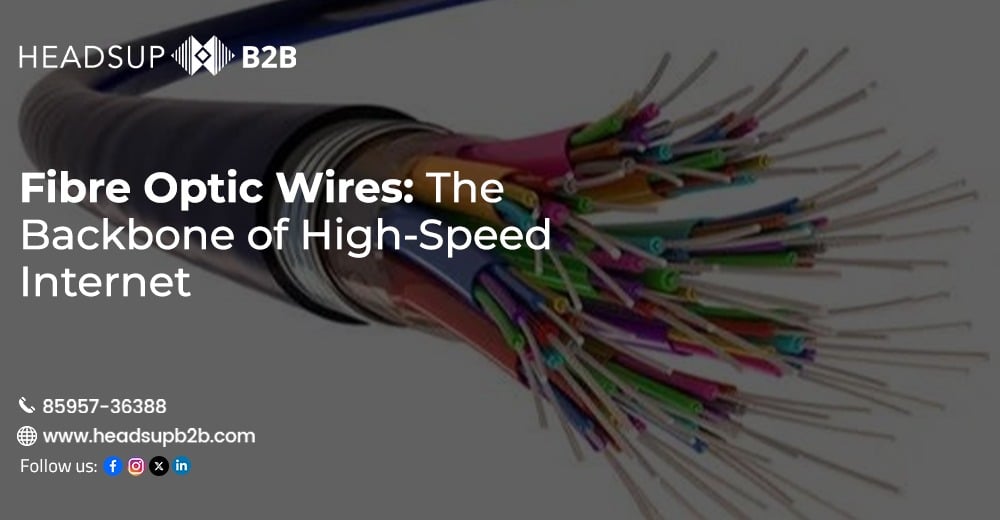
  • Fiber Optic Wires: The Backbone of High-Speed Internet

    Fiber Optic Wires: The Backbone of High-Speed Internet

    In today’s world where everything is time-sensitive, the internet speed has to be faster. Entertainment and commerce are just two sectors that the significant use of the Internet. fibre optic cable plays a crucial role in the huge data. In this blog of Headsup B2B, we’ll discuss the basics of fibre optic cable and why they have become the primary structure of high-speed internet.

    Introduction

    Consequently, high-speed internet is a necessity in today’s world. Whether it is watching series online, doing office work, or scrolling through the website, we need proper internet connectivity. But what enables such a result? The answer is somewhere in fiber optic cable. They are minute, thin and highly pliable cables made of glass or plastic. Perhaps the most underrated but indispensable component of the modern world due to their capacity to transfer humongous data at remarkable speed. Let’s learn about what fiber optic cable are, and their working principle and importance in today’s high-speed internet connection.

    Fiber Optic Cable

    Definition and Basic Structure

    Fibre optic cables are thin wires, made of either glass or plastic and are identified as carrying data through lights. Other cables that have often been used are copper cables, which also convey data by electrical signals. But fiber optic cables use light in the form of pulses, giving greater efficiency in passing data. These cables consist of a primary conductive core in which the light travels while the outer cover is called cladding. Cladding helps to reflect light to the core without much socket loss. This construction allows fiber optic cable to carry all kinds of data to and from terminals and stations over even at enormous distances.

    How They Differ from Traditional Copper Cables?

    Fiber optic cables are different from copper cables which use wires made of metals for conducting electrical signals; on the other hand fiber optic cables provide signals through optical fibers made of glass or plastic. This fundamental difference gives fiber optics several advantages:

    • they can cover larger distances without fading,

    • they are not easily affected by electromagnetic interference,

    • They, therefore, allow much higher speeds, which is a requirement by today’s web and telecommunication networks.

    How Fiber Optic Cables Work?

    The Science Behind Light Transmission

    Fiber optic cables work on Total internal reflection (TIR). In this, the light signals change their directions along the walls of the glass or plastic core. This process makes the light ‘stay in the core’ and go for broad distances without signal decay. It says light moves through the core in the form of pulses. Each pulse relays a binary string of data bits 0s and 1s.

    The Role of Glass or Plastic Fibers in Fiber Optic Cable

    The element of a fiber optic cable often consists of either glass or plastic fibers in the middle of the cable. Glass fibers are used for long-distance transmissions because it experiences a lesser amount of attenuation as compared to plastic fibers. While plastic fibers are a bit more flexible and can be more useful in the shorter distances of fiber optic communications. Both type of fibers help in transmitting the light signals through the cable. The cladding layer in this structure prevents the light from crossing the core through TIR.

    Advantages of Fiber Optic Cables

    • Higher Speed and Bandwidth

    Fiber optic cables in the practices allow data rates far higher than the other cables commonly regarded as copper. This is made possible through light signals and speeds that go as high as gigabits per second (Gbps) and above to suit the current generation most especially with applications that require a large portion of data such as VoIP, video streaming, cloud computing, and online gaming.

    • Greater Reliability and Less Signal Loss

    Because of the transmission and path of light signals, the fiber optic cables undergo slow signal depreciation over great distances. This reliability makes it possible to have stable internet for streaming and better communication making fiber optic important for areas like health, and business among others which require a stable reliable internet.

    • Enhanced Security and Resistance to Interference

    However, while using the copper cables, distortion may occur because the cables are sensitive to electromagnetic interference (EMI) that emanates from nearby electrical equipment. The Fiber optic cables are not affected by EMI. This implicit security characteristic of the fiber optic cables makes the media suitable for securing data. It is mostly used where data ought to be guarded like governmental and military communication as well as company networks.

    • Longevity and Durability

    Fiber optic cables are amazingly resistant to environments such as moisture, temperature variations, and physical force. This longevity implies more service time and fewer instances of maintenance as compared to copper cables; thereby proving that fiber optics is an economical solution in the long run to the providers of telecommunication services and developers of communication infrastructures.

    Fiber Optic Cable in Everyday Use

    Examples of Applications in Homes, Businesses, and Public Infrastructure

    • Homes: Fiber optics enable high-speed internet access, supporting seamless streaming, gaming, and video conferencing without lag or buffering issues.

    • Businesses: Many enterprises rely on fiber optic networks for secure and fast data transmission, enhancing productivity through cloud computing, remote collaboration, and robust cybersecurity measures.

    • Public Infrastructure: Fiber optics play a crucial role in smart city initiatives, facilitating efficient public services like traffic management, surveillance systems, and emergency response networks.

    Impact on Communication, Entertainment, and Commerce:

    • Communication: Faster internet speeds and reliable connections enable real-time communication through video calls, instant messaging, and VoIP services, fostering global connectivity and collaboration.

    • Entertainment: Streaming services deliver high-definition content seamlessly, catering to consumer demand for quality entertainment experiences on multiple devices simultaneously.

    • Commerce: E-commerce platforms benefit from secure transactions and rapid data processing, ensuring smooth online shopping experiences and enabling businesses to reach global markets efficiently.

    The Future of Fiber Optics

    Upcoming Advancements and Innovations

    • Increased Speeds: Current research and development focus on the improvement of the speeds of the fiber optic transmission. Beyond the mentioned capabilities, with planned improvements, it can reach Tbps and over.
    • Advanced Materials: There are usually advancements in the materials sciences that could lead to the creation of better fiber optic cables such as those that would experience minor signal attenuation and interference.
    • Integration with 5G: Fiber optic networks are therefore expected to be instrumental in realizing 5G since they are required in the backhaul infrastructure required by such a superior wireless system.

    Potential Impact on Future Internet Speeds and Connectivity

    • Enhanced Connectivity: Fiber optics is going to further extend the internet connectivity, to the previously disconnected regions and make an even greater impact on global internet connections than ever before.
    • Scalability: Thus, fiber optic networks are capable of meeting the demands as the usage of data increases shortly, and have provisions for new applications like augmented reality, virtual reality, and IoT.
    • Economic Growth: Internet connection is expected to open up latent demand for economic needs such as innovation, entrepreneurialism as well as Internet-based business models across the economies.

    Headsup B2B: A Reliable Platform for Fiber Optic Cable

    Headsup B2B is well know and trustworthy online platform for buying fiber optic cable. We have a variety of products from world-class manufacturers and trusted suppliers. Our team helps the customers in making the right choice and assist them throughout the procurement process. You can place your order, make easy payments, and even track the procurement procedure through our user-friendly platform. So, visit today and place your order now!