Tag: building materials

  • How to Choose the Right Building Material Supplier for Your Projects

    How to Choose the Right Building Material Supplier for Your Projects

    The backbone of any construction project is the quality of its materials. And for the same reason, you must partner with a trustworthy building material supplier. A dependable supplier helps you complete the project within your timeline and budget while meeting the quality benchmark. At Headsup B2B, we understand the high importance of procurement in the infrastructure industry and how crucial a good supplier relationship is for the project’s success.

    Why Choosing the Right Supplier Matters?

    Building construction materials are the core of any construction project and there can be no compromise when it comes to their quality.. Supreme quality building construction materials mitigate structural failure, ensure safety and save on future repair costs. A trustworthy building material supplier ensures:

    • Consistent, High-quality: Materials that adhere to industry standards and project specifications.

    • On-Time Delivery: Avoiding project delays by delivering materials precisely when needed.

    • Cost-Effective Options: Balancing budget-friendly pricing with superior quality.

    • Custom and continued Support: Expert recommendations matching your project’s needs.

    Factors to Consider When Choosing a Supplier

    1. Material Quality and Standards Compliance

    High-quality building construction materials are critical for a project’s success. Choose the right and trusted building material supplier, who can guarantee materials that meet the highest quality standards and comply with industry standards. Request documentation or samples to verify compliance. For instance, when choosing a construction material supplier of products such as cement, go for a supplier with BIS-certified products, bulk purchase options, and comprehensive test reports. Reliable suppliers are transparent about their processes and certifications.

    2. Proven Reputation and Experience

    A building material supplier’s reputation indicates their reliability and expertise. Seek out reviews, testimonials, and case studies to understand their credibility. Long-standing suppliers are more likely to have streamlined their processes and earned the trust of their clients. The key questions you must ask should include

    • How extensive is their experience in the industry?

    • What kinds of projects have they worked on?

    • References from or a portfolio of previous projects

    3. Pricing Clarity and Fairness

    Cost plays a vital role in supplier selection and clarity in pricing is as important. Partner with suppliers that provide transparency in costing with detailed and competitive cost breakdowns, without hidden fees. Trustworthy suppliers ensure their price quotes are clear and itemized to plan effectively.

    4. Reliable Delivery Services

    The success of your project depends on meeting deadlines effectively, so timely delivery of materials is important. Evaluate the supplier’s ability to handle logistics effectively and ask about contingency plans for potential delays. Consider factors such as the supplier’s logistical strength, fleet size, storage facilities, and the distance between their operations and your project size.

    5. Commitment to Sustainability

    As green construction is at the forefront of the modern construction industry, partnering with an eco-conscious supplier with ethical sourcing policies is a smart move. The choices benefit the environment and position your company as a leader in sustainability.

    6. Reliable Customer Service & Support

    The supplier’s willingness and responsiveness to manage unforeseeable issues during your project can have a significant impact on the project’s success. Choose a supplier, after assessing their communication channels, availability, and after-sales service to ensure you have all the support needed to overcome challenges effectively and swiftly.

    5 Steps to Vet a Building Material Supplier

    1. Define Your Needs

    Identify the type and quantity of your materials, along with a timeline for supplier selection.

    2. Research Suppliers

    Utilize Headsup B2B and research industry directories to find credible supplier options.

    3. Get Proposals and Samples

    Request for proposals, certifications, and product samples to evaluate a supplier’s offerings.

    4. Assess Infrastructure Support

    Assess the supplier’s facilities, and inspect storage, inventories, and processes to verify reliability.

    5. Make it Official

    Negotiate detailed contracts and outline clear terms for quality and delivery.

    Potential Delays & Pitfalls

    • Lack of Transparency: Suppliers may be reluctant to share certifications or test reports, indicating potential issues with transparency or compliance.

    • Communication Challenges: Delayed responses or unclear answers suggest potential reliability and communication issues.

    • Negative Market Reputation: Patterns of negative market feedback about quality or delivery indicate deeper concerns about the supplier’s performance.

    • Unrealistic Pricing: Unrealistic prices and offers that seem too good to be true often come at the cost of quality and can lead to unexpected issues.

    At HeadsUp B2B, we make supplier selection seamless with

    • Access to Trusted Suppliers: A curated network of pre-vetted, dependable partners.

    • Easy Comparisons: Transparent pricing and detailed product listings at your fingertips.

    • Efficient Logistics: Robust support for on-time, hassle-free deliveries.

    • Sustainable Choices: A wide range of eco-friendly materials to align with your sustainable values.

    The Headsup Difference

    Choosing Headsup B2B takes out the guesswork of selecting the right building material and provides you with a strategic partner. At Headsup B2B, we understand the importance of quality and provide the tools and the support that is needed to succeed. Let us help you streamline your procurement process and aid in securing the best material for the success of your project. Contact us today at +91 93133 06060 or info@headsupb2b.com!

    FAQs

    1. Why is it important to choose the right building material supplier for my construction project?
    Choosing the right supplier ensures you receive high-quality materials that meet project specifications, are delivered on time, and at competitive prices. This helps avoid delays, ensures the project’s structural integrity, and reduces overall cost.

    2. What are the key factors to consider when selecting a building material supplier?
    The key factors include high-standard material quality, the supplier’s reputation, experience, comprehensive material selection, pricing transparency, reliable delivery services, commitment to sustainability, and excellent customer service.

    3. How do I verify a supplier’s credibility and quality of materials?
    Look for documentation such as certifications (e.g., BIS-certified products), test reports, samples, and case studies. A reputable supplier will be transparent about their processes and provide evidence of industry compliance and a portfolio of successful projects

    4. What role does sustainability play in choosing a building material supplier?
    Sustainability is becoming increasingly important in construction. Partnering with a supplier committed to ethical sourcing and eco-friendly materials helps reduce environmental impact and positions your organization as a leader in green construction.

    5. How does HeadsUp B2B simplify the supplier selection process?
    HeadsUp B2B offers a curated network of pre-vetted suppliers, making comparing prices and products easier. We provide access to reliable suppliers with proven track records of supplying high-quality products, support for timely deliveries, and sustainable options for your project needs.

  • Top 10 Building Material Suppliers in Delhi 
| Fueling Infrastructure Growth

    Top 10 Building Material Suppliers in Delhi | Fueling Infrastructure Growth

    New Delhi, India’s administrative, financial, and industrial hub, is expanding rapidly to meet its growing infrastructure demands. As the capital city witnesses an influx of migrants and an increase in population, its strategic importance is further elevated by its role as the political epicenter of the nation. The city has projects of national importance such as the construction of the new parliament building, administrative blocks, and state houses underway. Due to the growing population and in-migration, the infrastructure needs of the city have grown, multi-fold.

    To cater to these demands, numerous building material suppliers in New Delhi are providing innovative and high-quality products. In this blog, we will explore the top 10 construction and building material suppliers in Delhi contributing to the city’s dynamic growth.

    Top Building Material Suppliers in Delhi

    1. Dalmia Bharat

    Damia Bharat is one of the leading cement companies in Delhi NCR and all over India. It was established in the year 1985 at Delhi. The company has an installed capacity of 37 MTPA. Dalmia Bharat offers all the building construction materials such as PPC, PSC, OPC, etc. The company has 80 years of experience in the cement business and sustainability is at the core of its business. Dalmia has the vision to be carbon-negative by the year 2040.

    2. Kajaria Ceramics

    Kajaria Ceramics leads the ceramics market with high-quality ceramic and vitrified tiles that are used on walls and floors. Its products are used in both residential and commercial projects. The company has its production units in more than one location in the Indian territory namely UP, Rajasthan, Telangana, Andhra Pradesh, and Gujarat. All the plants are highly sophisticated and equipped with the latest technologies such as automation and robotics. It has a production capacity of vitrified tiles of 1.40 million square meters per annum.

    3. Greenlam Industries

    Since 2013, Greenlam Industries has been a leading provider of laminates, decorative veneers, and engineered wood flooring. With a turnover exceeding ₹1,650 crore and a workforce of 3,500 employees, the company’s products are known for their aesthetic appeal and durability, meeting the needs of both modern and traditional architecture in New Delhi.

    4. Headsup B2B Pvt Ltd

    Headsup B2B was founded in 2022 with a vision to simplify procurement by connecting buyers and sellers. It specializes in end-to-end solutions, ensuring high quality materials, operational excellence, and financial support. Headsup B2B helps strengthen their supply chain efficiently. The vision to revolutionize building material supplier’s domain has enabled the company to expand its client base across Delhi NCR and Pan India.

    5. Gold Plus Glass Industry Limited

    Based in Rohini, New Delhi, Gold Plus Glass Industry Limited specializes in high-quality glass products, including clear float glass, reflective glass, and acoustic glass. With manufacturing facilities in Roorkee and Belgaum and a daily production capacity of 2,050 tonnes, the company caters to diverse sectors such as construction and automotive, making it a major player among construction and building material suppliers.

    6. Shalimar Paints

    Founded in 1902, Shalimar Paints is India’s first paint manufacturing company. Known for its emulsions, primers, varnishes, and industrial coatings, the company’s products have been used in iconic buildings like the Howrah Bridge and Rashtrapati Bhavan. Shalimar Paints remains a preferred choice for both heritage and modern projects.

    7. JK Lakshmi Cement

    JK Lakshmi Cement has been a leader in the cement industry since 1982. With an annual capacity of 13.9 million metric tons, the company provides a wide range of products, including regular Portland cement, ready-mix concrete, and AAC blocks. Its sustainable practices make it a reliable partner for Delhi’s growing infrastructure needs.

    8. Steel Infra Solutions Pvt. Ltd (SISCOL)

    Established in 2017, SISCOL specializes in structural steel solutions for large-scale projects such as industrial complexes, airports, and high-rise buildings. With advanced fabrication facilities in Bhilai, Chhattisgarh, the company is known for precision engineering and innovative designs. SISCOL’s contributions to major projects in Delhi make it an indispensable name among construction and building material suppliers.

    9. Action TESA

    A part of the action group, action TESA is a leader in engineered timber panel products with MDF boards, particle boards, and laminated floors. With an annual manufacturing capacity of 750,000 cubic meters, the enterprise is well known for its technological improvements. It is a trusted name in the Delhi furniture and construction industry.

    10. Acro Paints

    Founded in 1989, Acro Paints focuses on architectural paints, high-overall performance coatings, and decorative finishes. With a strong distribution community of over 3,000 sellers, Acro Paints is dedicated to durable and good-quality solutions, making it a trusted brand among Delhi’s builders and architects.

    Conclusion

    New Delhi is growing due to its strategic location and political importance. To cater to the infrastructure growth, industry giants like Dalmia Bharat and Kajaria Ceramics to modern players like Headsup B2B, have enabled access to innovative and diverse range of building construction materials. These companies are expanding the national capital’s skyline with a focus on quality, sustainability, and efficiency. As it continues to develop, the building material suppliers remain pivotal to its success.

    At Headsup B2B, we are dedicated to simplifying the procurement and fulfillment process, ensuring high-quality products and seamless operations. With a focus on reliability and efficiency, we connect businesses with the right solutions to support growth and enhance operational success. Our end-to-end services are designed to optimize supply chains, driving long-term value for our partners.

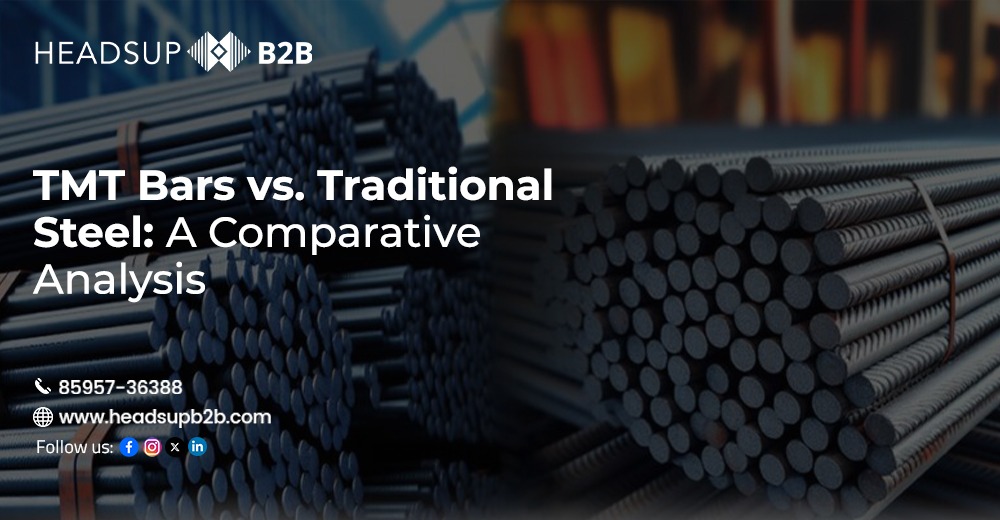
  • TMT Bars vs. Traditional Steel: A Comparative Analysis

    TMT Bars vs. Traditional Steel: A Comparative Analysis

    It almost seems impossible to construct anything without steel and steel rebar. Classical rebars, or iron rods, are dependable building components that continue to withstand the test of time in old, robust structures. Headsup B2B – a B2B marketplace providing TMT steel bars and other construction materials knows the value of these materials for your project. In this blog post, the important points that distinguish TMT steel bars from conventional ones will be highlighted with a brief on why TMT is a preferred option for the modern construction.

    Introduction

    Advancements in technology over the course of the twentieth century introduced many changes to construction. Among the most significant is the use of TMT steel bars as the most recommended construction steel bar. These bars are used for reinforcement of concrete structures and are supplementary reinforcements other than steel bars. Interested in why such a difference? The key differences lie in the raw materials and the manufacturing process. Let’s look at how TMT steel bars differ from conventional steel bars and why TMT bars are usually preferred.

    Understanding TMT Steel Bars and Traditional Steel Bars

    TMT Steel Bars?

    TMT bars are reckoned as the modern generation of construction materials that are characterised by high strength and durability. This is made possible by heat treatment followed by rapid cooling, something that reduces the impurities by using virgin iron ore.

    Traditional Steel Bars?

    Conventional bars are the foundation of traditional construction and are usually mild steel. They receive no treatment and can’t brag about any design advantages.

    Learn More:- 10 Steps to Finding the Best TMT Bars in India

    Manufacturing Process

    TMT Steel Bars: Manufacturing Process

    High-strength reinforcement bars are called thermo-mechanically treated, or TMT, bars. TMT bars are manufactured using rolling, water quenching, atmospheric cooling, and self-tempering techniques. These processes are critical to producing high-quality TMT bars. The quality of rolling mills, quenching systems, tempering processes, and raw materials all contribute significantly to the quality assurance of TMT bars. The top producers of TMT bars give careful consideration to these phases and elements to create exceptional, unrivalled goods.

    Traditional Bars: Manufacturing Process

    High Yielding Strength Deformed TMT steel bars. After heat treatment, these conventionally used steels are manufactured via a cold twisting technique. The TMT steel bars acquire physical imperfections as a result of the cold twisting procedure. There are various benefits to these deformations.

    Difference Between TMT Steel Bars and Traditional Bars

    Strength

    TMT steel bars significantly increase strength, which makes them perfect for the structural demands of today. Even though they are dependable, traditional bars might not be as strong. Although steel TMT bars remain the only material used in modern buildings, the newer grades are making it even more practical and aesthetically pleasing.

    Flexibility

    Like a skillfully performed dance, TMT steel bars give flexibility in addition to strength. In the construction of bridges, tunnels, coastal buildings, and marine projects, TMT bars are the preferred choice, meeting all requirements effectively. Available in various sizes and weights, they offer tailored solutions, and their superior concrete adhesion, as seen in VRKP’s dual-ribbed design, instills confidence in engineers.

    More simplistic applications might be better served by traditional bars, which are robust but less agile.

    Ductility

    Any material’s ductility is its capacity to undergo deformation without collapsing, even after it has reached its breaking point. When it comes to preventing structural collapse in construction constructions, TMT steel bars are more ductile than TOR Steel. TMT steel bars also contribute to a building structure’s increased strength because of their exceptional strength.

    Elongation

    Any material’s ability to extend before failing is known as elongation. This component is crucial in determining any bar’s ductility. The more the elongation, the greater the ductility and, consequently, the reduced likelihood of any structural structure being damaged. TMT steel bars improve the safety of your projects because they are longer than traditional bars.

    Fire-Resistance

    Low thermal stability makes traditional steel bars incapable of withstanding high temperatures. However, TMT bars’ greater thermal stability allows them to hold onto almost 80% of the surrounding temperature, assisting in the safety and security of construction projects in the event of a fire.

    Corrosion Resistance

    TMT bars include an edge that is naturally resistant to corrosion. Longevity is ensured by the protective layer formed during the treatment procedure, particularly in demanding situations. When purchasing building materials, one should take into account exposure to dampness, water seepage, and salt water. Because of the unique chemical treatments, steel TMT bars are your best option, but typical bars in construction need a little extra care to prevent rust.

    Which TMT steel or traditional bars are best for your project depends on its particular requirements. TMT steel bars improve green buildings by using environmentally friendly procedures. While classic bars offer unparalleled dependability, they add a contemporary twist with their strength, flexibility, and resistance to corrosion.

    Headsup B2B is an online platform for the best TMT steel bars. We provide TMT bars from trustworthy suppliers and manufacturers. We also offer expert assistance and a wide range of TMT steel bars that can cater for your specific projects. So, visit Headsup B2B and place your order now!

  • The Influence of River Sand on the Cost and Quality of Construction

    The Influence of River Sand on the Cost and Quality of Construction

    Today’s engineers emphasise building a sustainable project using this vital raw material in the construction sector. Made primarily of small fragments of broken-down rocks, corals, or shells, river sand is a loose, fractured natural substance. A typical ingredient in concrete mixes is river sand. River sand has less clay and silt, which gives producers better control over the workability and calibre of the concrete and mortar. In this blog, the experts at Headsup B2B will explain its properties, and the effect it has on the cost and quality of building materials.

    What is River Sand?

    Sand from rivers occurs naturally. River sand forms naturally due to overmining, weathering, or erosion processes, in contrast to other forms of sand made by crushing rock. It often has a coarse gradation; however, this can vary. It may be used for many landscaping and construction projects, including filling drainage basins, concrete sand, and arena foundations. Usually, silica sand from quartz is the main component since it is composed of the same substance as the nearby rock that it was eroded from.

    Properties of River Sand

    Workability

    The smooth, rounded grains contribute to its workability. Using construction materials in mortar and concrete mixes facilitates easier mixing, placing, and finishing.

    Gradation

    The term “gradation” refers to the distribution of particle sizes in sand. With well-graded sand and a balanced particle size distribution, concrete mixes can pack better and have a reduced chance of segregation.

    Cohesive and load-bearing capacity

    Because river sand frequently possesses excellent cohesiveness and bearing ability, it may be used in a range of construction applications, including road construction and foundation layers.

    Angular

    Compared to crushed or manufactured sand, it is more rounded. The concrete’s spherical form may have an impact on its strength and ability to tolerate specific stresses.

    Low Permeability

    Because river sand is not very porous, it has poor permeability. This feature might be helpful in gardening and building projects where drainage is an important consideration.

    Cost Implications of Using River Sand

    It has excellent quality, which makes it the most popular choice of builders in the construction industry, but it tends to be more expensive than other types of sand. With varying regions and availability, river sand prices vary, making it an important consideration in construction budgets.

    Factors Influencing the Price

    Several factors affect the cost of river sand:

    • Transportation: Transporting it from its source to the construction site can be costly, especially if the site is far from the river.

    • Sourcing: The method and location of extraction impact the price. Sand sourced from areas with strict regulations or limited supply tends to be more expensive

    • Demand and Supply: High demand for this sand, coupled with limited availability, often drives up prices.

    Comparison of River Sand with Alternative Materials

    River sand is generally more expensive than manufactured sand or crushed stone, while artificial sand is cheaper but may offer different quality, and crushed stone may require more processing.

    Long-Term Cost Benefits

    Investing in high-quality sand offers long-term benefits due to its superior binding properties, cleanliness, and durability, reducing maintenance and repair costs and enhancing construction project efficiency, offsetting its initial higher cost.

    Quality Impact of River Sand on Construction

    How it Enhances Concrete Strength:

    River sand is known for its ability to enhance the strength of concrete. Its fine particles provide a smooth texture, ensuring better mixing and binding with cement. As a result, concrete constructions become stronger and more resilient and can tolerate large loads and inclement weather.

    Benefits of the Fine Texture and Clean Composition

    The smooth texture of river sand gives a better finish on surfaces, and this property makes it ideal for plastering and other finishing works. Additionally, river sand is typically free from impurities like clay and silt, which can weaken the concrete. This purity guarantees integrity and strength.

    Comparison Between River Sand vs M-Sand

    Why Headsup B2B is the Go-to Platform for Sourcing River Sand

    Headsup B2B is a prominent online platform for sourcing construction products, offering several key advantages that make it your go-to choice.

    • Quality Assurance

    Headsup B2B ensures that all the river sand on its platform meets high-quality standards.

    • Easy Sourcing Process

    The user-friendly interface of Headsup B2B makes the sourcing process straightforward and efficient. You can easily browse, compare, and select from the options to meet your specific project needs, all from the comfort of your home.

    • Excellent Customer Support

    Headsup B2B provides exceptional customer support to assist you throughout the sourcing process.

    • Competitive Pricing

    Headsup B2B offers competitive pricing for, helping you manage your construction costs effectively.

    Choosing Headsup B2B for sourcing river sand means opting for quality, reliability, and efficiency, making it the smart choice for all your construction needs.

  • Adhesives in Construction: Bonding Materials for Durability

    Adhesives in Construction: Bonding Materials for Durability

    In today’s constantly evolving construction industry, adhesives are the most important yet overlooked material. These seemingly humble materials play a pivotal role in ensuring the durability and longevity of structures worldwide.

    Adhesives, with their ability to seamlessly bond materials together, enhance buildings’ structural integrity and contribute to their aesthetic appeal. If you are looking for high-quality adhesives for construction projects,

    Headsup B2B is an online platform that provides a wide range of construction materials and adhesives from the most reliable construction adhesives suppliers.

    We connect construction adhesive suppliers with potential buyers and make the procurement process easy and smooth. In this blog, we will cover some important topics about adhesives like their types, uses, right procurement methods etc.

    What is Adhesive

    Construction adhesive is multipurpose, it helps to attach tile, moulding, and drywall, and also works as fixtures to walls, ceilings, and floors. It is often in tubes and used with caulking guns to join two surfaces together. The substance is as strong and reliable as rivets, screws, or nails.

    Types of Adhesive

    While selecting the appropriate glue for a project or repair, it’s critical to comprehend how various glue types behave with different materials. The types of adhesives you can use are as follows.

    • Epoxy Resin Adhesives

    • Hot Melt Adhesives

    • Acrylic Adhesives

    • Water-Based Adhesives

    • Solvent-Based Adhesives

    • Anaerobic Adhesives

    • Pressure Adhesives

    • Electrically Conductive Adhesives

    • Plastisol Adhesives

    • Thermoset Adhesives

    How to Choose the Right One for Your Project?

    Because every type of adhesive has unique properties, it is essential to consider the following factors when selecting the best adhesive.

    • Examine the surface type and condition because certain adhesives work only on porous surfaces and some suit nonporous ones.

    • The durability of the adhesive refers to its longevity. Even though environmental factors might impact durability, always choose adhesives that can last long.

    • The time taken by the glue to dry and cure is known as the drying and curing period. While there is no specific time for drying or curing, adhesives with quicker drying or curing will be a good choice if you have a certain time limit.

    • Choose the adhesive according to your needs and budget. You can also seek the help of experts like Headsup B2B to make your process easier.

    Applications of Construction Adhesives

    Here are some common uses of construction adhesives:

    • It helps in the adhesion of ceramic tiles

    • Used in carpet layering

    • Top-of counter Lamination and installation of veneers and laminates on interior furniture.

    • When mending a floor, adhesives work as the bonding layer between the substrate and the existing floor.

    • for the plasterboard lamination fastening process.

    • For HVAC, heating, ventilation, and air conditioning.

    • In prefabricated or manufactured houses.

    • Pre-finished panel fixing.

    • Repairing resilient or vinyl flooring.

    • Adhesives are also essential materials for repairing roof tiles and roofing systems.

    • Wall covering or wallpaper application as well as surface preparation.

    • Building materials and construction materials are included in the construction business.

    Headsup B2B: A Trustworthy Online Platform for Construction Adhesive Suppliers and Buyers

    Headsup B2B stands out as the top online platform for procuring adhesives, and here’s why:

    A Wide Range of Products from Prominent Construction Adhesives Suppliers

    Headsup B2B offers a vast range of adhesive products from reliable construction adhesives suppliers. Our platform offers you plenty of options to meet your specific project needs. Furthermore, we provide expert assistance to our customers for successful purchases.

    Easy-to-Use Platform

    The platform is designed with user-friendly navigation, making it simple to search for and find the right adhesives for your project’s needs. So, you can easily search for the product, select the category, and place the order.

    Transparent Pricing

    Headsup B2B provides transparent pricing information. Our platform also allows customers to compare prices from different construction adhesives suppliers and make informed purchasing decisions

    Efficient Procurement Process

    The professionals at Headsup B2B work with dedication and a customer-centric approach to streamline the procurement process. Our platform allows customers to quickly place orders, track shipments, and manage invoices, saving them time and hassle.

    Reliable Customer Support

    The platform offers reliable customer support to assist you with any queries or issues you may encounter during the procurement process.

  • AAC Block: Lightweight Construction Solutions

    AAC Block: Lightweight Construction Solutions

    Welcome to this extensive guide to AAC blocks – a lightweight and advanced construction technology also known as the backbone of the construction industry. AAC stands for Autoclaved Aerated Concrete. AAC blocks are not only bricks; they rather are niche, environmentally friendly products of the future. When it comes to the manufacture of AAC blocks, reliability stands out as a main aspect. Headsup B2B is an online platform that connects potential buyers with authentic AAC blocks manufacturers and suppliers. In this blog, we will discuss the AAC block and tips to find the right AAC blocks manufacturers.

    What is AAC Block?

    Fine aggregates, cement, and an expansion agent are the main ingredients of autoclaved aerated concrete (AAC), which gives the newly mixed material the appearance of bread dough. 8% of this kind of concrete is air. The material is moulded and cut into precisely dimensioned components in the plant where it is manufactured.

    Types of AAC Blocks

    The various AAC block types are as follows:

    Solid AAC Blocks

    Suitable for load-bearing applications, these blocks are dense and solid throughout.

    Aerocon AAC Blocks

    Aerocon AAC Blocks are perfect for non-load-bearing walls and partitions because of their lightweight design and cellular structure.

    AAC Hollow Blocks

    The hollow core design provides improved thermal insulation when used in both load-bearing and non-load-bearing walls.

    AAC Panels

    These are large, easily assembled panels that are used to build roofs and walls.

    AAC Lintels

    Made especially to make lintels and other structural elements.

    U-Blocks

    U-shaped for effective beam and lintel construction.

    Sound Insulation Blocks

    Designed for spaces that need to reduce noise, these blocks offer exceptional sound insulation.

    Thermal Insulation AAC Blocks

    They are designed to improve thermal insulation and support the use of energy-efficient building materials.

    Benefits of Using AAC Blocks in Construction

    Among the benefits of AAC Block are

    • Makes handling simpler and building more quickly.

    • Has superior thermal insulating qualities for increased energy effectiveness.

    • Contributes to the general safety of the structure by offering strong fire resistance.

    • Provides excellent sound absorption, resulting in calmer interiors.

    • Shows tenacity by fending against pests and deterioration.

    Applications of AAC Blocks

    Here are some significant uses of AAC blocks

    • The vital element in the construction of residential and commercial buildings.

    • It is used in warehouses and industrial facilities.

    • AAC blocks are often used in institutional buildings such as schools, hospitals, and other facilities.

    • Because of their remarkable durability and robustness, AAC blocks are the main component of infrastructure projects, such as tunnels and bridges.

    • Perfect for the construction of thin internal walls.

    • AAC clocks are ideal for reducing the structural load while designing high-rise structures.

    • It is also used in a variety of contexts for noise reduction.

    How to Procure AAC Blocks from Right AAC Blocks Manufacturers

    When procuring AAC blocks for your construction project, it’s crucial to follow these essential tips:

    Calculating Required Quantities

    Before placing your order, accurately calculate the quantity of AAC blocks needed for your project. Overestimating or underestimating can lead to delays and extra costs.

    Planning Delivery and Logistics

    Coordinate with your supplier to plan the delivery schedule and logistics efficiently. Consider factors like transportation, site access, and storage space for smooth delivery of the AAC blocks.

    Ensuring Proper Handling and Storage

    AAC blocks are lightweight but require careful handling to prevent damage. Store in a dry and well-ventilated area, away from moisture and direct sunlight, to maintain their quality.

    Seeking Expert Advice

    Don’t hesitate to seek advice from construction professionals or AAC block manufacturers. They can provide valuable insights and recommendations customised to your project requirements, helping you make informed decisions.

    By above tips, you can streamline the procurement process and ensure the successful integration of AAC blocks into your construction project.

    HEADSUP B2B: An Online Platform for Authentic AAC Blocks Manufacturers and Potential Buyers

    Headsup B2B stands out as the top online platform for AAC block manufacturers and buyers for several reasons:

    Extensive Network

    Headsup B2B boasts a vast network of AAC block manufacturers, offering buyers a wide range of options.

    Transparent Transactions

    Headsup B2B facilitates transparent transactions between manufacturers and buyers, providing clear pricing, terms, and conditions to foster trust and Accountability.

    Easy Procurement Process

    With user-friendly features and intuitive navigation, Headsup B2B simplifies the procurement process, allowing buyers to quickly find, compare, and purchase AAC blocks according to their specific requirements.

    Expert Support

    The platform offers expert support and guidance to both AAC blocks manufacturers and buyers, ensuring smooth communication and resolving any issues promptly.

    Quality Assurance

    The platform makes sure that all manufacturer’s records meet stringent quality standards, giving buyers peace of mind regarding the reliability and performance of the AAC blocks.

  • Aggregates: Essential Components for Durable Construction

    Aggregates: Essential Components for Durable Construction

    The rapid growth of cities has led to increased pollution, with large populations concentrated in urban areas. However, amidst this urban sprawl, a surprising resource emerges: high-quality construction aggregates like gravel and sand. These aggregates are produced from the recycling and demolition of buildings, contributing to the strength and durability of structures. As a result, basic construction becomes more manageable and efficient. Today, in this competitive market, finding reliable aggregate suppliers is quite challenging. So, Headsup B2B, a prominent online platform for aggregate procurement, is here. We have the best product options from authentic aggregate suppliers. Additionally, we offer expert selection guidance and support to buyers.

    Despite being the most essential element for construction, aggregates are the most underrated material. So, let’s uncover some basic yet important details about the construction aggregates in this blog post.

    What is Aggregate?

    ​Sand, gravel, crushed stone, and other particles added to concrete, mortar, and asphalt to enhance their qualities are collectively known as aggregates. Aggregate can be artificial or natural and comes in several forms, sizes, and types.

    There are several reasons why aggregates are significant

    1. They strengthen and prolong the life of building materials like asphalt and concrete. Aggregates provide stability and strength to handle large loads and adverse weather by acting as a sturdy foundation and binding agent.

    2. They are an economical choice for various building projects since they are easily accessible and cost-effective.

    3. They are adaptable to the particular requirements of a project. Aggregates may be used to make the perfect mixture for a given application since they are available in several sizes, forms, and varieties.

    4. The aggregates are also used for landscaping, agriculture, and decoration.

    Types of Construction Aggregates

    Aggregates are of two types:

    Natural Aggregates

    Natural resources, including crushed stone, sand, and gravel, are the sources of natural aggregates. They are frequently found in rock quarries, riverbeds, and glacial deposits. They are the result of geological processes.

    Artificial Aggregates

    By combining and processing recycled concrete, slag, fly ash, and other materials, artificial aggregates are made. , also known as man-made or synthetic aggregates. Crushing, screening, and grading processes produce aggregates with the right size, shape, and strength.

    Properties of Construction Aggregates

    • The aggregates have special sizes and shoes that affect their workability, durability, and use.

    • Different aggregates have different porosity levels, which affect their water-absorbing ability. High-absorption-rate aggregates make the final material more susceptible to degeneration, such as cracking.

    • Aggregate strength is based on how resistant it is to impact and crushing. The aggregate’s strength influences the material’s strength and durability.

    • Durability: Aggregates are resilient to weather conditions, including moisture exposure, freezing and thawing cycles, and general wear and tear. The durability of aggregate affects the final material’s durability.

    Application of Construction Aggregates

    Concrete

    A vital component of concrete is aggregates, which provide strength and durability to constructions like roads, bridges, and buildings.

    Building Foundations

    Aggregates are the main component of the base material for building a foundation. It provides stability and support for the weight of the structure.

    Rail Ballast

    Aggregates are also used at the base of railway tracks, providing stability and strength to the tracks.

    Landscaping

    In landscaping, aggregates are the main elements in the decoration of gardens, walkways, and paths. It adds an aesthetic look.

    Water Filtration

    Aggregates also play a vital role in water filtration by removing impurities.

    Asphalt

    Aggregates also provide a robust and long-lasting surface for asphalt for road paving that can tolerate heavy traffic.

    Erosion Control

    In erosion control, aggregates are used to stop soil erosion and guard against landslides.

    Drainage Systems

    In drainage systems, aggregates are a major element in creating a porous material that lets water pass through and reduces floods and water damage.

    Why Choose Headsup B2B for Procuring Construction Aggregates?

    Choosing Headsup B2B for your construction aggregate procurement offers numerous benefits for buyers and suppliers. For buyers, Headsup B2B provides a user-friendly platform where you can easily browse and compare a wide range of aggregate suppliers.

    Quality Product at a Reliable Cost

    Headsup B2B provides the best option, ensuring you find the best quality materials at competitive prices. With transparent pricing and easy ordering processes, you can organise your procurement workflow and save valuable time and resources. Additionally, Headsup B2B offers a secure payment system and reliable delivery options, giving you peace of mind that your aggregates will arrive on time and in top condition.

    Increasing Visibility of Authentic Aggregate Suppliers

    Headsup B2B offers a valuable opportunity to showcase your products to a large network of potential buyers. Our platform also provides tools and resources to help aggregate suppliers manage their product lists, track sales, and optimise their marketing strategies. Headsup B2B also enables suppliers to maximise profits and stay ahead of the competition. With its focus on simplicity, transparency, and efficiency, Headsup B2B is the ideal choice for buyers and suppliers looking to streamline their construction aggregate procurement process.