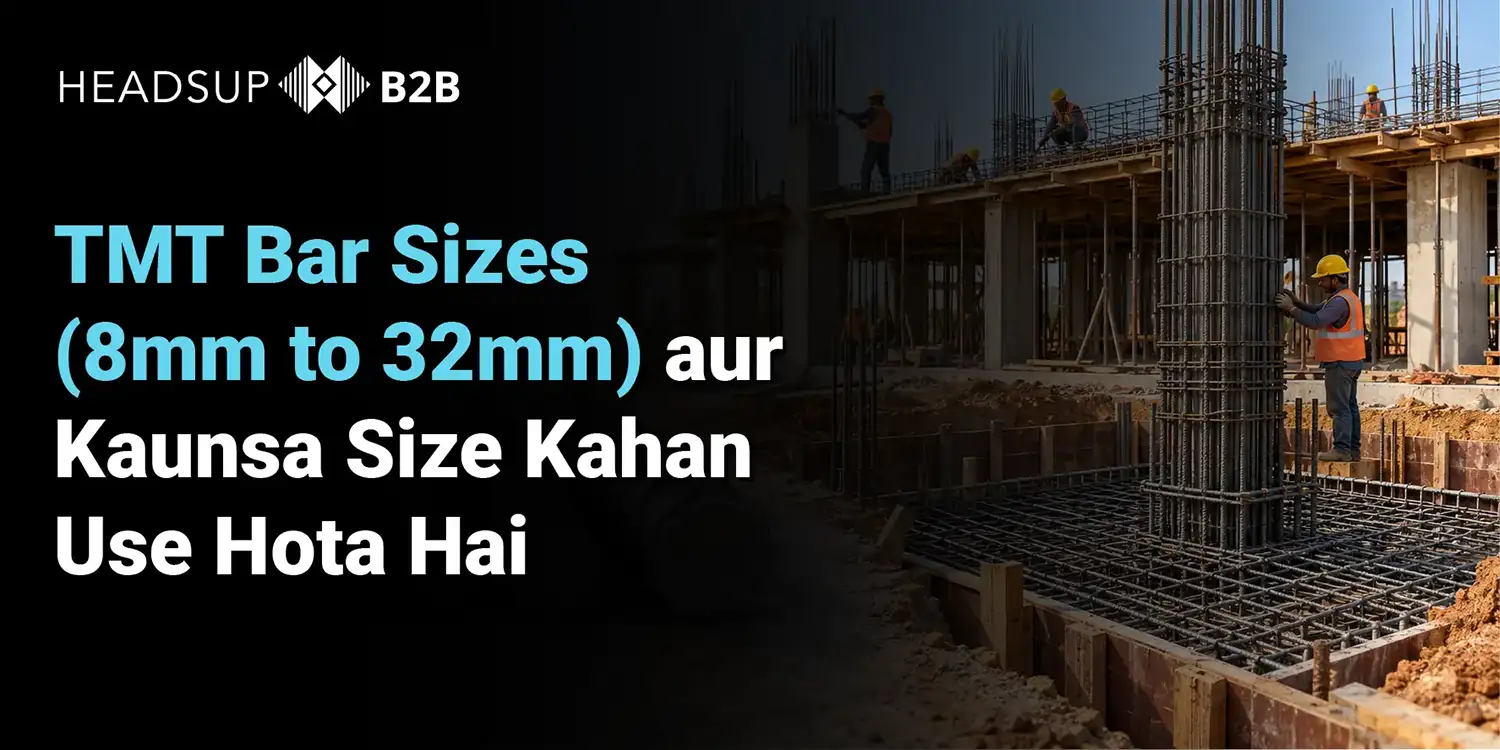
Every RCC structure uses a mix of TMT bar sizes — thin bars for stirrups and slabs, thicker bars for columns and foundations. Choosing the wrong size wastes steel or weakens the structure. This guide explains each size, where it is used, how much it weighs and what the code says.
Walk onto any building site and you will see bars of six or seven different diameters. Each has a job. Stirrups hold the main bars in place. Slab bars spread the load. Column bars carry it to the ground.
Getting the size right is not a matter of preference. It is set by the structural design and checked against the code. The drawing decides the size. This guide helps you read it, order it and check it.
1. TMT Bar Size Chart: 8mm to 32mm
| Size | Weight / metre (kg) | Weight / 12m bar (kg) | Approx. bars per tonne | Main use |
|---|---|---|---|---|
| 8mm | 0.395 | 4.74 | 211 | Stirrups, ties, slab bars |
| 10mm | 0.617 | 7.41 | 135 | Slabs, light beams, stirrups |
| 12mm | 0.889 | 10.67 | 94 | Columns, beams, slabs |
| 16mm | 1.580 | 18.96 | 53 | Columns, beams, footings |
| 20mm | 2.469 | 29.63 | 34 | Heavy columns, rafts, deep beams |
| 25mm | 3.858 | 46.30 | 22 | High-rise columns, bridges |
| 32mm | 6.321 | 75.85 | 13 | Infrastructure, deep foundations |
Larger sizes such as 28mm, 36mm and 40mm are also made, mainly for bridges, metros and heavy industrial structures. For grades and overall buying guidance, see the complete guide to TMT bars.
2. Which Size Is Used Where
The table below shows the sizes typically seen in residential and commercial RCC buildings. It is a general guide only — the structural drawing always overrides it.
| Structural element | Typical main bars | Typical secondary bars | Why |
|---|---|---|---|
| Footing / foundation | 10–16mm | — | Mesh at the base spreads column load into soil |
| Column | 12–20mm (higher for tall buildings) | 8mm ties | Main bars carry compression; ties stop them buckling |
| Beam | 12–20mm | 8mm stirrups (10mm for heavy beams) | Main bars take bending; stirrups take shear |
| Slab | 8–10mm (12mm in thicker slabs) | 8mm distribution | Thin members need thin, closely spaced bars |
| Lintel and chajja | 8–10mm | 8mm | Short spans, light loads |
| Staircase | 10–12mm | 8mm distribution | Inclined slab behaviour |
| Raft, retaining wall, high-rise core | 16–32mm | 10–12mm | Very high loads and moments |
⚠ DO NOT SUBSTITUTE SIZES ON SITE
- Replacing 12mm with 10mm to save cost reduces strength below the design.
- Replacing 12mm with 16mm “for safety” can congest the section and leave too little concrete cover.
- Any change in size or number of bars must be approved by the structural engineer.
- Keep the bar bending schedule on site and check against it.
3. What IS 456 Says About Bar Sizes
IS 456:2000, the Indian code for reinforced concrete, sets minimum and maximum limits that every design must respect. A few rules that directly affect bar size:
| Element | Rule | What it means on site |
|---|---|---|
| Column main bars | Diameter not less than 12mm | 8mm or 10mm cannot be used as main column bars |
| Column main bars | At least 4 bars in a rectangular column, 6 in a circular one | Minimum bar count regardless of load |
| Column steel quantity | Between 0.8% and 6% of cross-section (4% is the practical upper limit) | Too little or too much steel is not allowed |
| Column ties | Diameter at least ¼ of the largest main bar, and not less than 6mm | 8mm ties suit main bars up to 32mm |
| Column tie spacing | Not more than the least of: column’s smaller dimension, 16 × smallest main bar diameter, or 300mm | Closer spacing is common, especially in seismic zones |
| Slab bars | Diameter not more than ⅛ of slab thickness | A 125mm slab should not use bars thicker than about 15mm |
| Slab steel quantity | Minimum 0.12% of cross-section for high-strength deformed bars | Sets the minimum steel in thin slabs |
4. Size, Weight and Bars per Bundle
Bars are sold by weight but used by length. Converting between the two avoids over-ordering and billing disputes.
Weight per metre = D² ÷ 162, where D is the diameter in mm. For a 12mm bar: 12 × 12 ÷ 162 = 0.889 kg per metre, or about 10.67 kg per 12-metre bar.
IS 1786 also allows a tolerance on weight per metre, which is tighter for larger bars. Approximately ±7% for bars up to 10mm, ±5% for 10–16mm and ±3% above 16mm. That is why actual weighbridge weight can differ slightly from the theoretical figure.
Bundle size varies by mill and size. Smaller diameters come in bundles with more bars; larger diameters in bundles with fewer. Always bill on actual weighbridge weight or agree in writing on theoretical weight. Use the TMT bar weight calculator for quick conversions.
5. Worked Example: Steel in One Column
How much does size change steel quantity? Take one column, one storey high.
ILLUSTRATIVE STEEL QUANTITY (APPROX.) — ONE 230 × 300 MM COLUMN, 3 M HIGH
| Variable | Assumption | Approx. steel (kg) | Note |
|---|---|---|---|
| Closer ties | 8mm @ 100mm | ≈ 21.7 | Common near joints in seismic zones |
| ✓ Base case | 4 × 12mm, 8mm @ 150mm | ≈ 18.1 | Within IS 456 limits for this column |
| Wider tie spacing | 8mm @ 190mm | ≈ 16.7 | Near the code maximum; less confinement |
| More main bars | 6 × 12mm, 8mm @ 150mm | ≈ 23.5 | Higher load capacity |
| Bigger main bars | 4 × 16mm, 8mm @ 150mm | ≈ 26.4 | Higher load capacity; check cover |
A 4mm change in bar size can mean nearly half as much steel again. Size is a design decision, not a site decision.— Headsup B2B Procurement Research, October 2026
6. How Size Affects Price
Price per kg varies slightly with size. Thinner bars such as 8mm and 10mm usually cost a little more per kg because they take more rolling per tonne — a “size extra”. Thicker bars cost less per kg but more per piece because each piece is heavier.
Two practical points follow. First, check whether a quote applies to all sizes or only to 12mm and above. Second, price your full size mix, not a single benchmark size. For approximate current rates (inclusive of GST), see TMT bar price today in India.
7. How to Check Bar Size on Site
Read the markings
Bars carry embossed brand, grade and BIS licence markings. Bundle tags show size, grade and heat number.
Weigh a sample
Cut or measure a 1-metre length and weigh it. Compare with D²/162. A 12mm bar should weigh close to 0.889 kg per metre, within tolerance.
Do not rely on a tape across the ribs
Ribs make the bar look thicker than its nominal size. Weight is a more reliable check than measuring across ribs.
Check the mill test certificate
The MTC lists the size, grade and test results for each batch.
8. Ordering the Right Size Mix
Order from the bar bending schedule (BBS), not from rough estimates. The BBS lists every bar by size, shape and cutting length, so you can total the weight by diameter.
⚠ ORDERING CHECKLIST
- Total weight by size from the BBS — 8mm, 10mm, 12mm, 16mm and so on.
- Add a small allowance for cutting wastage and laps as advised by your engineer.
- Order all sizes together to avoid paying retail rates on small top-ups.
- Confirm grade (for example Fe 500D) is the same across all sizes.
- Ask for the MTC for each size and batch.
Headsup B2B supplies TMT bars from 8mm to 32mm in primary and BIS-certified secondary brands, with bulk delivery and credit for verified buyers. Explore TMT bars supply on the Metal Solutions page.
Get TMT Bars in Every Size You Need
- ✓ 8mm to 32mm in Fe 500, Fe 500D and Fe 550D
- ✓ Primary and BIS-certified secondary brands
- ✓ Full size-mix orders with bulk delivery
- ✓ Credit for verified buyers
Request a Quote →