Tag: 1 mw solar project

  • 7 Key Components of a Successful 1 MW Solar Project

    7 Key Components of a Successful 1 MW Solar Project

    A 1 MW solar power project meets high energy demands and is a practical and scalable sustainable solution. This amount of solar power lights up about 2,500-3,000 solar panels, based on their wattage. These projects can power manufacturing units, cold storage & warehouses, malls & corporate buildings.

    Relevance of Site Selection

    For site selection, factors such as sunlight availability and the environmental impact assessment are important. About 4-5 acres of sunlight is required for a 1 MW solar project.

    Feasibility Studies

    A feasibility study of various locations for solar energy generation potential includes studying solar radiation, calculating the levelized cost of energy, and evaluating the long-term project viability.

    Approvals

    Before setting up any solar power projects in India, it is mandatory to get the required approval from DISCOM and ensure that land use approvals have been obtained. ISO certification assures the quality of service.

    Technology Usage

    Technology plays an important role, and choosing the right photovoltaic panel depends on the cost and efficiency. To achieve 1 MW capacity, the number of panels required varies based on wattage

    Financing

    For financing a solar power project, it is vital to outline funding strategies such as equity, government subsidies, green bonds, and Power Purchase Agreements (PPAs). The cost of a 1MW solar power plant in India is Rs 4–5 crores, including the cost of solar panels, solar inverters and other vital components like combiners & junction boxes, and the cost of erection systems.

    Project Execution

    From sourcing the right materials to installation, commissioning and post-commissioning support, every phase depends on on-time project execution. End-to-end, successful project execution requires continuous monitoring and post execution follow up.

    Grid Integration and Maintenance

    Integrating solar power into the electrical grid is a multifaceted process that includes assessment of grid capacities, installation of suitable inverter technologies, adoption of power electronics, utilisation of smart meters, incorporation of energy storage solutions, and securing necessary permits, which is followed by maintenance considerations such as regular inspections, performance monitoring, upgrades and retrofitting, and grid resilience planning to ensure safety from harsh weather conditions and other emergencies.

    The Bottom Line

    Developing 1 MW of solar power projects is a challenging yet rewarding endeavour. With innovation and collaboration, solar energy can fuel sustainable growth. Solar power costs 18% less than coal-fired electricity and stands at ₹4.34 per kWh, proving to be a viable alternative that is cost-efficient and sustainable.

    Solar power is the future of energy. Power your project with a 1 MW solar energy project. Partner with Headsup B2B for seamless procurement, commissioning and post-commissioning services with Headsup B2B, ensuring reliable, efficient and scalable solutions for a cleaner tomorrow.
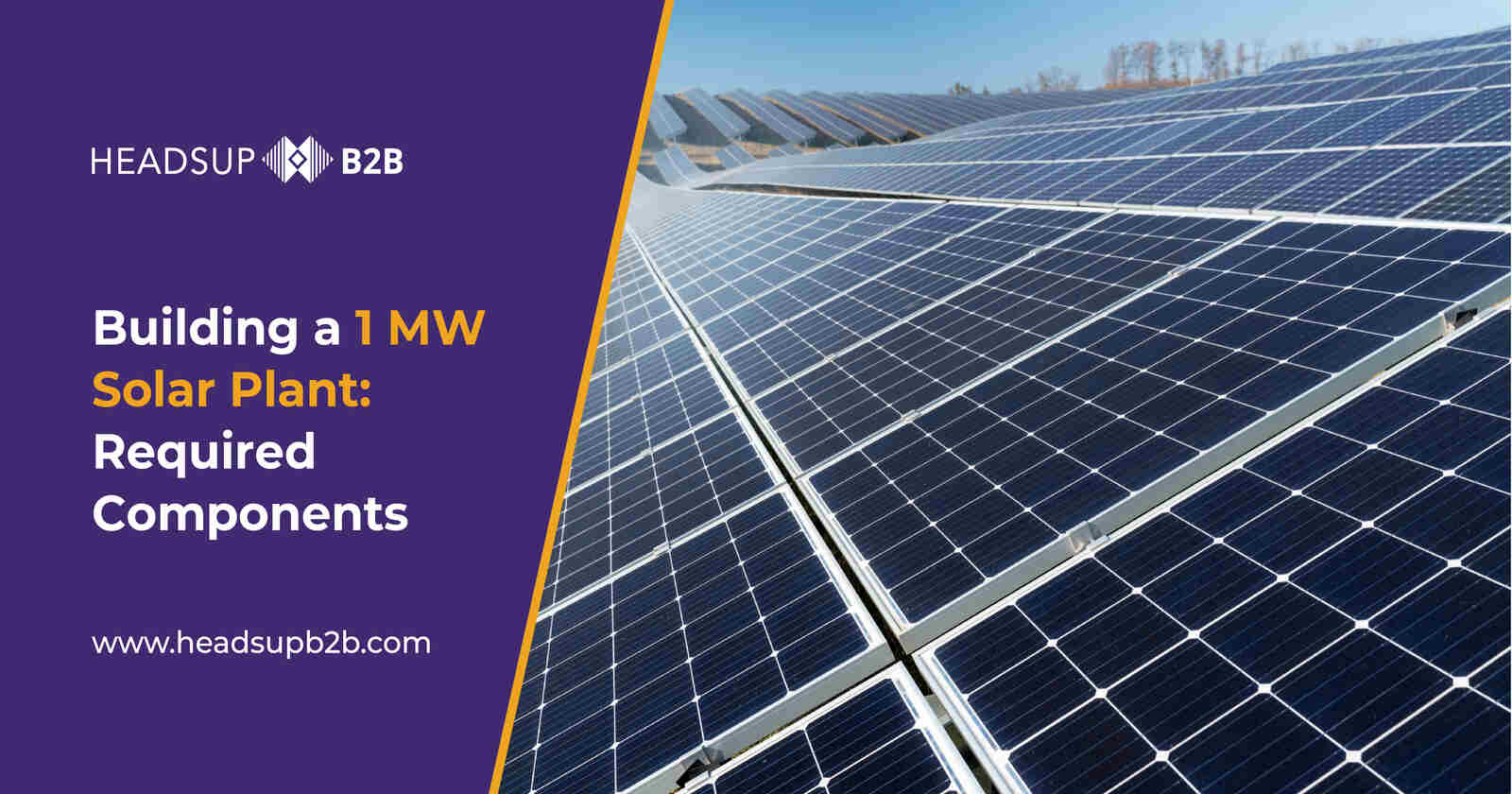
  • Building a 1 MW Solar Plant: Required Components

    Building a 1 MW Solar Plant: Required Components

    Imagine a nation that runs on clean energy and powers thousands of households, contributing to net zero emissions and reducing carbon footprints, healing the planet and combating climate change. The Indian government revised the goal of the National Solar Mission, in 2022 aims for the same.

    The new goal aims at significantly increasing the country’s renewable energy capacity. According to the energy generation and consumption trends, Solar power is expected to meet half of the world’s electricity demand by 2030, with 80% of the energy grid. This makes Solar a forerunner in combating climate change. With its significant contributions to the green energy revolution, how do we leverage it to make the greater vision a reality? The answer may lie in understanding how to build a scalable 1 MW Solar Power plant.

    Let us explore the various components required to build a 1 MW Solar plant.

    Why 1 MW Solar Power Plant?

    A 1 MW solar plant is a common benchmark for industrial and commercial energy needs, with a capacity to light up 2,500-3,000 solar panels, depending on their wattage. It provides a practical and scalable solution to meet high-energy demands. The panel efficiency is up to 22% in Monocrystalline or Polycrystalline panels.

    Building 1 MW of solar power projects is a challenging and rewarding endeavour due to its potential role in bridging the gap between current and  the future achievement of climate change goals. Its impact extends beyond power generation, contributing to a more sustainable and resilient energy landscape. With collaboration and innovation, solar energy can fuel sustainable growth. Solar power costs 18% less than coal-fired electricity and stands at ₹4.34 per kWh, proving to be a viable, cost-efficient and sustainable alternative to conventional energy sources.

    The electric power generated by solar panels is in direct current (DC) form. This form cannot be used to power most household electrical appliances. The three types of inverters are string inverters, microinverters and Hybrid inverters that are utilised in inverter systems. This scale of solar power may need multiple inverters with an efficiency of about 98%.

    Mounting System

    The need for secure attachment to a surface, roof or ground for the panels is fulfilled by robust mounting systems. The placement of this device ensures maximum sunlight absorption and, hence, increased efficiency. Mounting systems can be fixed or adjustable, with some even tracking the sun’s movement for increased efficiency. With a tilt angle of 15-30°, multiple mounting systems can be utilised for complete efficiency.

    Charge Controller: For a 1 MW solar power project, the charge controller plays a critical role in regulating the charging process. During the charging process, there is a chance that overcharging happens due to the excess flow of the current. To avoid this, charge controllers ensure optimal performance and battery longevity.

    Battery Storage: Sometimes, the solar energy generated is more than what is used. Battery storage helps save the excess solar energy that has been generated for future use. The excess solar power generated from 2,500 to 3,000 solar panels can be saved with the help of battery storage.

    A 1 MW solar plant offers a cost-effective path to India’s energy independence, with installation costs ranging from INR 4-8 crores, depending on the region. It is a sustainable investment. With a 25-year lifespan for solar panels and 10–15 years for inverters, it guarantees long-term energy savings and environmental benefits.