Category: Building Materials

  • Top 10 Building Material Suppliers in Delhi 
| Fueling Infrastructure Growth

    Top 10 Building Material Suppliers in Delhi | Fueling Infrastructure Growth

    New Delhi, India’s administrative, financial, and industrial hub, is expanding rapidly to meet its growing infrastructure demands. As the capital city witnesses an influx of migrants and an increase in population, its strategic importance is further elevated by its role as the political epicenter of the nation. The city has projects of national importance such as the construction of the new parliament building, administrative blocks, and state houses underway. Due to the growing population and in-migration, the infrastructure needs of the city have grown, multi-fold.

    To cater to these demands, numerous building material suppliers in New Delhi are providing innovative and high-quality products. In this blog, we will explore the top 10 construction and building material suppliers in Delhi contributing to the city’s dynamic growth.

    Top Building Material Suppliers in Delhi

    1. Dalmia Bharat

    Damia Bharat is one of the leading cement companies in Delhi NCR and all over India. It was established in the year 1985 at Delhi. The company has an installed capacity of 37 MTPA. Dalmia Bharat offers all the building construction materials such as PPC, PSC, OPC, etc. The company has 80 years of experience in the cement business and sustainability is at the core of its business. Dalmia has the vision to be carbon-negative by the year 2040.

    2. Kajaria Ceramics

    Kajaria Ceramics leads the ceramics market with high-quality ceramic and vitrified tiles that are used on walls and floors. Its products are used in both residential and commercial projects. The company has its production units in more than one location in the Indian territory namely UP, Rajasthan, Telangana, Andhra Pradesh, and Gujarat. All the plants are highly sophisticated and equipped with the latest technologies such as automation and robotics. It has a production capacity of vitrified tiles of 1.40 million square meters per annum.

    3. Greenlam Industries

    Since 2013, Greenlam Industries has been a leading provider of laminates, decorative veneers, and engineered wood flooring. With a turnover exceeding ₹1,650 crore and a workforce of 3,500 employees, the company’s products are known for their aesthetic appeal and durability, meeting the needs of both modern and traditional architecture in New Delhi.

    4. Headsup B2B Pvt Ltd

    Headsup B2B was founded in 2022 with a vision to simplify procurement by connecting buyers and sellers. It specializes in end-to-end solutions, ensuring high quality materials, operational excellence, and financial support. Headsup B2B helps strengthen their supply chain efficiently. The vision to revolutionize building material supplier’s domain has enabled the company to expand its client base across Delhi NCR and Pan India.

    5. Gold Plus Glass Industry Limited

    Based in Rohini, New Delhi, Gold Plus Glass Industry Limited specializes in high-quality glass products, including clear float glass, reflective glass, and acoustic glass. With manufacturing facilities in Roorkee and Belgaum and a daily production capacity of 2,050 tonnes, the company caters to diverse sectors such as construction and automotive, making it a major player among construction and building material suppliers.

    6. Shalimar Paints

    Founded in 1902, Shalimar Paints is India’s first paint manufacturing company. Known for its emulsions, primers, varnishes, and industrial coatings, the company’s products have been used in iconic buildings like the Howrah Bridge and Rashtrapati Bhavan. Shalimar Paints remains a preferred choice for both heritage and modern projects.

    7. JK Lakshmi Cement

    JK Lakshmi Cement has been a leader in the cement industry since 1982. With an annual capacity of 13.9 million metric tons, the company provides a wide range of products, including regular Portland cement, ready-mix concrete, and AAC blocks. Its sustainable practices make it a reliable partner for Delhi’s growing infrastructure needs.

    8. Steel Infra Solutions Pvt. Ltd (SISCOL)

    Established in 2017, SISCOL specializes in structural steel solutions for large-scale projects such as industrial complexes, airports, and high-rise buildings. With advanced fabrication facilities in Bhilai, Chhattisgarh, the company is known for precision engineering and innovative designs. SISCOL’s contributions to major projects in Delhi make it an indispensable name among construction and building material suppliers.

    9. Action TESA

    A part of the action group, action TESA is a leader in engineered timber panel products with MDF boards, particle boards, and laminated floors. With an annual manufacturing capacity of 750,000 cubic meters, the enterprise is well known for its technological improvements. It is a trusted name in the Delhi furniture and construction industry.

    10. Acro Paints

    Founded in 1989, Acro Paints focuses on architectural paints, high-overall performance coatings, and decorative finishes. With a strong distribution community of over 3,000 sellers, Acro Paints is dedicated to durable and good-quality solutions, making it a trusted brand among Delhi’s builders and architects.

    Conclusion

    New Delhi is growing due to its strategic location and political importance. To cater to the infrastructure growth, industry giants like Dalmia Bharat and Kajaria Ceramics to modern players like Headsup B2B, have enabled access to innovative and diverse range of building construction materials. These companies are expanding the national capital’s skyline with a focus on quality, sustainability, and efficiency. As it continues to develop, the building material suppliers remain pivotal to its success.

    At Headsup B2B, we are dedicated to simplifying the procurement and fulfillment process, ensuring high-quality products and seamless operations. With a focus on reliability and efficiency, we connect businesses with the right solutions to support growth and enhance operational success. Our end-to-end services are designed to optimize supply chains, driving long-term value for our partners.

  • Top 10 Construction Materials : Everything You Need to Know

    Top 10 Construction Materials : Everything You Need to Know

    Building Construction materials are essential components in construction, significantly influencing the strength, functionality, and aesthetics of structures. They encompass natural options like wood and stone, as well as manufactured materials such as concrete and steel, each serving unique purposes in diverse projects.

    10 Types of Building Materials Used in Construction

    Building a house, hospital, school, or commercial structure is an exciting journey that begins with selecting the right building materials. These materials are fundamental to the construction process, serving as the key elements that determine the strength, functionality, and visual appeal of structures.

    Building materials can be broadly divided into natural options, such as wood and stone, which have been used for centuries for their organic charm and reliability, and manufactured materials like concrete and steel, which have transformed modern construction with their exceptional strength and adaptability.

    The choice of building materials serves as the foundation of any construction project, influencing not only its durability and aesthetic appeal but also its functionality and longevity. In India, the diversity of structures—from Kuchcha or slush houses to ultra-modern city architecture—highlights the importance of selecting the right mix of materials for specific purposes. This diversity reflects the evolving needs of construction and the critical role that building materials play in achieving sustainable, efficient, and long-lasting outcomes.

    1. Concrete

    Concrete is one of the most widely used materials in construction, known for its durability and strength. Made by combining cement, water, and aggregates (sand, gravel, or crushed stone), concrete is versatile and can be poured into molds to form a variety of shapes. It is essential in constructing foundations, floors, walls, and other structural elements in buildings.

    2. Metal

    Metal is a vital material used in construction due to its strength, flexibility, and resistance to wear and corrosion. It is widely used in structural frameworks for high-rise buildings, bridges, and industrial structures. Steel provides a high strength-to-weight ratio, making it ideal for supporting heavy loads and providing stability in complex structures.

    3. Wood

    Compared to druthers like plastic and other engineered products, wood offers a great natural advantage. It is a traditional construction material valued for its natural aesthetics, flexibility, and ease of handling. Timber is used in framing, flooring, roofing, and cabinetry. It is renewable and offers a sustainable choice for various types of construction, particularly in residential and low-rise buildings.

    4. Brick

    Made of clay and mud bricks come in different shapes and sizes. They are a durable, fire-resistant building material made from fired clay. Bricks are commonly used for constructing walls, chimneys, and pavements due to their strength and thermal mass. They also offer aesthetic appeal, particularly for facades and decorative elements.

    5. Glass

    Glass is used primarily for windows, doors, and facades to allow natural light into buildings while providing a clear view of the outside. It is also utilized in modern architectural designs, where it is used in curtain walls and decorative panels. Advances in energy-efficient glazing, such as double-glazed windows, have improved glass’s insulating properties.

    6. Stone

    Natural stone, such as granite, marble, and limestone, has been used for centuries in construction due to its strength and visual appeal. Stone is commonly used for foundations, external cladding, flooring, and decorative elements. It is durable, low-maintenance, and provides excellent insulation.

    7. Cement

    Cement is a key ingredient in concrete and mortar. It acts as a binder that holds other materials together to form strong, durable structures. Cement is essential for creating roads, foundations, slabs, and plaster finishes. There are different types of cement available depending on the project requirements, including Portland cement and hydraulic cement.

    8. Aluminum

    Aluminum is a lightweight, corrosion-resistant material that is widely used in the construction industry for windows, doors, cladding, and roofing. Its strength and resistance to weathering make it an ideal choice for areas exposed to the elements, and it is often used in modern, energy-efficient building designs.

    9. Sand

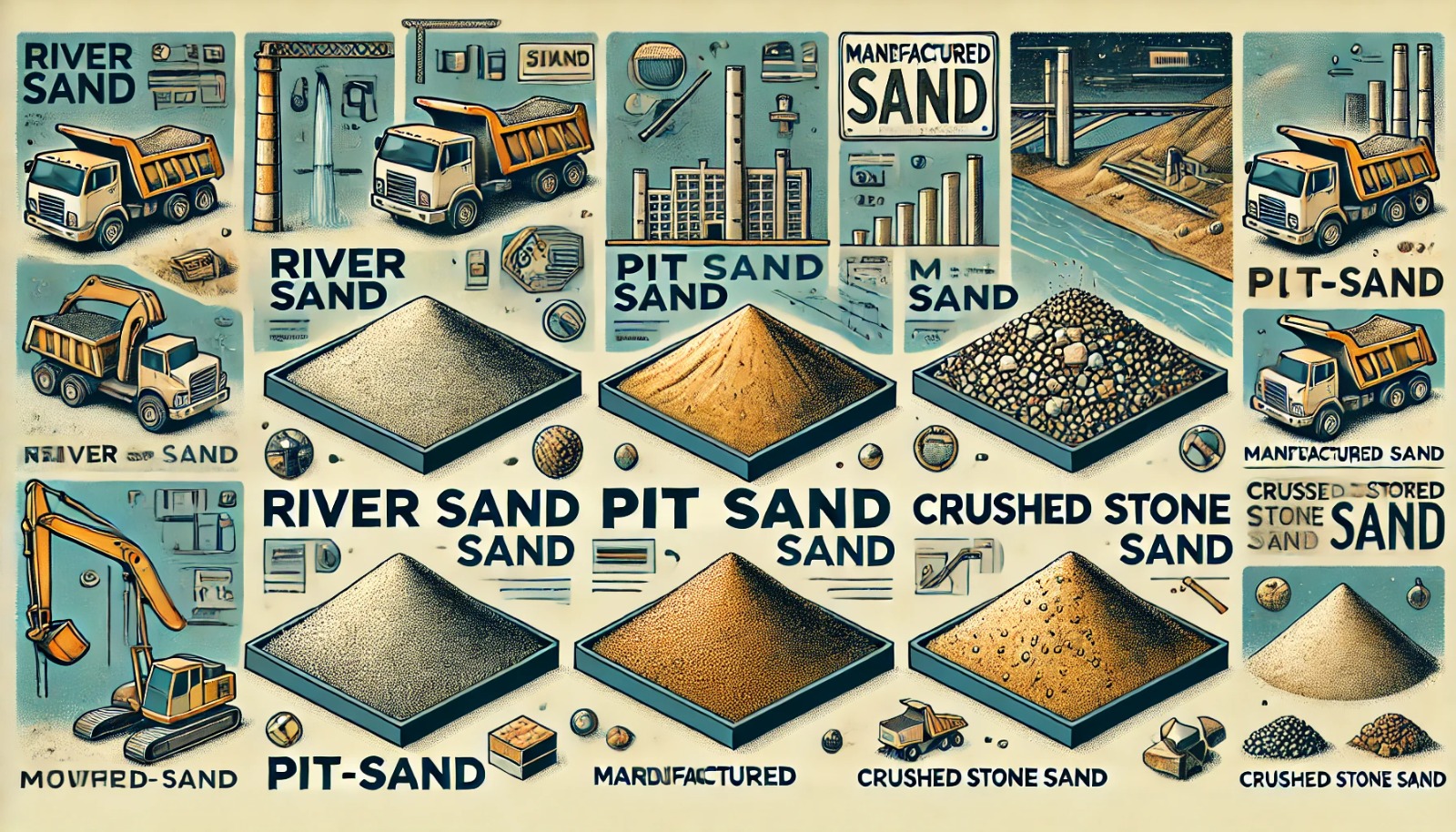
    Sand is a crucial building material in construction, primarily used in concrete, mortar, and plaster production. Its properties, such as particle size and shape, influence the strength and durability of structures. There are different types of sand: fine sand (for workability), coarse sand (for stability), crushed stone sand (for concrete), and manufactured sand (for high-strength concrete). Sand is also used in asphalt production and as a base material for utilities. Widely available and cost-effective, sand’s versatility makes it indispensable, contributing to the quality and longevity of buildings.

    10. Insulation Materials

    Insulation materials are used to regulate the temperature within buildings and improve energy efficiency. Materials like fiberglass, foam boards, cellulose, and spray foam are commonly used in walls, roofs, and floors to reduce heat loss or gain and improve soundproofing. Proper insulation helps reduce energy consumption and increases the comfort of indoor spaces.

    Building Construction Materials: Key Components and Their Roles

    Building construction materials are essential for creating safe, functional, and aesthetically pleasing structures. These materials not only provide the strength and stability required to support a building’s weight but also impact its energy efficiency, sustainability, and longevity. The selection of materials depends on the purpose of the building, local climate, budget, and the aesthetic vision of the architect or builder.

    • Structural Materials: These include concrete, steel, and wood, which are used to form the skeleton of a building. They provide the necessary support and ensure the structural integrity of the building.

    • Finishing Materials: Finishing materials such as drywall, paint, tiles, and flooring are used to create the final appearance of the building. These materials enhance the visual appeal, comfort, and functionality of indoor and outdoor spaces.

    • Roofing and Cladding Materials: Roofing materials, including metal, tiles, and asphalt, protect buildings from the elements. Cladding materials like stone, wood, or vinyl are used on the exterior walls for insulation and aesthetic appeal.

    • Plumbing and Electrical Materials: Pipes, wiring, and fixtures are integral to providing water, electricity, and other essential services in a building. Materials such as PVC, copper, and aluminum are commonly used for plumbing and electrical systems.

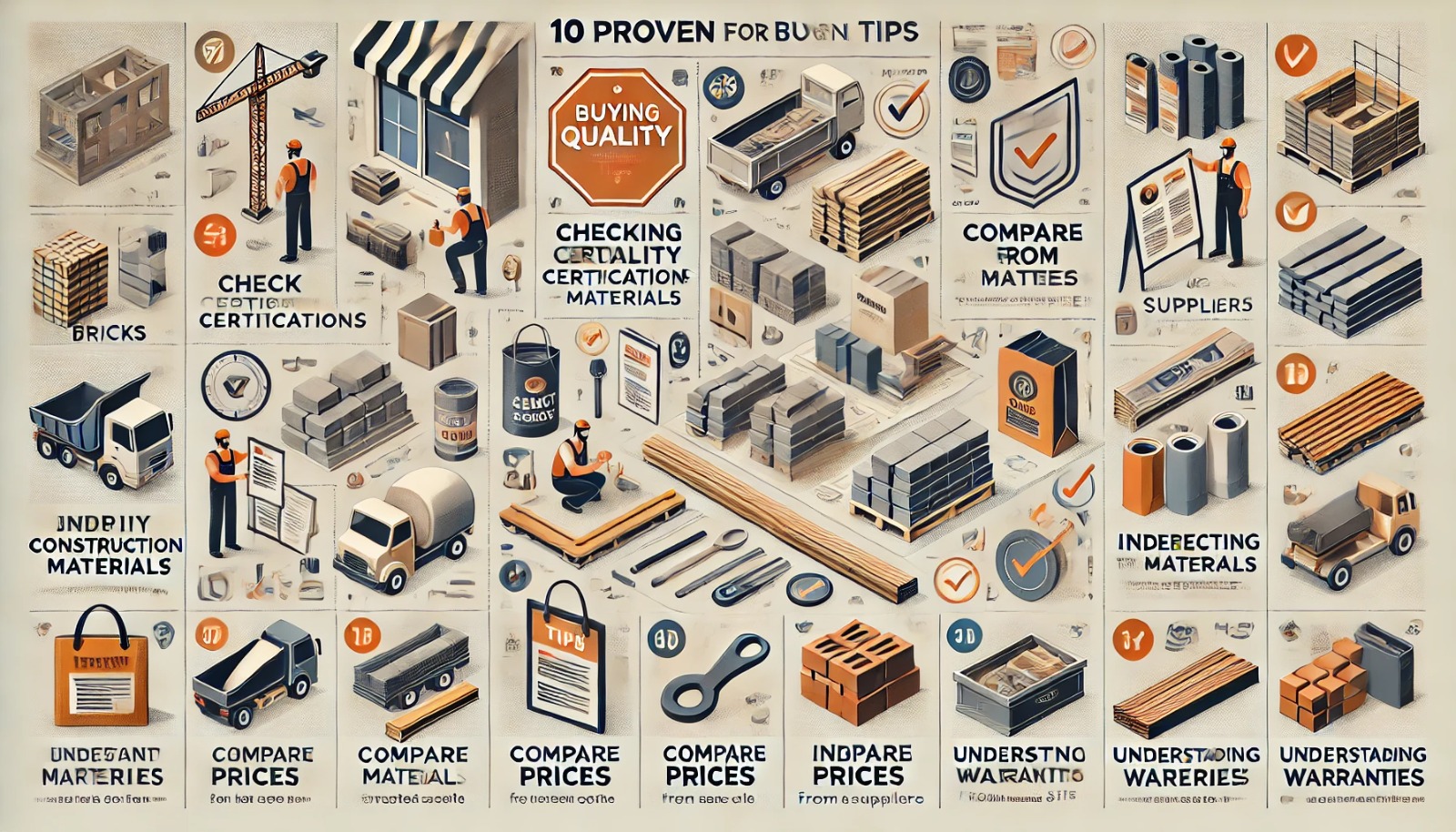
  • 10 Tips for Buying Quality Construction Materials

    10 Tips for Buying Quality Construction Materials

    When it comes to construction projects, the materials you choose play a critical role in determining the outcome. From the durability of the structure to its aesthetic appeal and safety, selecting quality construction materials is essential. But with the overwhelming number of options in the market, how do you ensure you’re buying the right building raw materials?

    This article will guide you through 10 proven tips for buying quality construction materials, ensuring your project stands the test of time, performs well, and stays within budget.

    Understand Your Project Needs

    Before purchasing any materials, it’s crucial to fully understand your project requirements. Every construction project is unique, and the materials you need depend on the specific demands of your design, climate, and intended use of the space.

    Analyze the scope of the project
    Start by outlining the scope of your project. Are you building a commercial structure, a residential home, or a renovation project? Each will have different material needs.

    Determine specific material requirements
    Consider factors such as load-bearing capacity, thermal insulation, and moisture resistance. The climate and geographic location of the project will also influence material choices.

    Set a Realistic Budget

    Quality construction materials often come with a higher price tag, but it’s essential to balance cost with long-term performance.

    Balancing quality with cost
    Rather than opting for the cheapest materials available, invest in products that offer a good balance between affordability and quality. Inexpensive materials may save you money upfront but could lead to higher maintenance or replacement costs down the line.

    Avoiding the cheapest options
    Low-cost materials often compromise on quality. Make sure your budget allows for durable materials that meet safety standards.

    Research Material Options

    Taking time to research the various materials available for your construction project can help you make an informed decision.

    Different materials available for various purposes
    Whether you’re building walls, floors, or roofing, there are different materials designed for specific functions. Understand the performance characteristics of wood, metal, concrete, glass, and composites before making your decision.

    Choosing materials based on durability, performance, and aesthetics
    The materials should not only meet your functional needs but also contribute to the overall look and feel of the finished project.

    Natural vs. Synthetic Materials

    When choosing materials, you’ll often have the option between natural and synthetic materials.

    Pros and cons of natural materials
    Natural materials like wood, stone, and clay have a timeless appeal and are environmentally friendly but may require more maintenance.

    When to use synthetic materials
    Synthetic materials, such as PVC, fiberglass, and certain metals, are often more affordable and durable but may lack the charm of natural materials.

    Verify Supplier Credentials

    Not all suppliers provide high-quality materials, and working with the right supplier can make all the difference.

    Importance of buying from reputable suppliers
    A reputable supplier will offer warranties, proper certifications, and a consistent supply of high-quality materials.

    How to check supplier certifications
    Check for certifications such as ISO standards, and ask for proof that the materials comply with industry regulations.

    Reading Reviews and Testimonials

    Customer feedback can be a valuable resource when evaluating potential suppliers.

    Customer feedback as a tool for evaluation
    Look for consistent reviews highlighting the quality of materials, customer service, and timely delivery.

    What to watch out for in reviews
    Be cautious of too many negative reviews, especially regarding material durability or supplier reliability.

    Inspect the Material Quality Before Purchase

    Never make a purchase without inspecting the materials firsthand.

    Physical inspection tips
    Check for obvious defects like cracks, warping, or irregularities in size and shape.

    How to detect inferior quality materials
    Look for signs of poor craftsmanship or substandard raw materials, as these could compromise the durability of your structure.

    Check Compliance with Industry Standards

    All construction materials must meet industry standards to ensure safety and functionality.

    Understanding local building codes and regulations
    Different regions have different building codes that dictate what materials can be used.

    Importance of material certifications
    Always ask for certification to prove that the materials meet the required safety and quality standards.

    ISO and ASTM Standards

    These are two common certifications you’ll come across in the construction industry.

    How these standards affect material quality
    ISO (International Organization for Standardization) and ASTM (American Society for Testing and Materials) certifications ensure that the materials meet globally recognized standards for safety and performance.

    Why you should ensure materials meet these criteria
    Using materials that meet these standards reduces the risk of structural failure and ensures compliance with legal requirements.

    Compare Prices Across Suppliers

    Don’t settle for the first supplier you come across—shop around to get the best deal.

    Getting the best deal without sacrificing quality
    Ask for quotes from multiple suppliers, but keep quality at the forefront of your decision.

    How to negotiate with suppliers
    Don’t be afraid to negotiate for discounts, especially if you’re purchasing materials in bulk.

    Plan for Delivery and Storage

    The way materials are stored and delivered can impact their longevity and usability.

    Ensuring materials are stored correctly
    Make sure that materials like wood are kept in dry conditions and that metals are stored away from moisture to avoid rusting.

    Avoiding damage during transportation
    Improper handling during delivery can damage even the best materials. Work with suppliers who offer secure transportation.

    Importance of Proper Material Handling

    The way materials are handled on-site is crucial for preserving their quality.

    Why material handling matters
    Handling materials incorrectly can lead to breakage, warping, or even structural failure.

    How to avoid material degradation
    Ensure proper handling techniques are in place, including using the right tools and storage solutions.

    Sustainability and Environmental Impact

    Choosing sustainable materials is not just a trend—it’s a responsible decision that benefits both the environment and your project.

    Choosing eco-friendly construction materials
    Look for materials that are renewable, have a low carbon footprint, or are recyclable.

    Long-term benefits of sustainable choices
    Sustainable materials often offer long-term cost savings through energy efficiency and durability, making them a wise investment.

    Conclusion

    Buying quality construction materials requires thoughtful consideration, research, and sometimes, a little extra investment. By following these 10 tips, you’ll ensure that your materials not only meet the demands of your project but also offer durability, performance, and value. Informed choices today will lead to fewer problems down the road, so take the time to plan properly and purchase wisely.

    FAQs

    1. How can I ensure that the construction materials I buy are high quality?

    Always check for certifications, inspect materials physically, and purchase from reputable suppliers.

    2. What are the most sustainable construction materials?

    Some of the most sustainable materials include bamboo, reclaimed wood, recycled metal, and insulated concrete forms.

    3. Is it better to buy natural or synthetic materials?

    It depends on the project. Natural materials are eco-friendly and aesthetically pleasing, while synthetic materials tend to be more durable and affordable.

    4. How can I negotiate better prices with suppliers?

    You can negotiate better prices by comparing quotes from different suppliers and leveraging bulk purchasing.

    5. Why is it important to check compliance with industry standards?

    Compliance ensures that materials meet safety, performance, and legal requirements, reducing the risk of structural failure or legal issues.

  • Top 10 High Quality AAC Block Manufacturers in India

    Top 10 High Quality AAC Block Manufacturers in India

    In India, Autoclaved Aerated Concrete (AAC) blocks are transforming the construction industry by offering a lightweight, eco-friendly, and cost-effective alternative to traditional building materials. Their impressive fire resistance, thermal insulation, and soundproofing qualities make them the preferred choice for architects, builders, and homeowners alike. Here, we present the top 10 AAC block manufacturers in India who stand out for their high-quality products, innovation, and commitment to sustainable construction.

    1. Magicrete Building Solutions

    Magicrete Building Solutions is a leading name in the AAC block industry in India, known for its commitment to quality and sustainability. Headquartered in Gujarat, Magicrete produces blocks that offer superior strength and durability, suitable for both residential and commercial projects. Their products are manufactured in modern facilities with state-of-the-art technology, ensuring consistent quality and performance. Magicrete also provides other eco-friendly construction materials like wall panels and construction chemicals.

    Key Highlights:

    • ISO-certified manufacturing facilities

    • Strong distribution network across India

    • Customizable blocks for various applications

    2. Ultratech Cement Ltd. (Birla AAC Block)

    Ultratech Cement, part of the Aditya Birla Group, is a trusted leader in India’s construction material industry. The Ultratech Birla AAC blocks are lightweight, thermally efficient, and made from eco-friendly materials. The company’s commitment to sustainable development is evident through its green building materials and energy-efficient manufacturing processes. Ultratech AAC blocks are known for their exceptional thermal insulation and soundproofing qualities.

    Key Highlights:

    • Environmentally friendly AAC blocks with high compressive strength

    • Strong distribution network for prompt supply

    • Tailored solutions for large-scale projects

    3. Biltech Building Elements Ltd.

    Biltech Building Elements is a pioneer in the AAC block sector in India, offering high-quality, cost-effective, and environmentally safe building materials. Known for their innovative approach, Biltech uses advanced German technology to produce AAC blocks with precision and durability. Their products are highly recommended for seismic zones due to their lightweight nature, which reduces building load significantly.

    Key Highlights:

    • Use of cutting-edge technology for precise manufacturing

    • High strength-to-weight ratio suitable for earthquake-prone areas

    • Comprehensive quality checks for every batch

    4. Siporex India (AAC Blocks)

    Siporex India, part of the Indian conglomerate YTONG, is one of the oldest and most respected AAC block manufacturers globally. Their AAC blocks are made from fine silica sand and are widely regarded for their durability, thermal efficiency, and fire resistance properties. The company emphasizes sustainable practices and continuously invests in innovation to improve the quality and environmental impact of its products.

    Key Highlights:

    • Fire-resistant AAC blocks suitable for high-rise buildings

    • Excellent thermal insulation, reducing energy costs

    • Advanced production facilities with strict quality control

    5. JK Lakshmi Cement (JK Smartblox)

    JK Lakshmi Cement, known for its top-tier building materials, manufactures JK Smartblox AAC blocks. Their products provide a high degree of thermal insulation, which keeps interiors cool in summer and warm in winter. JK Lakshmi Cement is also known for its focus on customer satisfaction, ensuring a smooth supply chain and technical support for users.

    Key Highlights:

    • High thermal efficiency reducing energy consumption

    • Lightweight yet robust blocks for various constructions

    • Effective soundproofing properties

    6. ECO-CARE Building Products Pvt. Ltd.

    ECO-CARE Building Products specializes in sustainable building materials, including high-quality AAC blocks. The company focuses on environmentally friendly production practices and delivers blocks that meet the rigorous standards of LEED and IGBC certifications. ECO-CARE is ideal for projects that prioritize green construction and energy efficiency.

    Key Highlights:

    • Environmentally certified production processes

    • High durability and compressive strength

    • Available in various dimensions for customized building requirements

    7. Renacon AAC Blocks

    Renacon, based in Tamil Nadu, is a prominent AAC block manufacturer in southern India. Their AAC blocks are recognized for their superior strength-to-weight ratio, excellent sound insulation, and resistance to water absorption. Renacon’s AAC blocks are manufactured in a facility equipped with the latest machinery, and the company provides efficient after-sales support, ensuring customer satisfaction.

    Key Highlights:

    • Advanced technology for high-quality AAC blocks

    • Water-resistant and mold-resistant properties

    • Strong network across South India

    8. Buildmate Projects Pvt. Ltd.

    Buildmate Projects manufactures AAC blocks under strict quality standards, using high-grade building materials for durability and performance. With a focus on customer needs, Buildmate provides customized AAC blocks for different building applications. The company also emphasizes the energy efficiency of its products, making them suitable for green buildings.

    Key Highlights:

    • High compressive strength blocks ideal for load-bearing walls

    • Customizable sizes to suit project requirements

    • Focused on sustainable and green construction solutions

    9. Godrej Construction (AAC Blocks)

    Godrej Construction, a part of the renowned Godrej Group, manufactures high-quality AAC blocks as part of its sustainable building solutions portfolio. Godrej AAC blocks are lightweight, durable, and provide high thermal insulation, making them suitable for eco-conscious projects. The company is committed to innovation and uses cutting-edge technology to produce blocks that are consistent in quality.

    Key Highlights:

    • Lightweight and thermally efficient blocks

    • Suitable for both commercial and residential applications

    • Strong brand reputation and customer trust

    10. Prime AAC Blocks

    Prime AAC Blocks is known for producing AAC blocks that offer high compressive strength and excellent water resistance. Located in Telangana, Prime AAC Blocks provides a reliable product suitable for large-scale projects. Their AAC blocks are cost-effective and widely used in both high-rise buildings and independent houses.

    Key Highlights:

    • Cost-effective solution for all types of construction

    • High resistance to water absorption

    • Strong and lightweight, reducing structural load

    Build Smarter with Trusted Building Materials
    Headsup B2B supports builders, contractors, and developers with top-grade AAC Blocks and complete construction material solutions.
    👉 Request Bulk Pricing

  • How Many Types of Sand Used in Construction?

    How Many Types of Sand Used in Construction?

    Sand is a crucial material in the construction industry, playing an essential role in building foundations, creating concrete, and ensuring the durability of structures. The type of sand used can significantly affect the strength, stability, and overall quality of a construction project. In this comprehensive article, we explore the different types of sand used in construction, their specific purposes, and why choosing the right sand is vital for every building project.

    7 Types of Sand Used in Construction and Their Uses

    1. River Sand

    River sand is one of the most commonly used types of sand in construction. Sourced from riverbeds, this sand has a smooth texture, fine grains, and is typically free of impurities. It is well-suited for plastering and masonry work due to its high quality and smooth consistency. River sand’s natural properties also make it ideal for concrete production, providing strength and a solid finish to structures.

    Advantages of River Sand

    • High-quality texture: Ensures smooth finishes in plastering and brickwork.

    • Naturally occurring: Readily available from riverbeds.

    • Cost-effective: Commonly used and affordable.

    However, excessive extraction of river sand can lead to environmental concerns, such as erosion and disruption of aquatic ecosystems, prompting the search for alternative sand sources.

    2. P Sand

    P sand is extracted from deep pits in the ground, usually from sandy soils located far from rivers and streams. It is coarse and angular, making it suitable for concrete production where strength is required. Its rough texture allows for a better bond with other materials, like cement and gravel, which enhances the durability of reinforced concrete structures.

    Advantages of Pit Sand

    • Angular particles: Provide better bonding in concrete mixes.

    • Free from salts: Prevents the risk of corrosion in reinforcement bars.

    • High strength: Suitable for structural applications.

    Due to its coarse nature, pit sand is not suitable for plastering work, as it can produce a rough finish.

    3. Manufactured Sand (M-Sand)

    Manufactured sand (M-sand) is an artificially created type of sand, made by crushing hard granite stones. It has become a popular alternative to natural sand, especially in areas where river or pit sand is not readily available. M-sand is used extensively in concrete production and other construction applications, and it offers several benefits over natural sand types.

    Advantages of Manufactured Sand (M Sand)

    • Consistent quality: M-sand is manufactured to specific standards, ensuring uniform grain size and purity.

    • Environmental sustainability: Reduces the need for river sand extraction.

    • Improved strength: Enhances the strength of concrete due to its angular and rough texture.

    M-sand is also less prone to impurities, such as silt and clay, which can weaken the concrete mixture.

    4. Sea Sand

    Sea sand is sourced from coastal areas and beaches. Although abundant, sea sand is less commonly used in construction due to its high salt content, which can cause corrosion of steel reinforcement in concrete. However, when properly treated and washed, sea sand can be used in certain applications where the risk of corrosion is minimized.

    Advantages of Sea Sand

    • Abundance: Easily available in coastal areas.

    • Cost-effective: Generally cheaper than river or pit sand.

    Despite its availability, the high salt content of sea sand limits its usage in most construction projects unless it undergoes thorough desalination and cleaning processes.

    5. Desert Sand

    Desert sand is abundant in arid regions, but it is rarely used in construction due to its fine grain size and smooth texture, which makes it unsuitable for concrete. Desert sand particles are too fine to bind properly with cement, leading to weak concrete mixtures. Although recent innovations in construction materials have explored ways to use desert sand, its use remains limited.

    Challenges of Using Desert Sand

    • Fine texture: Does not provide adequate bonding in concrete.

    • Smooth surface: Reduces the overall strength of the material.

    As of now, desert sand is primarily considered a last resort or experimental material for specialized construction projects.

    6. Quarry Dust

    Quarry dust is a byproduct of stone crushing and is often used as a replacement for sand in construction. It is coarser than typical sand but can be used in various construction applications, including paving, concrete blocks, and road construction. Quarry dust is highly valued for its cost-effectiveness and availability, especially in areas where traditional sand sources are scarce.

    Advantages of Quarry Dust

    • Affordable: A byproduct that reduces waste from stone quarries.

    • Improved strength: Can enhance the strength of concrete mixtures.

    • Widely available: Readily accessible in quarrying areas.

    Quarry dust’s coarse texture limits its use in fine plastering work, but it is an excellent option for filling material and road construction.

    7. Crushed Stone Sand

    Crushed stone sand is made by mechanically crushing rocks into small particles. Like manufactured sand, it provides an alternative to natural sand in construction, offering good binding properties and strength. Crushed stone sand is especially useful in concrete mixes and masonry work, as it can improve the durability and stability of structures.

    Advantages of Crushed Stone Sand

    • High strength: Suitable for structural applications.

    • Cost-effective: A practical substitute for natural sand in many regions.

    • Versatility: Can be used in concrete, mortar, and other construction materials.

    Choosing the Right Sand for Next Construction Projects

    Types of sand used in construction plays a critical role in the strength, durability, and overall success of any construction projects. Each sand has specific properties that make it suitable for different applications, from river sand’s smooth texture for plastering to pit sand’s coarse grains for concrete. With the growing emphasis on sustainability and the limited availability of natural sand, alternatives like manufactured sand and quarry dust are becoming increasingly popular.

    By understanding the properties and best uses of each type of sand, construction professionals can make informed decisions that optimize project outcomes, enhance structural integrity, and minimize environmental impacts.

  • Aggregates in Concrete Mix Design Proportions, Workability, and Performance

    Aggregates in Concrete Mix Design Proportions, Workability, and Performance

    Concrete is a basic building material that gives infrastructure and buildings strength and longevity. Aggregate materials are one of the main ingredients in concrete. In this blog post from Headsup B2B, we’ll examine the function of aggregates in concrete mix design, paying particular attention to their performance, workability, and proportions.

    Introduction

    Concrete is a basic building material that gives infrastructure and buildings strength and longevity. Aggregate materials are one of the main ingredients in concrete. To get the appropriate workability and performance, it is essential to comprehend how these elements impact the concrete mix. In this blog, we shall examine the function of aggregates in concrete mix design, paying particular attention to their performance, workability, and proportions.

    Types of Aggregate Materials

    Coarse Aggregates

    Coarse aggregates are the larger of the two materials used in concrete and are often made up of several small stones. A few types are gravel and crushed stone. These materials help introduce concrete’s strength and bulk. Gravel is a small stone, that does not have a rough surface, it is washed by water mainly sourced from river beds. The other, crushed, is uneven and is produced by the mechanical breaking of rocks into smaller pieces. All of them are necessary for developing an excellent concrete mix that is suitable for construction.

    Fine Aggregates

    They are termed fine aggregates and are coarser than silt particles commonly being sand. Sand then goes in between the larger coarse aggregates and the fine aggregates cement them together. It helps in achieving a uniform mix of concrete that is easy to deal with on the construction site. Sand can be classified as river sand crushed and mixed sand etc. The kind of sand that is used greatly determines the quality of the concrete that will be produced.

    Choosing the Right Type of Aggregate

    Deciding on which type of aggregates to use is a very vital decision any construction project firm has to make. However, the choice is to be based on the necessities of the project implemented. For example, the construction of any gigantic project such as a bridge requires robust and long-lasting aggregates. Sidewalks for instance may not be such major projects that require such strong materials. There is also the environmental factor; for instance, there are regions that experience freeze/thaw cycles, and one has to use aggregates that will not be affected by such a condition. The kind of aggregates one uses determines the conduct of the concrete and how long it will last.

    Proportions of Aggregate Materials

    Importance of Correct Proportions in Concrete Mix

    Proportioning of concrete is a very essential aspect that determines the quality of a concrete mix. The right proportion of aggregate materials, binder material, which is cement, and water makes the concrete strong and at the same time easily manageable. If the proportions are off then it may crack, and it becomes weak or even hard to work with for an individual. This makes sure that the stresses that the concrete is likely to experience after it has been entered are catered for.

    Common Ratios Used in Concrete Mix Design

    Standard ratios are usually followed while designing concrete mixes to balance workability and strength. The 1:2:3 ratio is a typical combination that indicates:

    one cement section

    two parts sand or fine aggregate

    Crushed stone or gravel in three sections for coarse aggregate

    Factors Influencing the Choice of Proportions

    Several factors influence the choice of proportions in a concrete mix-

    Project Requirements

    Depending on the nature of the project that needs to be completed, different tasks are called for. For instance, you may need very strong concrete for a bridge and very ordinary concrete for the sidewalk. Regarding the proportions of concrete, it is necessary to indicate that the specific load-bearing requirements and the intended application of the element dictate the proportions of the concrete composition.

    Environmental Conditions

    This is the aspect that determines the mix design depending on the environment where the concrete is to be used. In the regions with freezing and thawing cycles, it is vital to use aggregates that are not prone to cracking. He said that in hot climate conditions, a blend of concrete that has lower tendencies of losing water and shrinking is desirable.

    Workability

    The methods of handling concrete including the ability to mix it, transport it, place it and finish it is also critical. One has to understand that to produce more workable concrete may require more fine aggregates and water but this should not in any way deter strength.

    Workability of Concrete

    Definition and Importance of Workability in Concrete

    In main earthwork construction workability relates to the ease at which the concrete can be mixed, placed and compacted as well as the methods that can be employed to finish the concrete. Workability in concrete refers to how easy it is to work on the concrete while placing it without the material segregating or the cement falling to the base or floating on the water. It is pivotal because the decision made here determines the good quality and the ease of construction. There are some inevitable consequences of the low workability of concrete such as void, honeycombing, and poor surface finish which results in the reduction of the strength of structures.

    How Aggregate Materials Affect the Workability

    • Size and Shape of Aggregates

    • Texture of Aggregates

    • Grading of Aggregates

    Methods to Improve Workability

    1. Use of Admixtures

    2. Adjusting Water Content

    3. Optimizing Aggregate Grading

    Performance of Concrete

    How Aggregate Materials Impact the Strength and Durability of Concrete

    Concrete’s strength and longevity are largely determined by its aggregate content. How they affect these properties is as follows

    Strength

    Aggregates form the major component and foundation of concrete establishing its volume and general framework. It also reveals that workability and well-graded aggregate with the required size and shape of the aggregates affect the property of concrete in terms of compressive strength. These characteristics require the cement paste and the aggregates to have a good bond to achieve overall high strength.

    Durability

    It does not easily wear out even when attacked by weather, chemically corrosive substances and internal physical pressures. Strength and durability: The aggregates used in making concrete which is lessened to weathering and chemical attack improve the durability of concrete. For instance, alkali-resistant aggregates that do not affect the cement alkali reactivity reduce effects like AAR that cause cracked structures.

    Testing Methods to Evaluate the Performance of Concrete Mixes

    • Compressive Strength Test

    • Slump Test

    • Flexural Strength Test

    • Durability Tests

    • Aggregate Tests

    Builders and engineers may make sure that the concrete mix design satisfies the necessary performance standards and offers strength, durability, and dependability for construction projects by carrying out these tests.

    Practical Tips for Selecting Aggregates

    Guidelines for Choosing the Right Aggregates for Specific Projects

    1. Understand Project Requirements

    2. Match Aggregate Properties to Environmental Conditions

    3. Consider Aesthetic Requirements

    Tips for Testing and Ensuring Quality Aggregates

    1. Conduct Regular Testing

    2. Check for Impurities

    3. Evaluate Physical Properties

    4. Consult Standards and Specifications

    Choose Headsup B2B for the Aggregate Materials

    Being one of the most trustworthy online platforms for aggregate materials Headsup B2B provides superior quality aggregate materials. We have the best manufacturers and suppliers on our platform that only provide the best material at reasonable prices. Headsup B2B also provides expert assistance to customers and helps them throughout the selection and buying process. We have a dedicated team for delivery and you can also track your order on our user-friendly platform.

  • Cement Brand Comparison: Which Offers the Best Value for Money?

    Cement Brand Comparison: Which Offers the Best Value for Money?

    Preface

    An overview of why choosing the best cement brands matters for construction projects and how Headsup B2B aids businesses in making smart decisions.

    Introduction

    Cement is a cornerstone of infrastructure construction. It is essential for building homes, schools, bridges, and skyscrapers. The strength and durability of these structures are contingent on the quality of the cement.

    At Headsup B2B, we understand that choosing the right cement brand can be challenging. Our goal is to help businesses find the best cement for their needs. We focus on providing value for money, ensuring the best quality without overspending. This comparison will guide you in making an informed decision, so you can select a cement brand that meets your requirements and budget.

    Many questions about the building materials—particularly cement—come to mind when we plan to construct our homes. Since cement is one of the key components that ensure the lifespan of the structure, any improper advice or influence can be extremely costly or hurt the overall quality of the construction.

    What Type of Cement to Opt for?

    Cement is classified into several types and used for different reasons in construction projects. Therefore, it’s critical to comprehend the characteristics and applications of each form of cement. Three types of cement are typically used in ordinary construction: Portland Slag Cement, Portland Pozzolana Cement, and Ordinary Portland Cement (43 Grade & 53 Grade).

    Uses and Applications

    • In all RCC constructions, such as footings, columns, beams, and slabs, where initial and ultimate strength are the primary structural requirements, OPC 53 Grade cement is advised.

    • PPC and PSC cement are helpful for general construction projects and highly advised for masonry, plastering, and tiling projects, as starting strength is not a critical performance criterion in these cases.

    Can the same type of cement be used for all Applications

    Various varieties of cement possess unique qualities that may be optimally utilised to save costs and enhance the calibre of the building.

    As was previously mentioned, OPC 53 Grade cement is advised for all RCC projects due to its high initial and ultimate strength, which is a crucial need for structural integrity (i.e., in RCC members).

    Use PPC or PSC for non-structural/masonry applications, such as plastering, tiling, and masonry, depending on which is most cost-effective. These cements have a more effective finishing, have a slower rate of heat hydration (which makes them less prone to shrinkage and cracks), and have higher workability (since PPC and PSC include fly ash and GGBFS, respectively).

    The Best Cement Brands One Should Go For:

    When choosing a brand, cost is the most crucial factor to consider. Select a cement brand that provides the necessary grade (such as PPC, OPC 53, etc.) at the most affordable cost in your area.

    Customers frequently become confused about which brand to choose due to the abundance of excellent brands on the market. Certain brands, such as Ultratech, ACC, Ambuja, and Jaypee Associates, have several manufacturing facilities and are well-known throughout numerous states.

    Choosing the right cement brand can significantly impact the quality and durability of your construction projects. At Headsup B2B, we’ve analysed several top cement brands to help you find the best value for your money. Below, we provide an overview of the key features and market positions of four leading cement brands:

    Ultratech Cement

    UltraTech Cement Limited is India’s largest cement company and a prestigious global producer. It produces grey, white, and ready-mix concrete, with a capacity of 117.95 million metric tonnes per year. The company operates 22 manufacturing units, 27 grinding units, one clinkerization unit, and seven bulk packaging terminals. UltraTech Building Solutions (UBS) offers one-stop shopping for housebuilders, with over 2500 outlets across India.

    Shree Cement

    Shree Cement Limited is a top 5 cement company in India, distributing manufacturing operations across six states with a 44.4 million metric tonnes per annum cement manufacturing capability. The company also manufactures synthetic gypsum to replace natural gypsum in cement production. By FY26, the company expects to increase its capacity by 12% CAGR to 80 million tonnes. Brands include Shree JungRodhak, Bangur, and Rockstrong.

    Ambuja Cement

    Ambuja Cements Ltd., India’s largest cement manufacturer, operates five integrated plants and eight grinding units across the country. The company is known for its efficiency, environmental protection efforts, and innovative practices. It is the first Indian cement company to construct a captive port and has pioneered the development of multiple biomass and co-fired technologies for greener power generation.

    ACC Cement

    ACC, founded in 1936, is India’s top cement and concrete maker, with 14 modern factories, 30 ready-mix facilities, and 20 sales offices. With over 10,000 employees and 9,000 dealers, ACC is a trailblazer in manufacturing, marketing, and human management. It is known for its commitment to environmental friendliness, ethical standards, and community welfare programmes. Mid-range pricing offers a good balance between cost and quality.

    Dalmia Bharat

    The Dalmia Bharat Group, a profitable and rapidly developing one of the best cement brands in India, has experienced exponential growth in the last five years. The company is committed to responsible growth and has received numerous awards for its efforts in energy conservation, energy efficiency, safety, health, and environmental concerns, including from the Government of India. Available in most major markets, though slightly less widespread than Ultrateh, ACC, etc. Dalmia Bharat has built a strong reputation for premium quality and is trusted by many top contractors.

    JK Cement

    JK Cement Ltd. is a leading Indian grey cement producer and the world’s third-largest white cement manufacturer. Established in 1975, the company has a Grey Cement capacity of 15 MnTPA and a total white cement capacity of 1.20 MnTPA. JK Cement is also the world’s leading wall putty manufacturer and third-largest white cement manufacturer. With a strong international presence, JK Cement has a reputation in 43 countries and has two subsidiaries: JK Cement Works Fujairah FZC and JK White Cement (Africa) Ltd. Slightly higher in price, JK Cement justifies the cost with superior quality. It offers exceptional quality with a focus on achieving the highest standards in construction.

    Ramco Cement

    Ramco Cements Ltd., formerly Madras Cements, is India’s fifth-largest cement producer, producing Portland cement in eight state-of-the-art facilities. With a production capacity of 16.5 million MTPA and 10 manufacturing facilities across India, the company has been a leader in promoting mixed cement since 1997. It is widely available across various regions, making it easy to procure. Ramco Cement is one of the best cement brands in the industry, known for its reliability and consistent performance.

    Birla Corp

    Birla Corporation, founded in 1919, is India’s leading and among the best cement brands. With four divisions: cement, jute, vinoleum, and car trim, it grew into a multi-product conglomerate with a turnover of ₹1300 crore in 1998. The group owns 500 enterprises across various industries, including textiles, manmade fibres, cables, woollens, vehicles, sugar, paper, shipping, cement, and more. Birla Corp, offers competitive pricing, making it a budget-friendly option for many businesses. Known for its high strength and durability, cement ensures long-lasting construction.

    So, these are some of the best cement brands in India, and there are many more. One can choose from these brands according to their needs and budget. Always prioritise your budget before making any decision. Headsup B2B is one of the most prominent online platforms for cement and other building materials. We connect trustworthy suppliers of the best cement brands with potential buyers and make sourcing easy and smooth.

    Key Factors in Choosing a Cement Brand

    Price

    When selecting a cement brand, price is often the first factor to consider. Cement prices can vary widely based on brand and quality. Typically, prices range from to per bag, depending on the type and quality. For large-scale projects, buying in bulk can significantly reduce costs. It’s crucial to compare prices and consider bulk discounts to get the best value for your investment.

    Availability

    Availability can influence your choice significantly. Some brands might be available only in certain regions. Ensure that the brand you choose is readily available in your area to avoid delays in your project. Additionally, consider the ease of procurement. Brands with a wide distribution capacity and a strong supply chain network can offer more reliability in terms of timely delivery.

    Quality

    Quality is another important factor. The cement’s strength and durability can greatly impact your structure’s longevity. High-quality cement will guarantee that your structures are strong and long-lasting. Consistency is also key; you want a brand that delivers the same high performance every time. Look for certifications and quality marks that guarantee the product meets industry standards.

    Brand Reputation

    The reputation of a brand can provide insight into its reliability and quality. Established and best cement brands with a long history in the market tend to be more trustworthy. Customer reviews and testimonials can offer valuable information about the brand’s performance and service. Positive feedback from other businesses and contractors can help you make a more accurate decision.

    At Headsup B2B, we aim to help you navigate these factors to find the best cement brands for your needs.

    In summary, each of these brands offers unique advantages depending on your specific needs and budget. So, explore more about these brands and make informed decisions with Headsup B2B.

  • Top Building Construction Materials for Durability and Eco-Friendliness in 2024

    Top Building Construction Materials for Durability and Eco-Friendliness in 2024

    Best Eco-Friendly Building Materials for Homes | Strength Meets Sustainability

    Ee explore the Best Eco-Friendly Building Materials for 2024 that combine strength and sustainability, ensuring your projects are both durable and eco-friendly.

    Introduction

    Sustainable living is becoming more and more of a worldwide necessity in a time when environmental worries are at an all-time high. The building industry is crucial to this shift because the materials used in construction have a big influence on the state of the environment on our planet. Using eco-friendly building materials is crucial to reducing our environmental impact as we approach 2024. According to recent industry studies, there has been a notable 30% rise in the use of sustainable building practices over the last five years, indicating a strong global trend towards greener construction techniques.

    Understanding Eco-Friendly Building Materials

    What are Eco-Friendly Construction Materials?

    Green building materials are eco-friendly construction solutions derived from renewable or recyclable resources, energy-efficient techniques, or sustainable practices. They minimize environmental harm, save non-renewable resources, and promote environmental sustainability by reducing the ecological impact of construction projects.

    Importance of Eco-Friendly Building Materials

    Beyond only protecting the environment, eco-friendly building materials are crucial. They are essential to creating a sustainable future because they lessen the negative effects of construction on the environment and public health. Using such materials, even inexpensive choices, is crucial to satisfying regulatory standards, attaining energy efficiency, and improving overall quality of life in light of the growing worldwide focus on sustainability. They are essential for lowering greenhouse gas emissions, preserving water and energy, and cutting down on landfill trash.

    Advantages of Sustainable Building Materials

    Using sustainable building materials has several advantages, such as:

    Environmental Impact Reduction: Using these materials greatly reduces the carbon impact of building a home. Pollution, habitat damage, and deforestation are decreased when resources are obtained responsibly, recycled, or quickly regenerated.

    Energy Efficiency: Because environmentally friendly materials frequently have better insulating qualities, using less energy for heating and cooling is possible. This lowers utility expenditures in addition to conserving energy.

    Healthier Living Environments: Green construction materials typically contain non-toxic, less volatile elements that improve indoor air quality and reduce the risk of health problems caused by dangerous chemicals off-gassing.

    Enhanced Property Value: Tenants and buyers that place a high value on sustainability are frequently drawn to buildings built using sustainable materials. Higher property values and a better return on investment may result from this.

    Durability and Longevity: A lot of ecologically friendly, long-lasting building materials are also quite durable. As a result, during the course of the building’s lifetime, regular replacements and repairs will have less impact on the environment.

    A 2024 poll revealed that over 50% of global builders now favor eco-friendly materials, indicating their increasing acceptance and integration into standard building procedures, contributing significantly to the industry’s shift towards sustainable practices.

    Types of Sustainable Building Materials for Home

    The need for more environmentally friendly housing has sped up the creation and use of sustainable construction materials. These materials reduce the negative effects of development on the environment while simultaneously having positive long-term effects on health and the economy. The key categories of sustainable construction materials that will revolutionise houses in 2024 are given here with emphasis on their special qualities, and benefits.

    Recycled Steel

    Recycled steel is a popular green building material due to its strength and longevity. Salvaged steel from automobiles, buildings, and other structures, melted down, and reformed into new steel goods. This reduces the carbon footprint of acquiring and processing raw materials and lowers the total energy consumption of the steel industry.

    Benefits

    • Cuts down on trash and landfill usage: Reusing scrap steel reduces the amount of waste that is disposed of in landfills.

    • Energy efficiency is around 75% less energy-intensive than producing new steel from fresh sources.

    • Strength and durability: Provides the same structural integrity as fresh steel, which is necessary for heavy-duty constructions and building frames.

    Bamboo

    Bamboo is well known for its outstanding environmental qualities. Bam is one of the fastest-growing plants on Earth. And it may be harvested every three to five years, unlike hardwood trees, which can take decades to reach maturity. Compared to conventional hardwoods, it is a more sustainable option because of its quick development cycle. Moreover, bamboo naturally wards off pests and diseases, reducing the need for artificial pesticides that are harmful to the environment.

    Benefits

    Renewable quickly: Bamboo grows three to five years to reach full size, much faster than hardwood trees.

    Carbon sequestration: Compared to many tree species, bamboo forests are better at absorbing carbon dioxide.

    Versatility: It may be used for many different things, such as decorative treatments and structural parts.

    Recycled Wood

    Reclaimed wood, obtained from dismantling existing buildings. It is one of the important component in new construction to reduce environmental impact and the need for new raw materials. Each piece of recycled wood has a distinct grain and patina, giving dwellings a rustic look without removing more trees. Cross-laminated timber (CLT) construction is becoming increasingly popular in sustainable architecture.

    • Waste reduction: It assists in lowering the amount of stuff that is thrown away.

    • A distinct visual appeal provides a unique appearance with a touch of history.

    • lowers the loss of forests: reduces the need for fresh wood, and safeguards the ecosystems of forests.

    Hempcrete

    The production of hempcrete occurs with hemp hurd, the woody core of the hemp plant, mixing with water and a lime-based binder. Consequently, a lightweight cementitious insulating material for walls, floors, and roofs. Hempcrete is environmentally friendly and sustainable because, throughout its curing process, it collects more CO2 than it releases. It controls moisture in the structure and acts as a great insulator, lowering the likelihood of mould growth and respiratory issues.

    Benefits

    Extremely sustainable: Hemp grows quickly without much water and doesn’t require toxic pesticides.

    Great insulation: offers exceptional acoustic and thermal qualities.

    Carbon-negative: Seeks out and retains ambient CO2 for growth and healing.

    Cork

    The cork oak tree, which regenerates its bark every nine to twelve years, is a renewable resource. Cork is main component for its insulation properties in flooring and wall coverings, and its natural resilience and compressibility make it a comfortable material. This growth is due to the increasing demand for natural cork, which can preserve wine for longer and has good storage capabilities.

    Benefits

    Sustainable harvesting cycle: Cork bark regenerates every 9 to 12 years, making it a renewable resource.

    Thermal insulation: Energy expenses are decreased by thermal insulation, which provides inherent thermal resistance.

    Acoustic properties: It is perfect for calm, quiet household conditions and helps decrease noise transmission.

    Straw Bales

    The production of bales of natural straw occurs from wheat, rice, barley, or oats are crushed, heaped, and covered with plaster. Because of this technique’s exceptional insulating qualities and sustainability, green buildings today have brought it back to life. Straw is a low-impact material and a good insulator made from agricultural waste. The plaster coating of correctly build straw bale structures , provides good fire protection as well as moisture and insect resistance.

    Benefits

    Better insulation: Straw bales may save a lot of money on heating and cooling because of their high R-values.

    Low-cost material: Straw is a cheap and easily accessible resource since it is frequently seen as agricultural waste.

    Fire resistance: Straw bale walls have the potential to be more fire resistant than many conventional building materials when properly sealed.

    Why Headsup B2B is the Best Online Platform for Sourcing Eco-Friendly Construction Material?

    Choosing the right platform for sourcing building materials can make a huge difference in the success of your projects. Here’s why Headsup B2B stands out as the best choice for builders, contractors, and developers:

    Wide Range of Building Construction Materials

    We offers a vast selection of building construction materials, from traditional options like steel and concrete to innovative and sustainable choices like bamboo and hempcrete. We can meet all demands related to your project.

    Quality Assurance

    We understand that the quality of materials is crucial for the durability and safety of your builds. That’s why we only partner with trusted suppliers who meet our high standards. You can be confident that every product you purchase is reliable and top-notch.

    Competitive Pricing

    we believe in providing value for your money. Our platform offers competitive pricing on all materials, ensuring you get the best deals without compromising on quality.

    Easy Navigation

    Our user-friendly website makes it simple to find exactly what you’re looking for. With intuitive search functions and detailed product descriptions, you can quickly locate the materials you need and make informed decisions.

    Sustainability Focus

    We are committed to promoting eco-friendly building practices. Our platform highlights sustainable materials, helping you choose options that are good for both your projects and the planet.

    Expert Support

    Need advice or have questions? Our team of experts is here to help. Whether you need assistance with product selection or have technical queries, we’re just a call or click away.

    Reliable Delivery

    We know that timely delivery is critical for keeping your projects on track. Headsup B2B ensures prompt and reliable shipping, so you get your materials when you need them.

    Secure Transactions

    Your security is our priority. Our platform uses advanced encryption and secure payment methods to protect your personal and financial information.

    With Headsup B2B, sourcing construction materials is easier, faster, and more reliable.

  • The Influence of River Sand on the Cost and Quality of Construction

    The Influence of River Sand on the Cost and Quality of Construction

    Today’s engineers emphasise building a sustainable project using this vital raw material in the construction sector. Made primarily of small fragments of broken-down rocks, corals, or shells, river sand is a loose, fractured natural substance. A typical ingredient in concrete mixes is river sand. River sand has less clay and silt, which gives producers better control over the workability and calibre of the concrete and mortar. In this blog, the experts at Headsup B2B will explain its properties, and the effect it has on the cost and quality of building materials.

    What is River Sand?

    Sand from rivers occurs naturally. River sand forms naturally due to overmining, weathering, or erosion processes, in contrast to other forms of sand made by crushing rock. It often has a coarse gradation; however, this can vary. It may be used for many landscaping and construction projects, including filling drainage basins, concrete sand, and arena foundations. Usually, silica sand from quartz is the main component since it is composed of the same substance as the nearby rock that it was eroded from.

    Properties of River Sand

    Workability

    The smooth, rounded grains contribute to its workability. Using construction materials in mortar and concrete mixes facilitates easier mixing, placing, and finishing.

    Gradation

    The term “gradation” refers to the distribution of particle sizes in sand. With well-graded sand and a balanced particle size distribution, concrete mixes can pack better and have a reduced chance of segregation.

    Cohesive and load-bearing capacity

    Because river sand frequently possesses excellent cohesiveness and bearing ability, it may be used in a range of construction applications, including road construction and foundation layers.

    Angular

    Compared to crushed or manufactured sand, it is more rounded. The concrete’s spherical form may have an impact on its strength and ability to tolerate specific stresses.

    Low Permeability

    Because river sand is not very porous, it has poor permeability. This feature might be helpful in gardening and building projects where drainage is an important consideration.

    Cost Implications of Using River Sand

    It has excellent quality, which makes it the most popular choice of builders in the construction industry, but it tends to be more expensive than other types of sand. With varying regions and availability, river sand prices vary, making it an important consideration in construction budgets.

    Factors Influencing the Price

    Several factors affect the cost of river sand:

    • Transportation: Transporting it from its source to the construction site can be costly, especially if the site is far from the river.

    • Sourcing: The method and location of extraction impact the price. Sand sourced from areas with strict regulations or limited supply tends to be more expensive

    • Demand and Supply: High demand for this sand, coupled with limited availability, often drives up prices.

    Comparison of River Sand with Alternative Materials

    River sand is generally more expensive than manufactured sand or crushed stone, while artificial sand is cheaper but may offer different quality, and crushed stone may require more processing.

    Long-Term Cost Benefits

    Investing in high-quality sand offers long-term benefits due to its superior binding properties, cleanliness, and durability, reducing maintenance and repair costs and enhancing construction project efficiency, offsetting its initial higher cost.

    Quality Impact of River Sand on Construction

    How it Enhances Concrete Strength:

    River sand is known for its ability to enhance the strength of concrete. Its fine particles provide a smooth texture, ensuring better mixing and binding with cement. As a result, concrete constructions become stronger and more resilient and can tolerate large loads and inclement weather.

    Benefits of the Fine Texture and Clean Composition

    The smooth texture of river sand gives a better finish on surfaces, and this property makes it ideal for plastering and other finishing works. Additionally, river sand is typically free from impurities like clay and silt, which can weaken the concrete. This purity guarantees integrity and strength.

    Comparison Between River Sand vs M-Sand

    Why Headsup B2B is the Go-to Platform for Sourcing River Sand

    Headsup B2B is a prominent online platform for sourcing construction products, offering several key advantages that make it your go-to choice.

    • Quality Assurance

    Headsup B2B ensures that all the river sand on its platform meets high-quality standards.

    • Easy Sourcing Process

    The user-friendly interface of Headsup B2B makes the sourcing process straightforward and efficient. You can easily browse, compare, and select from the options to meet your specific project needs, all from the comfort of your home.

    • Excellent Customer Support

    Headsup B2B provides exceptional customer support to assist you throughout the sourcing process.

    • Competitive Pricing

    Headsup B2B offers competitive pricing for, helping you manage your construction costs effectively.

    Choosing Headsup B2B for sourcing river sand means opting for quality, reliability, and efficiency, making it the smart choice for all your construction needs.

  • The Ups and Downs of Aggregate Sourcing: A Focus on Quality Control

    The Ups and Downs of Aggregate Sourcing: A Focus on Quality Control

    In many different industries, including construction, infrastructure development, and road building, aggregate manufacturing is essential. Aggregates are the cornerstone of these industries, and as such, they must adhere to exacting quality requirements to guarantee the longevity and security of the buildings they support. At this point, quality monitoring in the manufacture of aggregates becomes crucial. We, the team at Headsup B2B, will examine the value of quality control in the collective in the sourcing of construction aggregates, its role in construction, etc. in this blog article.

    The Features of Aggregate: Size, Shape, and Gradation

    Aggregate is the primary component in concrete, affecting its appearance and workability. Its size and gradation, ranging from small sand to large rocks, affect the surface’s appearance. Aggregates are blended with finer ones to fill spaces and have angular particles, which can reduce workability and require more cement paste. There are three types of aggregate grades.

    • Gap Graded. The coarse aggregate particles in this kind of aggregate differ in size from the fine aggregate particles, but their size is comparable. The fine and big aggregates are put together by it.

    • Poorly graded aggregate: Variations in size in poorly graded aggregate pack the particles together and create big gaps in the concrete.

    • Well-Graded: Aggregate that has been graded properly spans even sizes, from fine to coarse. Quantity-wise, these aggregates might be complicated. especially considering that the main objective is always to maximise capacity while maintaining stability, design, strength, and workability.

    The Role of Construction Aggregates:

    The main application for construction aggregates is as a vital component in the creation of concrete. Aggregates, when mixed with cement and water, make a robust and long-lasting substance that serves as the basis for most building projects. These aggregates perform a number of vital tasks, such as:

    Strength and stability:

    Aggregates provide structures with the structural integrity needed to bear the loads and pressures on infrastructure and buildings. The kind and grade of the particles directly impact the durability and compressive strength of the concrete.

    Workability:

    The right amount of aggregates gives concrete the appropriate workability, facilitating pouring, placing, and finishing. The best workability is ensured by well-graded aggregates that have a balanced ratio of fine to coarse particles.

    Volume Stability:

    By lowering the quantity of cement paste needed, aggregates reduce the shrinkage and cracking of concrete. This enhances the structure’s overall performance and volume stability.

    How to select an Aggregate

    Importance of Quality Control in Construction Aggregates Sourcing:

    Consistency in Material Properties

    Quality control in aggregate manufacturing aims to maintain consistent material qualities like strength, durability, and particle size distribution. Producers can achieve consistency and predictable performance by implementing strong quality control procedures.

    Adherence to Industry Standards and Requirements

    Aggregates in construction require industry norms and quality control procedures to ensure performance. Compliance with grading, particle shape, and abrasion resistance criteria is crucial for ensuring quality.

    Improved Structural Integrity

    Quality control in aggregate manufacturing significantly impacts infrastructure projects’ durability and structural integrity. By using well-graded, consistent materials, producers avoid harmful materials, resulting in increased safety maintenance costs throughout the project.

    Cost Savings

    Regular quality control in bulk manufacturing can save money, reduce delays, rework, and repairs, minimise material usage, and prevent legal obligations or conflicts resulting from subpar products, ultimately benefiting the customer.

    Customer Satisfaction:

    Quality control in aggregate production is crucial for customer satisfaction in the construction industry, as it builds trust, establishes long-term relationships, encourages repeat business, and boosts market competitiveness.

    Moisture Content:

    The amount of moisture in the aggregates can have an impact on the concrete’s workability and mix ratios. The government guidelines set maximums for aggregate moisture content to guarantee. To precisely ascertain the moisture content, techniques like oven-drying metres are utilised.

    Crushing Value and Impact Value:

    Aggregate strength and toughness are evaluated using impact and crushing values. The purpose of these tests is to assess the aggregates’ resistance to impact and crushing loads.

    Specific Gravity and Water Absorption:

    Two essential indicators for evaluating the quality of aggregates are their specific gravity and water absorption. The maximum limitations for specific gravity and water absorption are specified in the quality standards.

    How Headsup B2B Ensures High Quality of Construction Aggregates.

    Headsup B2B ensures the high quality of construction aggregates by implementing several key measures.

    • The team at Headsup B2B carefully assesses all suppliers, ensuring they meet strict quality standards and comply with industry regulations. This guarantees that only reliable and reputable suppliers are listed on the platform.

    • Headsup B2B conducts regular quality checks and inspections of the aggregates. Our dedicated team checks the physical properties of aggregates, such as particle size, shape, and strength, to ensure they meet the specifications for various construction projects.

    • Our platform features reviews and ratings. This feature also allows buyers to share their experiences with purchasing and the quality standard of the product.

    • We believe in transparency, so we provide products at fair prices without compromising on quality.

    • Headsup B2B provides construction professionals with confidence in the quality and reliability of the aggregates they procure.